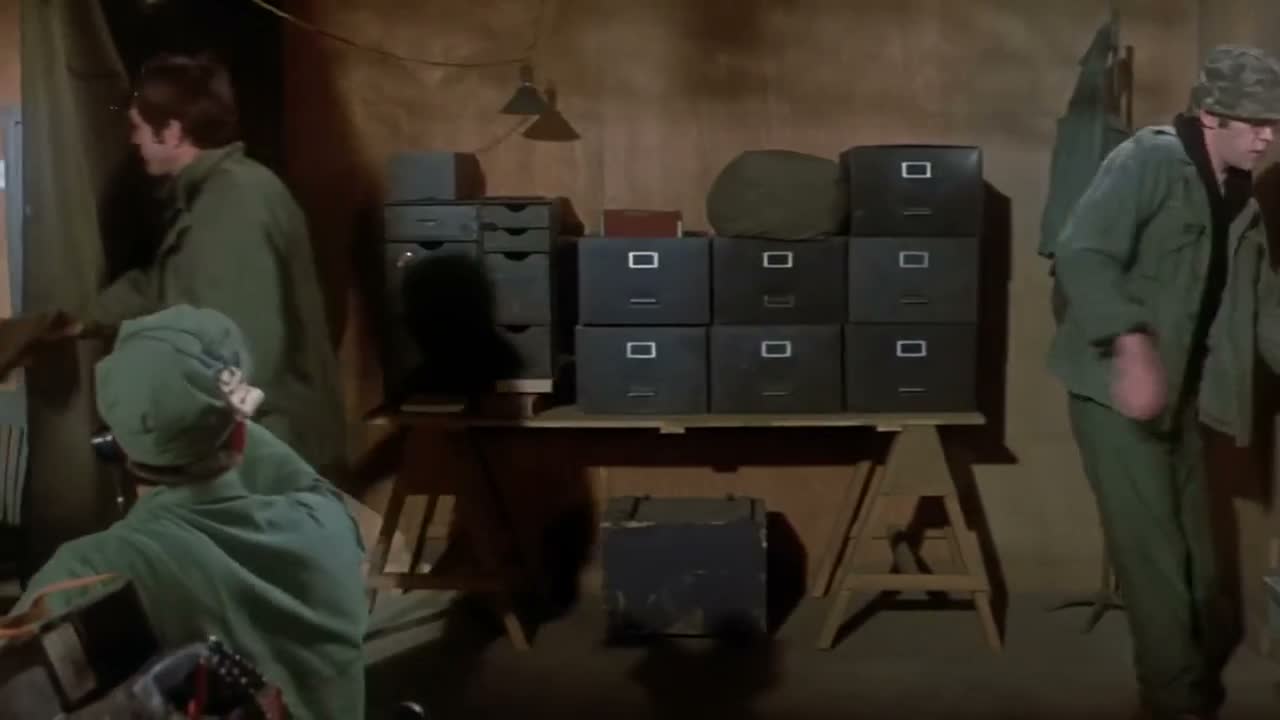
“Radar! Oh, Corporal O'Reilly. Gentlemen, I'm Corporal O'Reilly. They call me Radar.”
He gives rank and nickname in one breath, and the nickname says everything about him.
Informal
Chapter 2 of 22 · 2'24"
This scene is less about the new arrivals than about how the camp absorbs them. Radar's cheerful "They call me Radar," the offer to renumber a jeep, and the Bible lesson with Ho-Jon show a unit running on improvised rules and quiet kindness.
A Picture Book for Ho-Jon
New surgeons Hawkeye Pierce and Duke Forrest arrive at a MASH unit in Korea. Radar, the company clerk, welcomes them, stashes their things in Major Burns's tent and promises to change the jeep's numbers. Nearby, Father Mulcahy is teaching Ho-Jon, a mess-hall boy, to read from the Bible.
The comedy comes from how casually the unit bends its own rules and how gently it treats a stranger. Radar, barely more than a kid, runs the camp's paperwork and openly offers to alter a jeep's registration: "I'll change the numbers." The new doctors don't blink. Meanwhile Father Mulcahy uses scripture to teach Ho-Jon to read, and Ho-Jon recites "My cup runneth over" as a reading exercise. One of the surgeons answers with a practical offer instead — a book with pictures, because "it's easier to learn how to read when you look at pictures." Scripture and the picture book sit side by side, and the scene treats both as tools for the same job: helping someone get through the day.
A1–C2 is the CEFR scale. Cards above the level you pick fade, and playback will not auto-pause on them.
“Radar! Oh, Corporal O'Reilly. Gentlemen, I'm Corporal O'Reilly. They call me Radar.”
He gives rank and nickname in one breath, and the nickname says everything about him.
Informal
“Get everything out of the jeep. Don't worry about the jeep. I'll change the numbers.”
He handles a stolen jeep like laundry, and the calm is the joke.
Informal
“Don't you trust that man. He's a mad dog.”
Two short sentences and one animal metaphor make a warning nobody misses.
Informal
“This is Ho-Jon. He's one of our mess hall boys. I'm teaching him how to read.”
He introduces the boy and his own project in one warm, unshowy line.
Neutral
“Listen. I tell you what. I got a book here. It's got a lot of pictures in it, and I think it's easier to learn how to read when you look at pictures.”
He nudges with a better tool instead of a lecture, which is why the offer lands.
Neutral
“Jesus Christ. What's all that about?”
Shock and bafflement in one short line, exactly how an outsider reacts to all that praying.
Informal
Up next · 03push someone aroundThe scene: Hawkeye and Duke Want the Chaplain OutThe jeep almost certainly isn't theirs officially. As company clerk, Radar handles paperwork, so swapping the registration numbers keeps the vehicle off the books and usable. It's a small, early sign of how the unit bends army rules to get what it needs.
Ho-Jon is a Korean boy working in the camp's mess hall. Father Mulcahy is teaching him to read using the Bible. The scene shows the camp's quiet daily contact with the local population rather than combat.
It's an old-fashioned insult meaning someone is dangerous, unpredictable, and not to be trusted. The speaker is warning the new arrivals to stay away from that man rather than describing an actual illness.
A book with a lot of pictures, described as "a little adventure." The offer is practical: pictures make it easier to learn to read. It's a lighter, more modern alternative to the scripture Mulcahy was using.