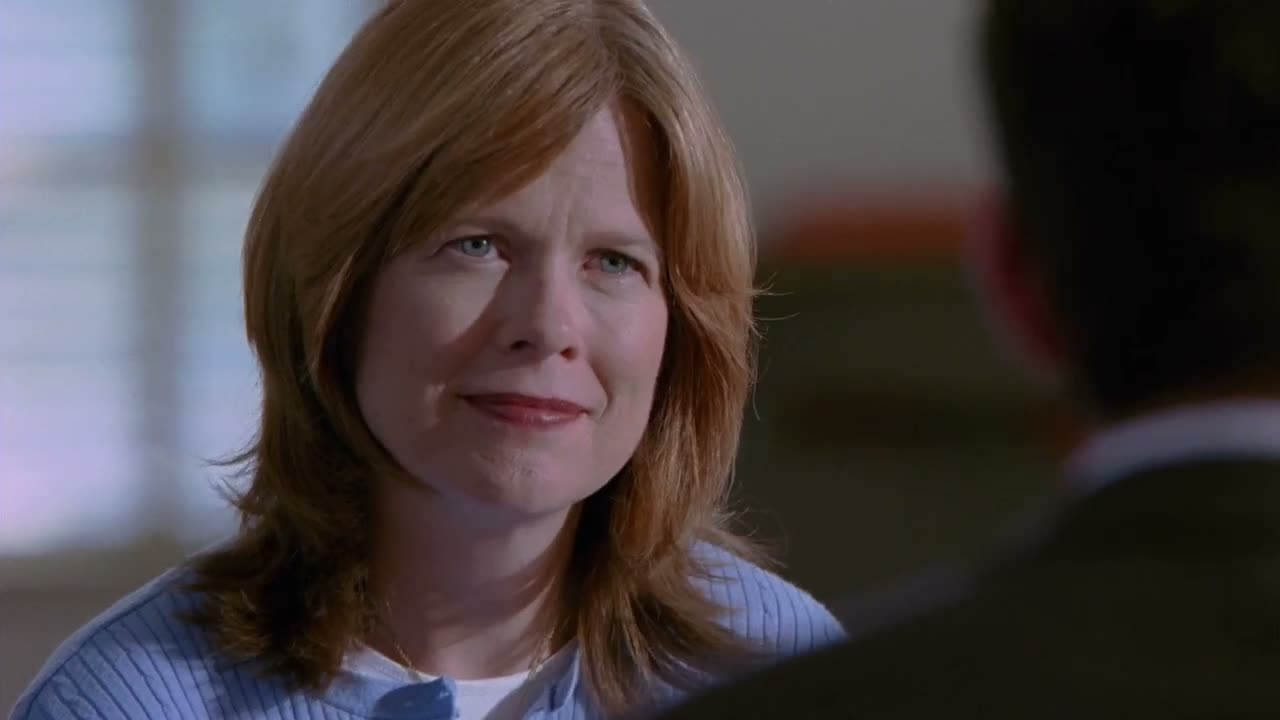
“In a way, the best teacher I ever had was my Tourette's.”
Calling his condition his best teacher flips the expected story without sounding bitter.
Neutral
Chapter 9 of 17 · 5'01"
Brad interviews for a teaching job and owns his Tourette's from the first minute. He tells the panel his tics were his greatest teacher: "In a way, the best teacher I ever had was my Tourette's." The panel is charmed — until one teacher asks how kids can learn while he's ticking.
Why Brad Wants to Teach
Brad Cohen applies to teach at a school and is interviewed by principal Jim Ovbey and assistant principal Hilarie Straka. They talk for nearly two hours. Later he meets the second-grade staff, where one teacher, Brenda, bluntly asks how he can expect children to learn when he ticks all the time.
On the surface this is a routine hiring interview; underneath, Brad is quietly doing something harder — applying for a job that most schools have already turned him down for. He refuses to hide his Tourette's, saying "I make a point of being open about it," and he answers the toughest question without flinching: "Before they know me, kids sometimes do think I'm just weird, or even scary, but once I educate them about my Tourette's... then they accept me as a good teacher." His line that "the best teacher I ever had was my Tourette's" is not self-pity; it's the reason he believes he can reach kids others can't. The scene ends on the hope he can't quite switch off: "hope is a hard habit to break."
A1–C2 is the CEFR scale. Cards above the level you pick fade, and playback will not auto-pause on them.
“In a way, the best teacher I ever had was my Tourette's.”
Calling his condition his best teacher flips the expected story without sounding bitter.
Neutral
“But hope is a hard habit to break.”
Framing hope as an addiction makes optimism sound stubborn rather than naive.
literary
“It was the best interview I had ever had.”
It judges the conversation, not the outcome, which is what makes it generous.
Neutral
“It's okay to color outside the lines if that's who you are.”
A child's coloring book becomes a philosophy: be who you are, even past the lines.
Neutral
Up next · 10go to bat for someoneThe scene: Brad Gets Kicked Off the Golf CourseBecause hiding it has never worked. He says he makes a point of being open about it, so students can ask anything and stop being afraid of what they don't understand.
She raises a real worry, but she judges him before knowing him. Brad himself admits kids find him weird or scary — until he educates them. The interview is his chance to answer, and he does.
It forced him to deal with rejection and to understand what it feels like to be the odd one out, which is exactly what he wants to spare his own students.
He means it's fine for a child to be different and to break from what's expected — as long as that's genuinely who they are.