
“It's not like you haven't seen it before.”
Why it's great
The dry reversal says we have been here many times, so no drama is needed.
Register
Informal
Use it yourself
It's not like you haven't heard me sing before.
Chapter 10 of 17 · 4'22"
Brad isn't just being asked to leave a golf course. His tics make the other players uncomfortable, and the manager wants him gone — until two golfers say, instead, "Would you like to join us?" The real fight is over who gets to decide whether Brad belongs.
Jeff's Surprise Visit
Two Golfers Stand Up for Brad
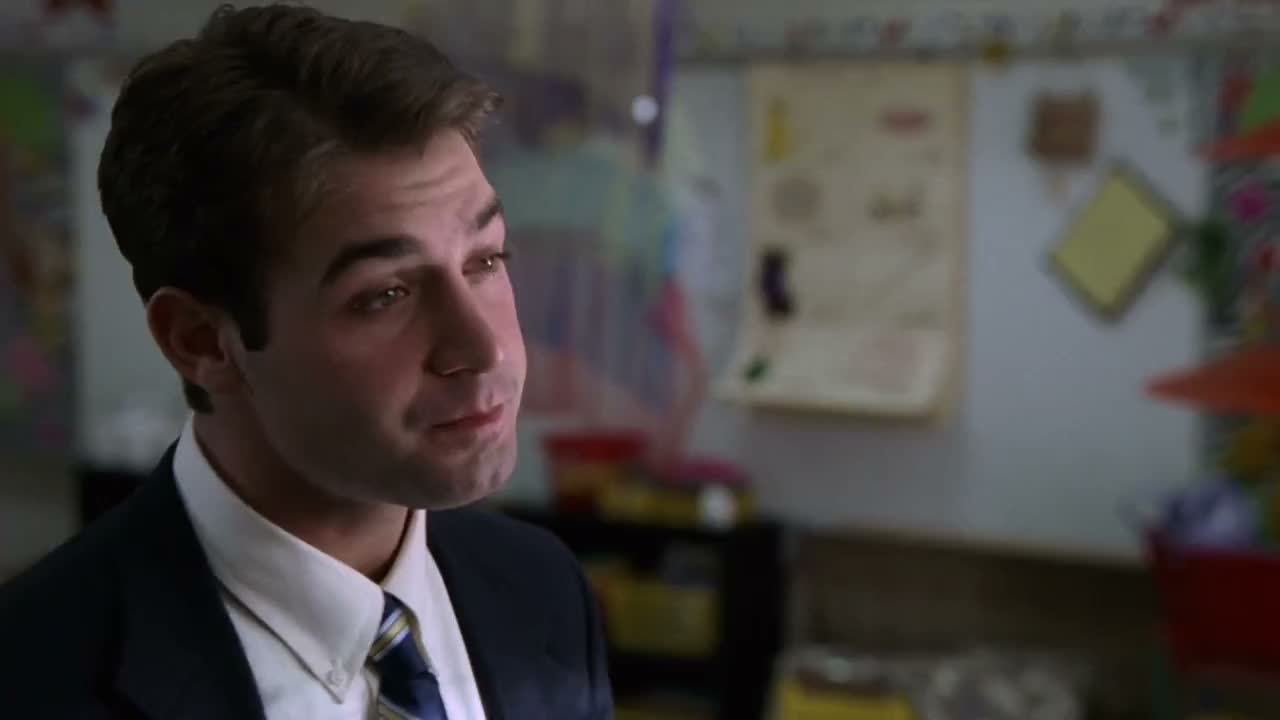
Brad Cohen is waiting to hear back about a teaching job when his younger brother Jeff shows up for a surprise visit and takes him golfing. On the course, Brad's Tourette's tics draw complaints; a manager orders him to leave, but two players in the next group invite him to join them instead.
On the surface the manager is enforcing a rule: Brad's barking and shouting disturb the other members. But the rule quietly assumes Brad is choosing to be disruptive, which is exactly what the film keeps pushing back on. Brad has spent his whole life explaining Tourette's to strangers, and here he does it again — "because I have Tourette's syndrome... It's a neurological disorder" — only to be told to leave anyway. What changes the scene isn't his explanation but someone else's decision to take his side: "Hey, Joe, leave the guy alone. He's fine." Jeff, who has watched his brother fight for basic acceptance, can hardly stand it; Brad answers that he sees these small acts of decency everywhere, and that the world is not as hostile as Jeff thinks.
A1–C2 is the CEFR scale. Cards above the level you pick fade, and playback will not auto-pause on them.
“It's not like you haven't seen it before.”
The dry reversal says we have been here many times, so no drama is needed.
Informal
“My life is full of people like that.”
It answers cynicism by counting kindnesses, which lands harder than arguing.
Neutral
“How can you stand living in a world where everybody is soignorant?”
The angry question is really worry, which is why Brad answers it so gently.
Informal
“I tried to convince myself something good would happen.”
The effort to stay hopeful is itself the confession — doubt and grit at once.
Neutral
 Up next · 11talk the talk, walk the walkThe scene: Brad Gets His First Teaching Job
He says Brad's noises are not fair to the other golfers and that he has to think of the other members. He treats the tics as a choice rather than a medical condition.
When the manager orders Brad off the course, one of them tells him to leave the guy alone and invites Brad to join their group. They judge him by what they see, not by the rule.
He has watched his brother be humiliated for something he cannot control. Brad, who is used to it, tells him most people are decent and that many have stood up for him.
It comes from baseball: stepping up to bat for someone means standing up for them. Brad uses it for the golfers who took his side.