
“Look at the angle - down and in.”
Why it's great
Two plain direction words turn an abstract wound into a picture you can see.
Register
Neutral
Use it yourself
Look at the angle — down and in, like this.
Chapter 14 of 17 · 5'01"
A juror acts out the stabbing to test the prosecution's story, showing the blade would have to go "down and in." Then a juror who grew up around switchblades says the killing "wouldn't be done that way" — and another, fed up and in a hurry, flips his vote: "I've had enough."
Juror 8 Demonstrates the Knife
Juror 5 Explains the Switchblade
The Room Turns on Juror 7
One juror takes the knife and demonstrates the downward stab described in court, arguing it fits a shorter man reaching up to a taller victim. Then a juror who grew up around switchblades says the boy would have used it underhanded. And another juror, tired of the arguing and eager to reach a ball game, suddenly votes not guilty — and the room turns on him.
The knife is the whole case in miniature: everyone agrees a boy was stabbed to death, and the fight is over who gets to explain the wound. One juror's demonstration is an argument that the physical evidence fits a shorter attacker; the man who knows switchblades answers with lived experience, not theory. What's really happening is that certainty is eroding, and the room can feel it. So when a juror who has been voting guilty suddenly shouts "I've had enough" and switches, it isn't courage or doubt — it's impatience dressed up as a decision. Juror 8 names it: "Who tells you that you have the right to play like this with a man's life?" The scene's real subject is the difference between changing your mind and simply wanting the room to be over.
A1–C2 is the CEFR scale. Cards above the level you pick fade, and playback will not auto-pause on them.
“Look at the angle - down and in.”
Two plain direction words turn an abstract wound into a picture you can see.
Neutral
“You can talk till your tongue is draggin' on the floor.”
The exaggeration is comic and final: more talking will change nothing.
Informal
“Or don't you have the guts to do what you think is right?”
It turns a question into a dare, forcing the man to answer in front of everyone.
Informal
“Who tells you that you have the right to play like this with a man's life?”
The repeated question pins a careless vote to a moral debt no one can wave off.
Formal
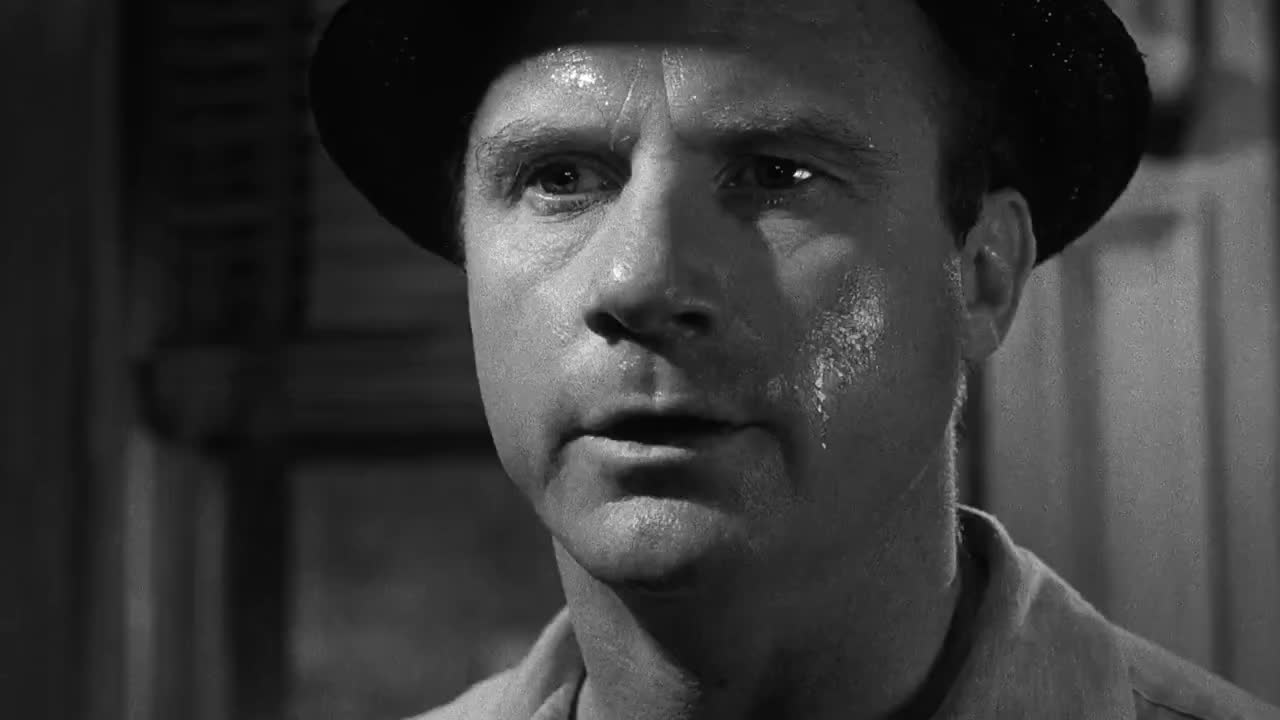 Up next · 15you peopleThe scene: Juror 10's Racist Rant
Not because he was persuaded. He says he's "had enough" of the arguing and wants to get to a ball game. He treats his vote as a way to end the day, which is why the others attack him for it.
It tests whether the boy could have made the wound. The downward, inward angle suggests a shorter attacker stabbing upward at a taller man, and the medical evidence becomes something the jury has to explain, not just accept.
Because he grew up seeing knife fights, so he knows a switchblade is used underhanded, not with the overhead motion being demonstrated. His experience gives the jury a concrete reason to doubt that the boy made that wound.
His switch tips the room, but the others are furious rather than persuaded, because he changed out of weariness, not belief. Juror 8 forces the choice back onto him: guilty or not guilty, decided on the evidence.