
“I'll tell you what I think. We're going nowhere here.”
Why it's great
It names the deadlock out loud and puts the speaker's impatience on the table.
Register
Informal
Use it yourself
I'll tell you what I think: this meeting is going nowhere.
Chapter 13 of 17 · 5'03"
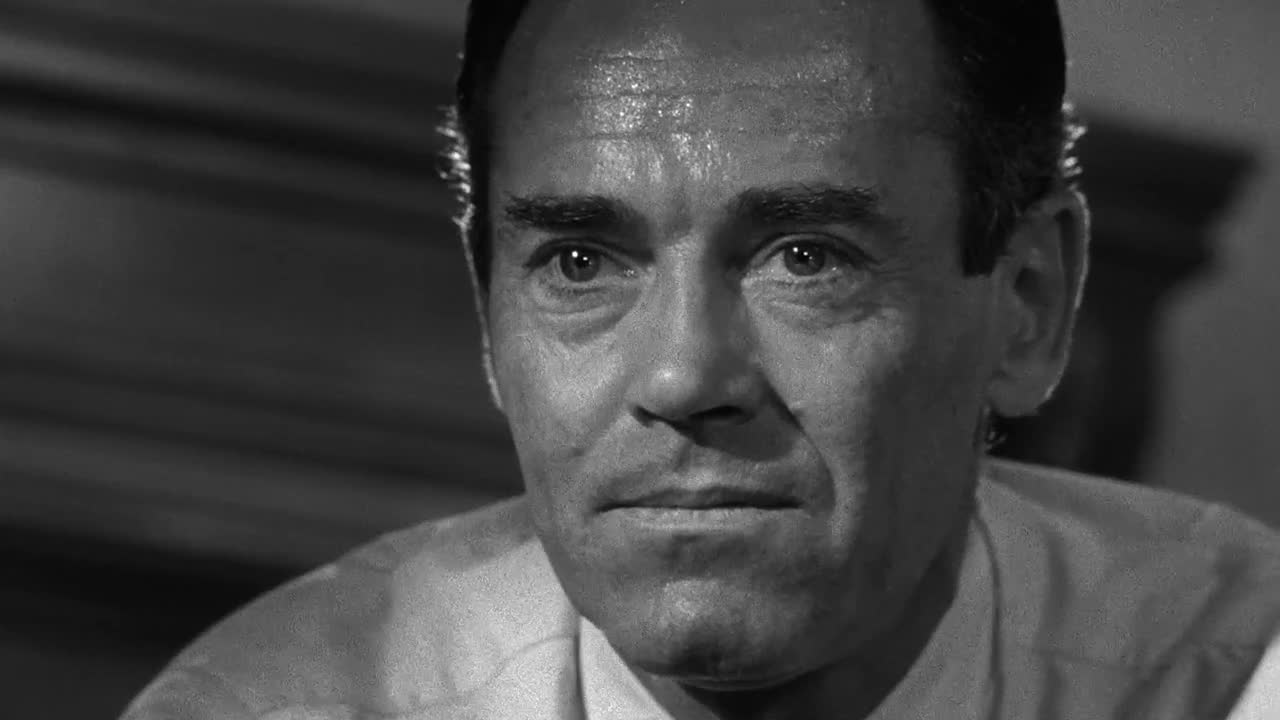
The jury is deadlocked and someone wants to declare a hung jury, but the argument isn't over. A juror re-examines the boy's only alibi — that he was at the movies — and then turns the same test on the room: asked what they saw on Monday night, a juror can only recall the first film, not the second.
The Jury Threatens to Hang
The jury seems stuck, and one juror moves to declare a hung jury and go home. Instead, the conversation returns to the boy's alibi: he said he was at the movies but couldn't name the films or the stars. A juror pushes the same question at the room, asking what someone else saw at the movies — and they cannot remember the second feature either.
The scene quietly turns the prosecution's strongest 'fact' back on the jury. The boy's failure to remember movie titles was used to prove he wasn't at the theater; but remembering a film you saw weeks ago is not easy. A juror tests this by asking someone else, "Where were you last night?" and then walking him through the nights until he names a film — The Scarlet Circle — and comes up short on the second feature. That admission does what argument could not: it shows the boy's memory problem is ordinary, not incriminating. The reenactment of the alibi runs the other way too: a lawyer could easily find out what played, so the boy could have memorized the titles in three months. Either way, the jury is now testing stories against their own experience rather than taking them on faith.
A1–C2 is the CEFR scale. Cards above the level you pick fade, and playback will not auto-pause on them.
“I'll tell you what I think. We're going nowhere here.”
It names the deadlock out loud and puts the speaker's impatience on the table.
Informal
“Listen. This kid wouldn't stand a chance with another jury, and you know it.”
It shuts the argument down while accusing the other man of already knowing the truth.
Informal
“You still don't think there's room for reasonable doubt?”
A quiet question that carries the whole standard the case turns on.
Neutral
“Maybe you don't fully understand the term "reasonable doubt."”
A soft opener carries a hard jab, attacking the other man's grasp of the rule itself.
Formal
 Up next · 14have the gutsThe scene: Juror 8's Knife Demonstration
To attack the boy's alibi with the jury's own memory. The prosecution said the boy must have lied because he couldn't name the films; the juror shows that anyone can forget a movie they saw.
It was the only explanation he offered for where he was when his father was killed. If his memory lapse is normal rather than proof of guilt, the case against him weakens.
A jury that cannot agree on a verdict, which can lead to a retrial. One juror wants to declare a hung jury and end the deliberation, but others resist.
Because it was an inexpensive, forgettable second film with unknown actors — exactly the kind of detail no one would remember weeks later. That is the point he is making about the boy.
The prosecution suggested he could have learned them in the three months between the murder and the trial, which is why the defense's timing argument matters so much to the jury.