
“They don't know what the truth is.”
Why it's great
A sweeping claim that writes off a whole group, revealing the speaker more than the group.
Register
Informal
Use it yourself
They don't know what the truth is, so they make things up.
Chapter 15 of 17 · 3'05"
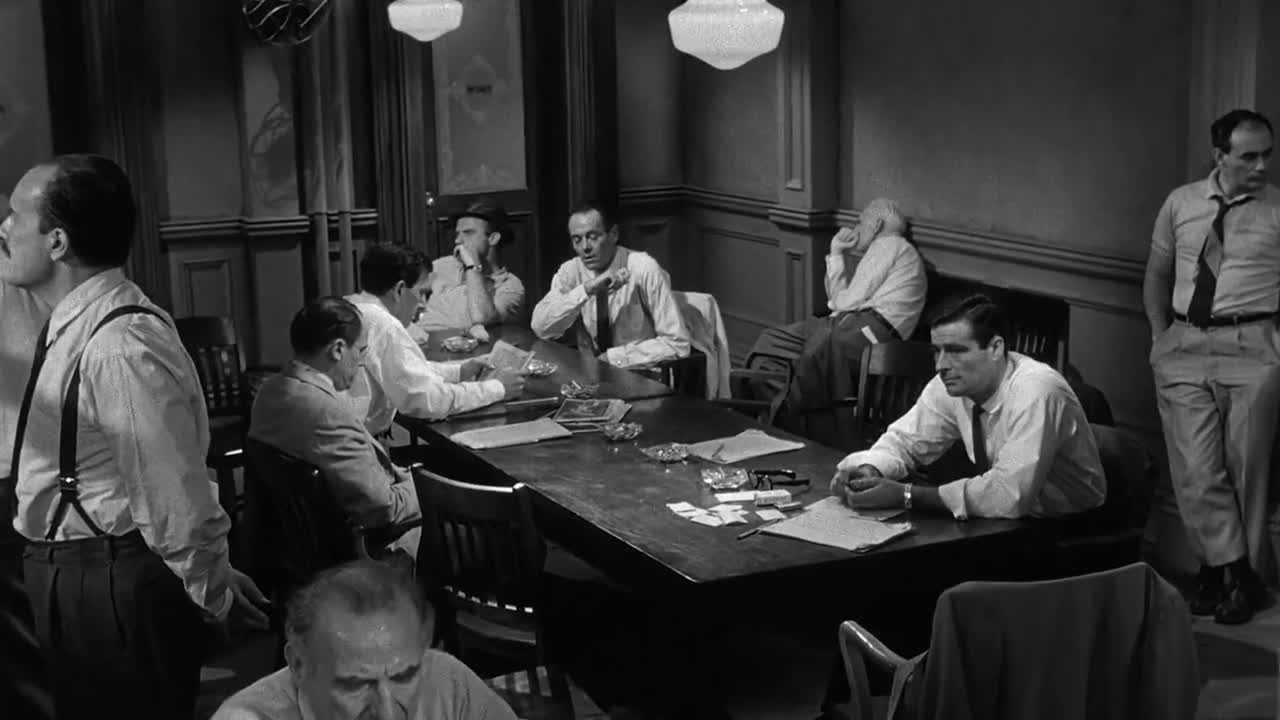
The jury room is finally cracking: the vote has swung to 9–3 for acquittal, and Juror 10 can't stand it. He erupts into a tirade about "these people," calling the defendant a liar and violent by nature. "They don't know what the truth is," he insists. The others just let him burn out.
❝ Monologue · 23 lines Juror 10 Rants About 'You People'
After a second vote, the count moves to nine not guilty and three guilty. Juror 10, who has been stewing all afternoon, loses control and attacks the defendant's background, calling him a liar and dangerous. Nobody argues with him; nobody listens either. Eventually he is told to sit down and keep quiet.
Juror 10 isn't really talking about the evidence — he's talking about race and class. His complaint that the jurors keep raising "picky little points" gives him away: facts annoy him because they don't fit the story he already believes. "They don't know what the truth is," he says, as if truth were something a whole group simply lacks. The scene's real move is what the other eleven do: nothing. They don't debate him; they turn away. In a film built on one man forcing the room to argue, the strongest rebuke is refusing to argue at all, and his words are left hanging in the silence.
A1–C2 is the CEFR scale. Cards above the level you pick fade, and playback will not auto-pause on them.
“They don't know what the truth is.”
A sweeping claim that writes off a whole group, revealing the speaker more than the group.
Informal
“These people are dangerous.”
Four words state the prejudice at its bluntest and leave nothing hidden.
Informal
“There's not a one of 'em who's any good.”
The double negative and 'em make the dismissal sound final and crude.
Informal
“This kid is a liar! I know it. I know all about them.”
He states flat facts and a conclusion, and the certainty is what makes it ugly.
Informal
I don't understand you people! I mean, all these picky little points you keep bringing up. They don't mean nothing! You saw this kid just like I did. You're not gonna tell me you believe that phony story about losing the knife... and that business about being at the movies. Look, you know how these people lie. It's born in them. I mean, what the heck. I don't have to tell you. They don't know what the truth is. And let me tell you, they don't need any real big reason to kill someone either. No, sir. They get drunk! Oh, they're real big drinkers, all of 'em. You know that. And bang - someone's lying in the gutter. Well, nobody's blaming them for it. That's the way they are, by nature. You know what I mean? Violent! Where are you going? Human life don't mean as much to them as it does to us. Look! They're lushing it up and fighting all the time... and if somebody gets killed, so somebody gets killed! They don't care! Oh, sure, there's some good things about 'em too. Look, I'm the first one to say that. I've known a couple who were okay, but that's the exception, you know what I mean? Most of 'em, it's like they have no feelings. They can do anything.
 Up next · 16obscure the truthThe scene: Juror 8 Warns About Prejudice
The 9–3 count shows the guilty majority is gone. Instead of answering the arguments that changed minds, he attacks the defendant's background — prejudice he carried into the room from the start.
The other jurors have heard enough. Silence denies him the fight he wants and lets his bigotry isolate him, which lands harder than shouting him down would.
He has stopped talking about the defendant and started judging a whole group. The phrase does the work of the verdict he wants: guilty by category, not by evidence.
No. He is silenced rather than persuaded, and later in the film he simply stops being listened to. The drama comes from the jurors he can't move, not from converting him.