
“It's not easy to raise my hand and send a boy off to die...”
Why it's great
It ties a small gesture of the hand to a boy's death, and the room feels the weight.
Register
Neutral
Use it yourself
It's not easy to sign off on someone's job like this.
Chapter 2 of 17 · 5'03"
The jury takes its first vote expecting to be done, and everyone raises a hand for guilty — except one man. Asked why, he answers, "It's not easy to raise my hand and send a boy off to die without talking about it first," and the room is forced to keep talking.
The Holdout Refuses to Rush the Verdict
❝ Monologue · 9 lines The Juror Speaks for the Boy
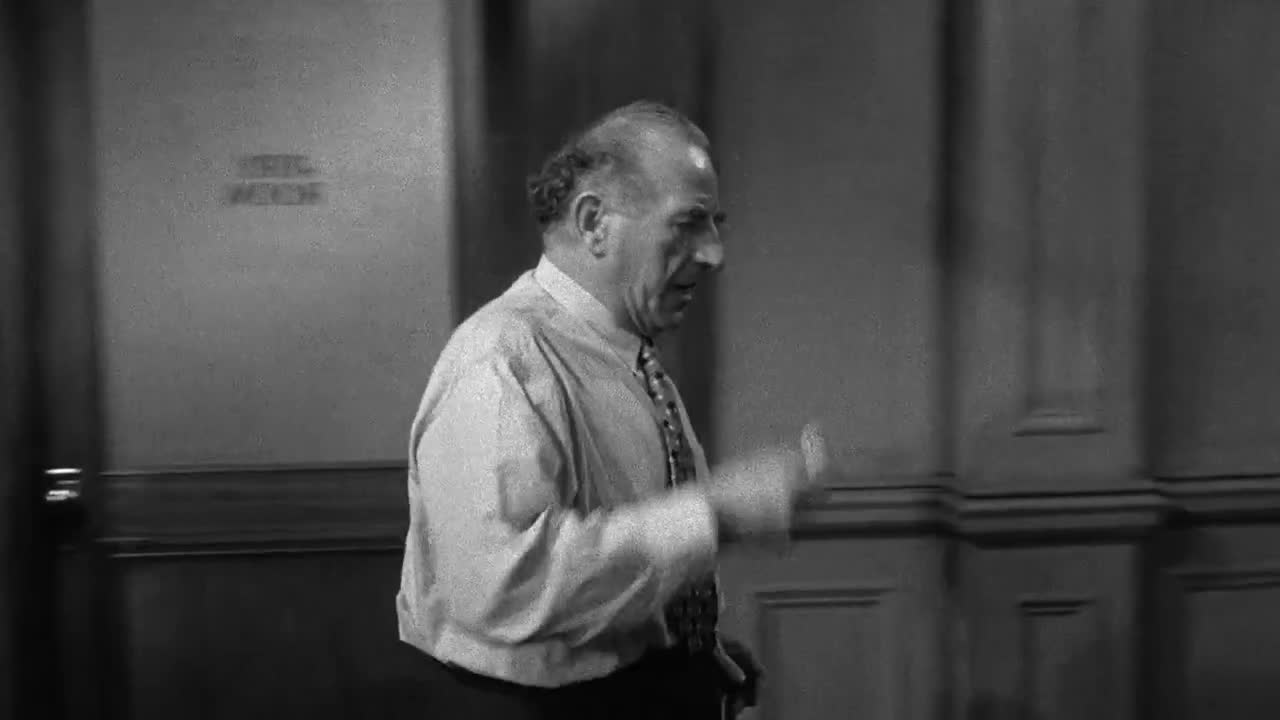
Twelve jurors are locked in a hot room to decide whether a teenage boy is guilty of murdering his father. The foreman explains that a guilty verdict means the electric chair, then calls the customary preliminary vote. Eleven hands go up for guilty; one juror votes not guilty and asks the others to talk it through.
The vote is supposed to be a formality, and that is exactly what makes the scene tense. Eleven men want to be done and go home; one won't raise his hand. "It's not easy to raise my hand and send a boy off to die without talking about it first," he says, and the room has no answer except to keep talking. His stand is not a claim of innocence — he admits he doesn't know if he believes the boy's story — but a refusal to let the verdict be a reflex. The others push back with the trial's facts and the cost of the trial itself, while he keeps pulling the conversation back to the boy's life: born in a slum, mother dead at nine, kicked around his whole life. "I just think we owe him a few words," he says, and the reply — "We don't owe him a thing" — shows how far apart they are.
A1–C2 is the CEFR scale. Cards above the level you pick fade, and playback will not auto-pause on them.
“It's not easy to raise my hand and send a boy off to die...”
It ties a small gesture of the hand to a boy's death, and the room feels the weight.
Neutral
“We can't decide it in five minutes. Supposing we're wrong.”
He sets a rule, then drops the real weight: what if the whole room is wrong?
Neutral
“I - I just think we owe him a few words. That's all.”
Against 'we owe him nothing', he asks only for a few words, pulling the debate back to a person.
Neutral
“We're talking about somebody's life here.”
The plain words drag a debate back to one human life and its weight.
Neutral
Look, this kid's been kicked around all of his life... you know, born in a slum, mother dead since he was nine. He lived for a year and a half in an orphanage when his... his father was serving a jail term for forgery. It's not a very happy beginning. He's a - a wild, angry kid. That's all he's ever been. And you know why? 'Cause he's been hit on the head by somebody once a day every day. I - I just think we owe him a few words. That's all.
 Up next · 03burden of proofThe scene: The Jurors Go Around the Table
Eleven jurors vote guilty almost immediately, treating the trial's evidence as settled. One juror votes not guilty — not because he thinks the boy is innocent, but because he wants the facts discussed first.
He says he doesn't know whether he believes the boy's story, and that voting not guilty is how he forces the jury to talk before sending a boy to die.
He reminds the jury that the charge is first-degree murder, so a guilty verdict is mandatory death — the electric chair. That is the weight behind why the vote cannot be rushed.
It means treated badly and pushed from place to place all his life — no stable home, no one looking after him. The juror uses it to explain why the boy turned out angry.
It is the customary way to see where everyone stands before debating. The foreman calls it a preliminary vote, expecting it to confirm the obvious — and it almost does.