
“There is a reasonable doubt in my mind.”
Why it's great
It refuses to argue and simply states the one legal idea the whole case turns on.
Register
Formal
Use it yourself
There is a reasonable doubt in my mind about his story.
Chapter 11 of 17 · 5'03"
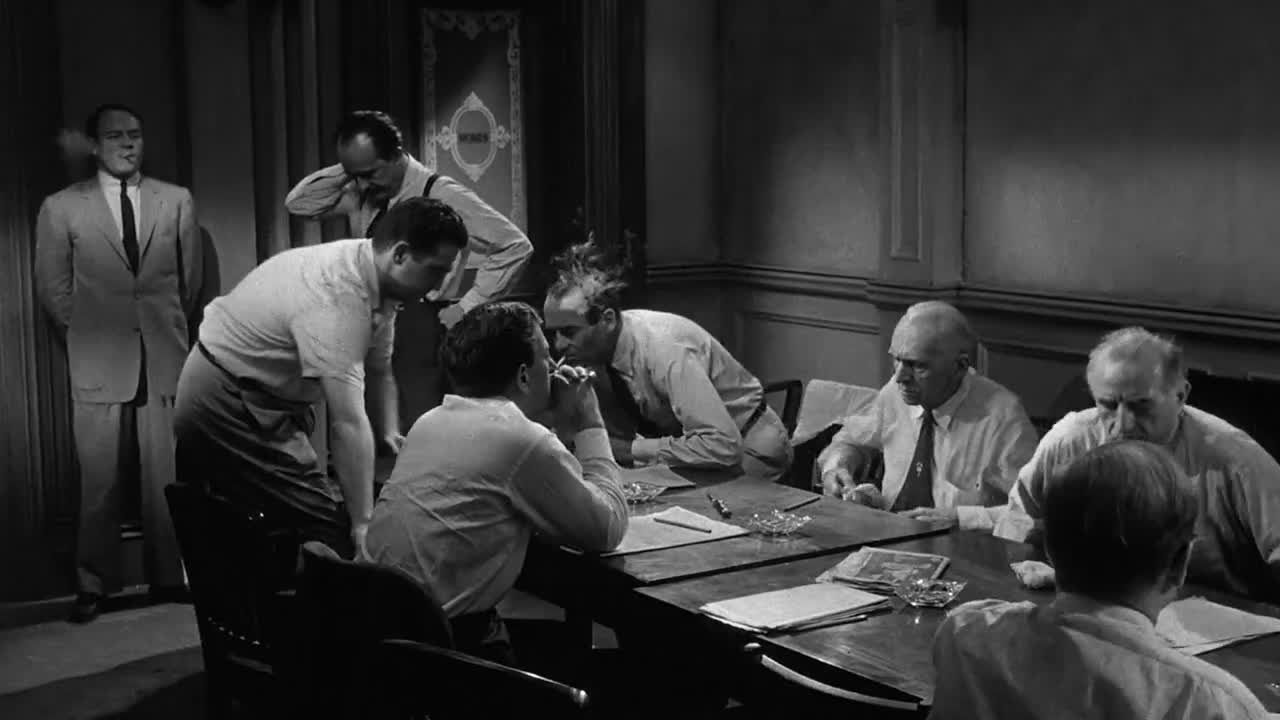
A second juror switches to not guilty, making it eight to four. Pressed for reasons, he says only that he has a "reasonable doubt." Then the jury turns to the old man: could a man who drags one foot and had a stroke really reach the door fifteen seconds after the body hit the floor? They reenact it.
A Juror Changes His Vote
❝ Monologue · 4 lines Juror Eight retells the testimony
He paces the testimony into footsteps, a door and a dash, walking the room through it.
❝ Monologue · 7 lines The foreman lays out the apartment
Room by room, he turns the testimony into a floor plan anyone can walk.
The Jury Reenacts the Old Man's Walk
A second juror changes his vote to not guilty, making the count eight to four. He refuses to explain beyond a single line about reasonable doubt, and the others call his reasoning stories pulled out of thin air. The argument then focuses on the old man: he had a stroke, drags one foot, and may not have reached the door in fifteen seconds. The jury reenacts the walk.
This is the scene where the jury stops arguing about words and starts measuring. The old man's testimony rested on one detail — that he got to his door in time to see the boy run — and the holdout turns that detail into a physical test. "Fifteen seconds after the body hit the floor," someone states, and then the only question left is whether an old man who had a stroke and "can walk only very slowly" could cover the distance. The reenactment also cuts the other way: the defense lawyer never raised the timing, which one juror reads as proof it would have meant "bullying and badgering a helpless old man." By the end, doubt has moved from a word to a fact of the room. And the last detail — the door was chain-locked — opens a new question entirely.
A1–C2 is the CEFR scale. Cards above the level you pick fade, and playback will not auto-pause on them.
“There is a reasonable doubt in my mind.”
It refuses to argue and simply states the one legal idea the whole case turns on.
Formal
“Maybe he didn't bring it up because it would have meant bullying and badgering a helpless old man.”
It reads the lawyer's silence as restraint, giving dignity to someone not in the room.
Formal
“I mean, you're sittin' here, you're pulling stories out of thin air, you know?”
The image of pulling stories out of thin air makes fabrication sound both easy and absurd.
Informal
“He can walk only very slowly. They had to help him into the witness chair.”
Two concrete details turn a vague claim about speed into something the room can measure.
Neutral
As soon as the body hit the floor, he said he heard footsteps upstairs... running toward the front door... heard the upstairs door open, the footsteps start down the stairs. He said he got to his own front door as fast as he could...
All right. Here's the apartment where the killing took place. The old man's apartment was directly beneath and exactly the same. Here are the el tracks, the bedroom, living room, kitchen, bathroom. Here's the hall. Here are the stairs. Now, the old man was in this bedroom right here. He says he crossed to the door and walked down the hall... opened the front door just in time to see the boy running down the stairs.
 Up next · 12see if the cat licks it upThe scene: The Jury Deadlocks at Six to Six
To test his testimony. He said he reached the door in time to see the boy run, fifteen seconds after the body fell. The jurors measure whether a man who drags one foot could actually do that.
Because pressing the old man on how fast he could walk would have meant badgering a frail, confused witness — and a jury would not like it. So the defense may have avoided a point that helped the boy.
It is the standard that prevents a conviction when the evidence leaves a reasonable person unsure. In this scene one juror uses it as his whole reason for voting not guilty.
He doesn't explain much. He says only that there is a reasonable doubt in his mind, and he wants the jury to examine the evidence rather than rush to a verdict.
It adds a new problem for the old man's account. If the front door was chain-locked, the boy could not simply have run out of it, which casts further doubt on the testimony.