
“That part of his mind just conveniently went blank.”
Por qué es buena
Calling the gap convenient turns a claim of amnesia into a quiet accusation.
Registro
Informal
Úsala tú
The deadline is the part that conveniently slipped his mind.
Capítulo 7 de 20 · 3'34"
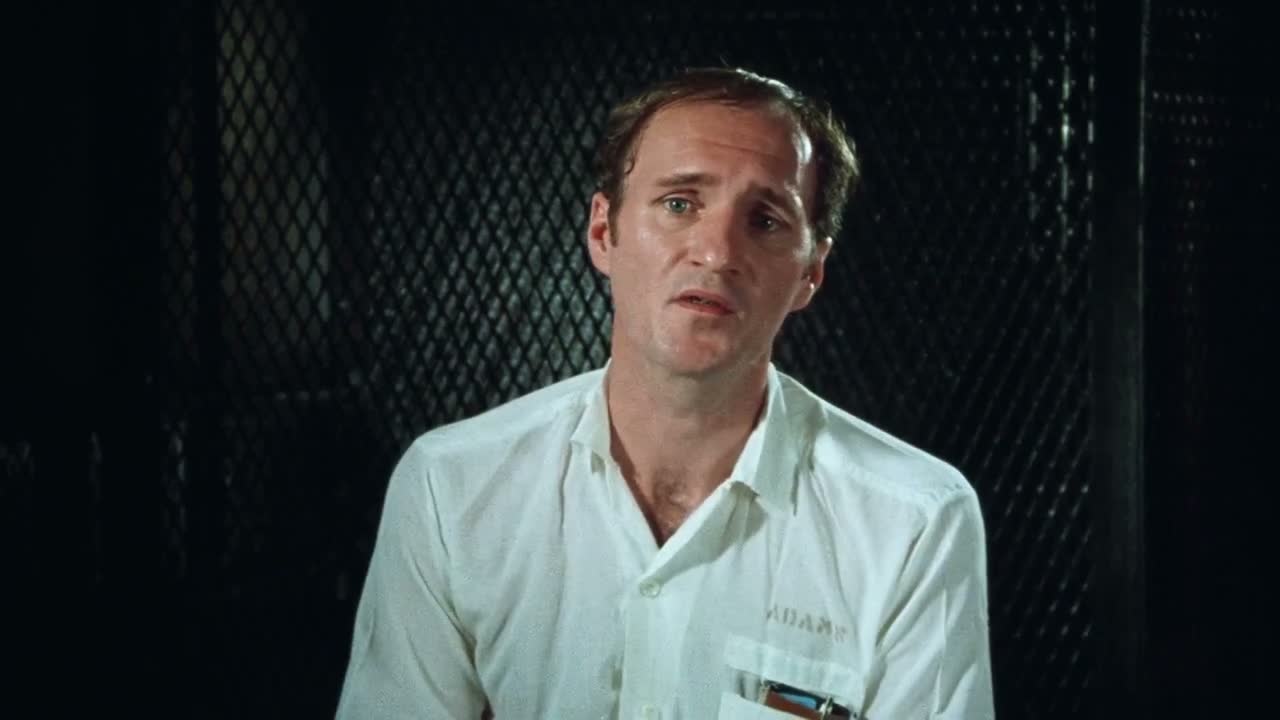
A statement Adams signed gets treated as his confession, and the film lets both sides speak over it. An investigator mocks the gap in his memory: "That part of his mind just conveniently went blank." Adams insists the document was never a confession, while police describe wasting weeks chasing a car that never existed.
The Convenient Memory Gap
❝ Monólogo · 4 frases They Called His Statement a Confession
The Wrong Car at the Scene
Across several interviews, the film returns to the statement Randall Adams signed. One speaker describes reading a copy and signing it. An investigator recounts the suspect's account — he admits driving, remembers nearing the scene, then loses ten minutes and recalls everything else vividly. Adams says the case was built on a document he never saw as a confession.
The chapter is about a piece of paper and what it is allowed to mean. Adams's account is blunt: the statement 'was never... and never would have been anything as "a confession."', yet the press and the prosecution used the word. The investigator's version is just as pointed in the other direction, dismissing the missing minutes as bad faith: 'That part of his mind just conveniently went blank.' and 'that's just a convenient memory lapse.' Later the film turns to the car itself, where the police admit they spent huge effort hunting a blue Vega when the car was a Comet: 'We just all had the wrong information.'
A1–C2 es la escala MCER. Las tarjetas por encima del nivel elegido se atenúan y la reproducción no se pausa en ellas.
“That part of his mind just conveniently went blank.”
Calling the gap convenient turns a claim of amnesia into a quiet accusation.
Informal
“And that's just a convenient memory lapse, is all that is.”
The doubled ending leaves no doubt: just a convenient lapse, nothing more.
Informal
“But yet, they labeled it as such.”
Short and flat, it exposes the gap between what a document is and what they call it.
Neutral
“They kept me completely away from everybody.”
One verb captures isolation: kept away from everyone, with no contact at all.
Neutral
“We just all had the wrong information.”
It admits the error without blame, yet the all makes the scale clear.
Neutral
But yet, they labeled it as such. Of course, I couldn't dispute this because I didn't even know about it. I heard no news. I knew nothing for two weeks. They kept me completely away from everybody.
 Siguiente · 08under the impressionLa escena: The Car With No Bullet Marks
Because he signed it believing it was an account he agreed with, not an admission of guilt. In his telling it was never anything like 'a confession,' yet officials labeled it as one.
It covers exactly the shooting. Adams remembers driving and nearing the scene, then blanks until the motel room, which the investigator treats as a suspicious, self-serving gap rather than real memory loss.
They searched for a blue Vega. The car they actually needed was a Mercury Comet, so every tip about a Vega sent the investigation the wrong way — a difference one officer sums up as having the wrong information.
A gap in memory that seems too useful to be real. The speaker uses it to accuse the suspect of pretending not to remember only the minutes that would incriminate him.