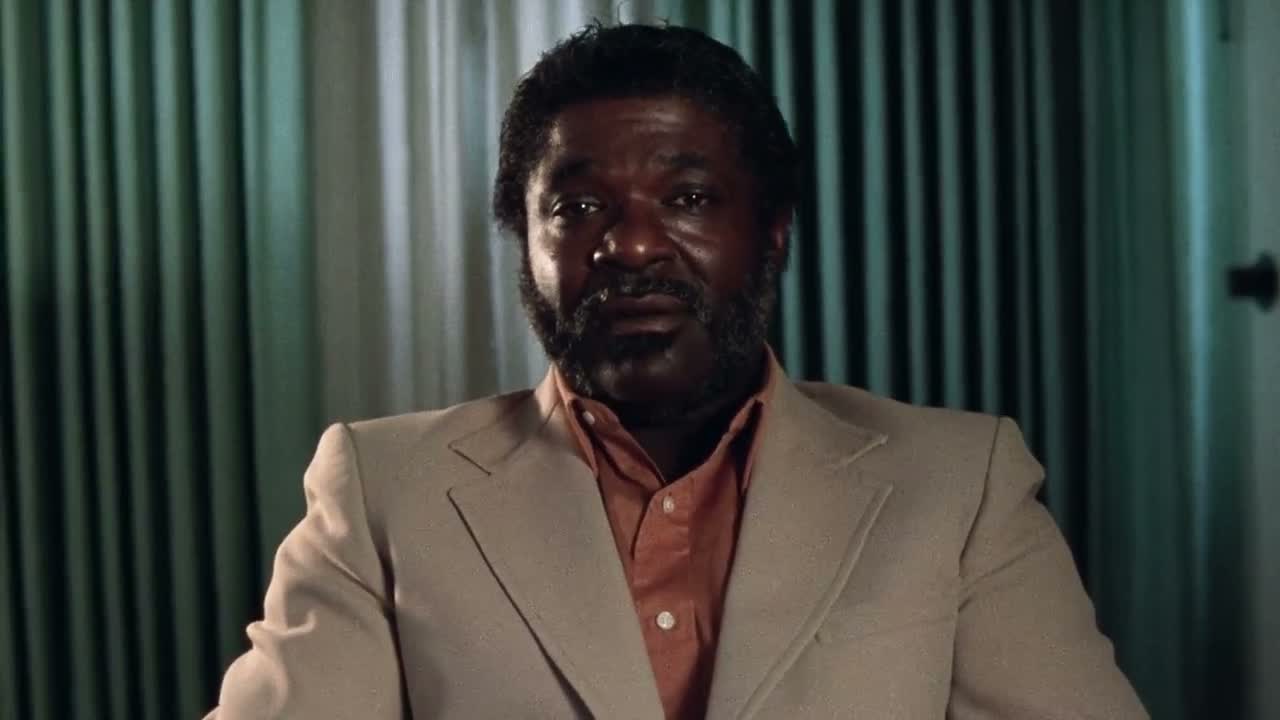
“Very convenient that the driver happened to have bushy hair.”
The mock surprise of 'very convenient' turns a changed detail into an accusation.
Informal
Capítulo 11 de 20 · 5'03"
An eyewitness's account shifts after two weeks with Internal Affairs: she first described "a fur-lined collar on the killer," then told the court it "might have been bushy hair" — and pointed at Randall Adams. The defense calls it a story that changes to fit: "She goes in saying one thing, she comes out saying another."
The Witness Changes Her Description
The Two-Week Gap That Changed Her Story
❝ Monólogo · 17 frases the witness who plays detective
Her cheerful nosiness explains why she watched so closely, and why her testimony matters.
The chapter follows one witness's changing account. Fifteen minutes after the killing she described 'a fur-lined collar on the killer.' At trial she said it 'might have been bushy hair,' then pointed straight at Randall Adams, who was convicted largely on that identification.
The whole case turns on one detail, and the detail keeps moving. Fifteen minutes after the officer is shot, the witness says the killer wore a fur-lined collar; by the time she is on the stand, it has become 'bushy hair,' which happens to describe the sixteen-year-old driving the car. Randall's defense treats the shift as the point: 'Very convenient that the driver happened to have bushy hair.' Then there is the unexplained gap — two weeks with Internal Affairs, after which, as the defense puts it, 'She goes in saying one thing, she comes out saying another.' The state's explanation is three words: 'We refreshed her memory.' By the last afternoon she is swearing to a description she never gave, and 'She's the one that got him convicted.' A trial built on memory is shown to run on whoever is allowed to edit it.
A1–C2 es la escala MCER. Las tarjetas por encima del nivel elegido se atenúan y la reproducción no se pausa en ellas.
“Very convenient that the driver happened to have bushy hair.”
The mock surprise of 'very convenient' turns a changed detail into an accusation.
Informal
“All she's got to do is look at a picture they took of me.”
The flat 'all she's got to do' makes a wrongful identification sound almost casual.
Informal
“It's a hell of a big difference from "fur-lined collar" to "bushy hair."”
A blunt intensifier slams two versions of the same detail side by side.
Informal
“She goes in saying one thing, she comes out saying another.”
The in-and-out parallel makes a changed story instantly visible.
Informal
“There's just little David Harris, and nobody believes him.”
The word 'little' and the flat ending make the only witness sound powerless.
Neutral
“She's the one that got him convicted.”
One short sentence pins a whole conviction on a single witness.
Neutral
When I was a kid, I used to want to be a detective... because I used to watch all the detective shows on TV. When I was a kid they used to show these movies with Boston Blackie... and he always had a woman with him. I wanted to be a wife of a detective or be a detective... so I always watched detective stories. I'm always looking because I never know what might come up. Or how I could help. I like to help in situations like that. I really do. It's always happening to me, everywhere I go... lots of times there's killings or anything. Even around my house. Wherever. I'm always looking or getting involved, to find out who did it, what's going on. I listen to people. And I'm always trying to decide who's lying, or who killed who... before the police do. See if I can beat them.
Siguiente · 12hinge onLa escena: A Couple Witnesses the ShootingThe film never gets a clean answer. She spent two weeks with Internal Affairs and returned with a different description, and the official explanation is only, "We refreshed her memory." The defense argues she was guided toward an identification.
Fifteen minutes after the killing, she described a fur-lined collar on the killer. On the stand, that became hair that "might have been bushy" — a detail that fit the driver, David Harris, rather than Randall Adams.
Decisive. As the defense says, the other evidence is thin — the only other witness pointing at Randall is a teenager nobody believes — so the changed identification is what "got him convicted."
The gas-station account of an argument and a police stop is told by the Millers, the couple who were driving that night. The husband describes turning to see his wife staring hard after the officer pulled a car over.
The driver of the car, David Harris, had bushy hair. If the killer's hair was bushy, the description fits the sixteen-year-old rather than Randall Adams, which is why the defense calls the new wording 'very convenient.'