
“Grigson is known as "Dr. Death" because he always testifies that way.”
Por qué es buena
A nickname plus a plain reason captures an entire career in one line.
Registro
Neutral
Úsala tú
She is known as the fixer because she solves every crisis.
Capítulo 15 de 20 · 3'24"
The prosecution's psychiatrist, Dr. Grigson — nicknamed "Dr. Death" because he always testifies this way — tells the court that Randall Adams will commit violent crimes if released. Adams answers with the obvious objection: "You can't tell what somebody's gonna do years from now." A juror, looking at the same evidence, ends up seeing David Harris as the killer.
Dr. Death Testifies Against Adams
❝ Monólogo · 17 frases Randall Answers Dr. Death
The Juror Who Saw David Harris
The chapter follows the testimony that helped send Randall Adams to death row. Dr. Grigson, the prosecution's psychiatrist, tells the jury that Adams will commit violent crimes in the future, though he examined him for only fifteen minutes. The defense notes Adams had no prior record; a juror later says he believed David Harris was the real killer.
The chapter is about a prediction dressed up as evidence. Dr. Grigson — 'known as "Dr. Death" because he always testifies that way' — tells the jury what Randall Adams will do years into the future, a claim the defense treats as impossible: 'You can't tell what somebody's gonna do years from now.' Adams, in his own words, is turned into a monster in the space of an interview: 'He called me Charlie Manson. He called me Adolf Hitler.' The record says otherwise — 'Randall never had any prior record' — so the prognosis is doing the work that facts cannot. By the end, a juror has drawn the opposite conclusion from the same evidence: he believes David Harris committed the murder, 'and it was their verdict that counted.' The chapter's subject is not who pulled the trigger but how a confident voice on the stand can hand a jury its certainty.
A1–C2 es la escala MCER. Las tarjetas por encima del nivel elegido se atenúan y la reproducción no se pausa en ellas.
“Grigson is known as "Dr. Death" because he always testifies that way.”
A nickname plus a plain reason captures an entire career in one line.
Neutral
“You can't tell what somebody's gonna do years from now.”
A plain statement about the future quietly dismantles a prediction of violence.
Informal
“And as far as we know, he never had any history of violence whatever.”
The hedge 'as far as we know' makes the flat denial that follows even stronger.
Formal
“I would go crazy and probably butcher half of Dallas County.”
Repeating the doctor's wild prediction shows how absurd the accusation sounded.
Informal
“Don't ever turn your back on me. And he talked to me 15 minutes.”
A warning and a time count side by side make the whole judgment look absurd.
Informal
“But it's very hard to understand why anybody has to kill a police officer.”
After granting every other crime, the line draws the one line that cannot be crossed.
Formal
“And it was their verdict that counted.”
The cleft ending lands on the verdict, not the truth, and the coldness says everything.
Formal
He called me Charlie Manson. He called me Adolf Hitler. He said I'm the type of personality... that can work all day and creep all night. He testified, Grigson... that the future seriousness... of my mental state... would be such that if they released me... I would go crazy and probably butcher half of Dallas County. Even though he talked to me 15 minutes... I have no prior convictions, no prior arrests... I was nonviolent for 28 years. On one instance... and that's saying if I did this, which I didn't... he's stating that, that's enough.... For the rest of my life, watch me. Don't ever turn your back on me. And he talked to me 15 minutes. He's crazy.
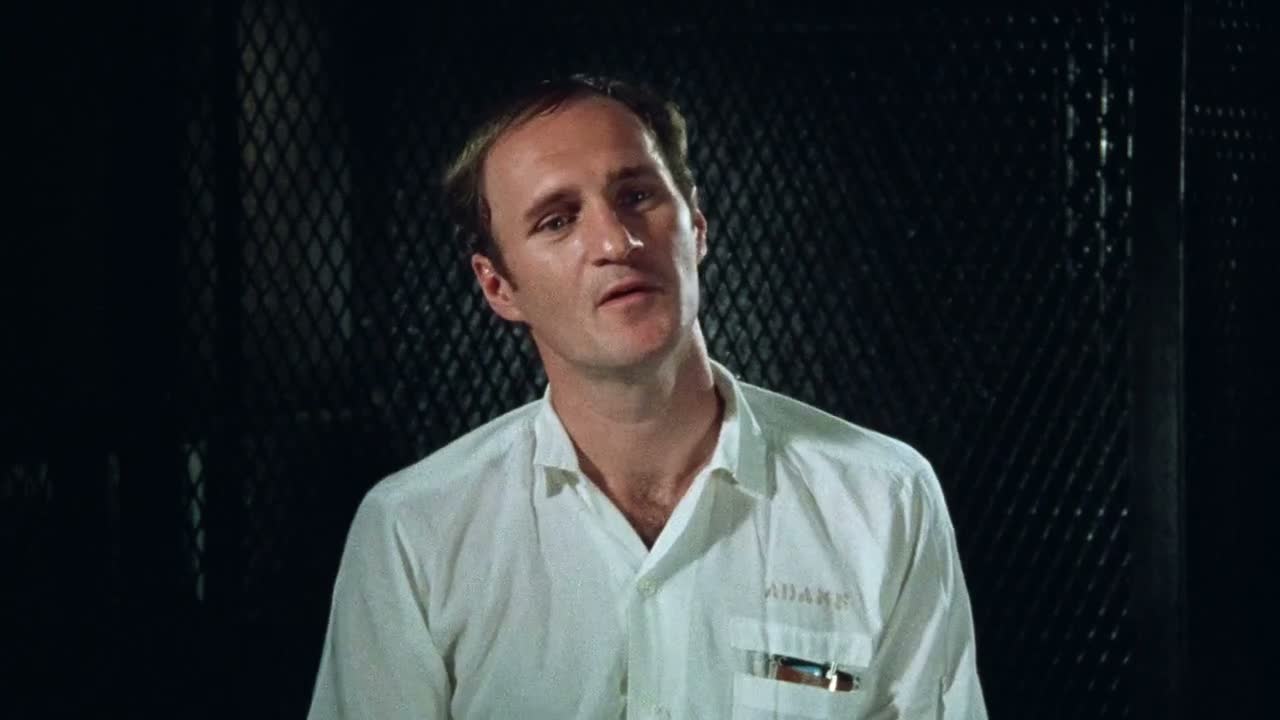 Siguiente · 16hard-nosedLa escena: Randall Adams on Death Row
Dr. Grigson, the prosecution's psychiatrist. He earned the nickname because he testifies for the prosecution in nearly every case that the defendant will commit violent crimes in the future.
About fifteen minutes, according to Adams. On that basis, Grigson told the jury that Adams would go crazy and 'probably butcher half of Dallas County' if released.
That he had none. As the defense puts it, Randall never had any prior record or any history of violence, which undercuts the prediction that he was a future killer.
Looking at the same facts — the stolen car, the guns, the crime spree, the bragging afterward — that juror concluded David Harris was the killer. But he was outvoted: "it was their verdict that counted."