
“He didn't give a damn what I said. I would sign this piece of paper.”
Por qué es buena
It shows raw power: your words mean nothing, only your signature matters.
Registro
Informal
Úsala tú
The manager didn't give a damn what I said.
Capítulo 2 de 20 · 3'16"
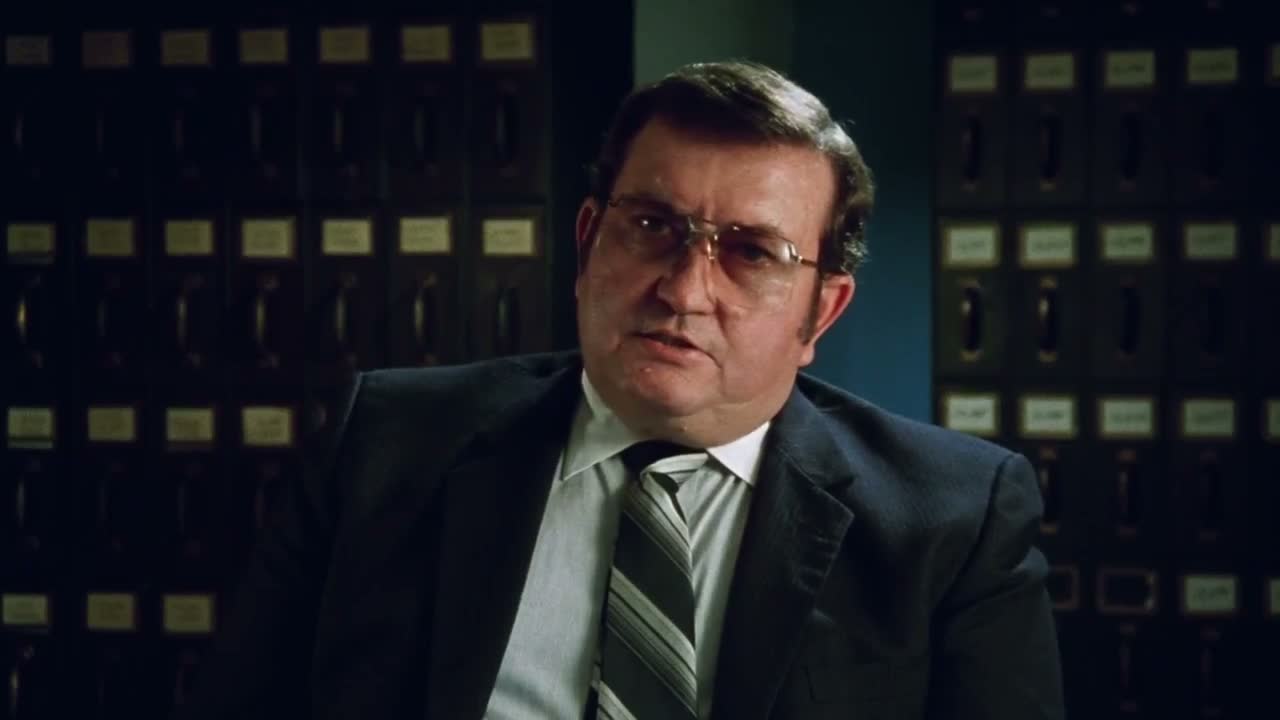
Detective Gus Rose wants Randall Adams to sign a confession, and Adams refuses. What follows is a standoff in a small room: a pistol thrown on the table, a service revolver drawn. "I do not like looking down the barrel of a pistol," Adams recalls. A second detective describes a suspect who showed no emotion at all.
The Confession Standoff at Gunpoint
The Detective Reads the Suspect
Randall Adams recounts the night police picked him up in Dallas, took him upstairs and left him in a small room. A detective brought in a confession for him to sign; Adams refused. The detective threw a pistol on the table, then pulled his service revolver. Adams describes staring down the barrel and the man's cold reaction.
The scene is a contest of wills inside a room the audience never sees. Adams says he kept telling the same story and nobody believed him, and the detective's method was pressure: "He didn't give a damn what I said. I would sign this piece of paper." The threat is physical — a pistol on the table, a service revolver drawn — but what Adams remembers is the boredom of it, the long stare, "I do not like looking down the barrel of a pistol." Against that, a second detective offers his own read on a suspect who stayed calm and "almost overacted his innocence." Two accounts, the same night, and no way to know which one to trust.
A1–C2 es la escala MCER. Las tarjetas por encima del nivel elegido se atenúan y la reproducción no se pausa en ellas.
“He didn't give a damn what I said. I would sign this piece of paper.”
It shows raw power: your words mean nothing, only your signature matters.
Informal
“I do not like looking down the barrel of a pistol.”
The calm understatement makes the fear land harder than a shout would.
Formal
“Never once was I allowed a phone call.”
Fronting the negative turns a plain fact into an accusation.
Formal
“Never once was an attorney there.”
The repeated inversion builds a rhythm of helpless, mounting denial.
Formal
“I found almost immediately that he didn't have much conscience.”
A quiet professional verdict that sounds more damning than outrage.
Neutral
 Siguiente · 03graveyard shiftLa escena: Officer Wood Shot at Traffic Stop
To close the case. A signed confession settles the investigation, so the detective keeps pushing for the signature even after Adams says he can't sign, and even after drawing his gun.
No. He refused repeatedly, and the pistol on the table plus the drawn revolver were meant to change that. In his account the detective eventually put the gun away and left, and no signature was ever given.
Literally, being at the wrong end of a gun. Adams uses it as understatement for a moment of real fear, said flatly rather than dramatically.
Another investigator's. He describes a suspect he sized up quickly as remorseless and calm, a man who 'almost overacted his innocence' — the kind of read that shaped how the case was built.