“A sentence is but a cheveril glove to a good wit.”
The glove image makes words stretchable, so twisting their meaning looks like skill rather than cheating.
literary
Capítulo 14 de 25 · 3'27"
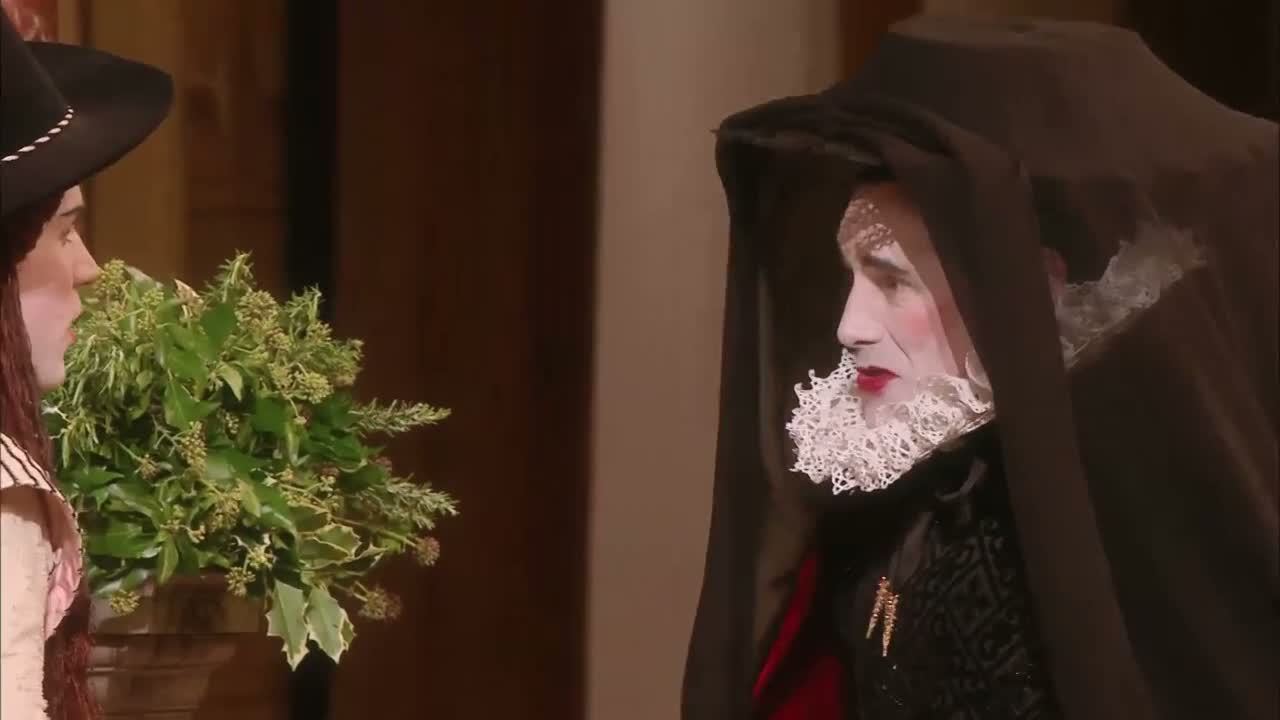
Feste and Viola trade wits before Olivia's house, and words themselves become the subject: a sentence is like a leather glove you can turn inside out. "Words are grown so false," the fool says, "I am loath to prove reason with them." It is a comic duel in which the servant out-talks his betters.
❝ Monólogo · 7 frases Viola on the Fool's Real Wisdom
Feste meets Cesario outside Olivia's house and they fence with words. The fool argues that anyone good with language can twist a sentence like a soft glove, until words themselves turn into liars: 'words are grown so false, I am loath to prove reason with them.' He denies being a fool and calls himself a corrupter of words, then wheedles coins from Cesario.
This is the play's wittiest scene about wit itself. Feste refuses to be called a fool, but his defence is a performance: he proves his cleverness by playing with the very words he says he distrusts, comparing a sentence to a 'cheveril glove' that a sharp mind can turn inside out. His line 'words are grown so false, I am loath to prove reason with them' is both a joke and a warning — in a play built on disguise, letters and mistaken identity, language is exactly what cannot be trusted. Viola, who is herself a living deception, hears the joke better than anyone and answers with the scene's best summary: 'This fellow is wise enough to play the fool.' The fool and the disguised woman recognise each other as performers.
A1–C2 es la escala MCER. Las tarjetas por encima del nivel elegido se atenúan y la reproducción no se pausa en ellas.
“A sentence is but a cheveril glove to a good wit.”
The glove image makes words stretchable, so twisting their meaning looks like skill rather than cheating.
literary
“And words are grown so false, I am loath to prove reason with them.”
Words have turned counterfeit, so he refuses to use them as proof, which is itself a witty paradox.
literary
“But wise men, folly fallen, quite taint their wit.”
The absolute phrase lets folly arrive like a fall, and the neat ending turns the joke into a warning.
literary
“They that dally nicely with words may quickly make them wanton.”
Playing with words makes them wanton: a whole ethic of language in one line.
literary
“Foolery, sir, does walk about the orb like the sun.”
Foolishness as the sun circling the globe: a grand metaphor for a silly truth.
literary
This fellow is wise enough to play the fool. And to do that well, craves a kind of wit. He must observe their mood on whom he jests, the quality of persons, and the time and, like the haggard, check at every feather that comes before his eye. This is a practise as full of labour as a wise man's art. For folly that he wisely shows is fit. But wise men, folly fallen, quite taint their wit.
Siguiente · 15I am not what I amLa escena: Olivia Confesses to CesarioHe plays the professional fool, but he insists he is not foolish. He calls himself 'a corrupter of words,' meaning his real skill is twisting language rather than being simple-minded.
He says people twist words to mean whatever they want, and since contracts and bonds misuse them, he finds language too false to argue with. That is why he jokes that words are rascals.
Welkin is an old word for the sky, so being 'out of my welkin' means beyond my world or my concern. Feste uses it to say who Cesario is and what he wants are not his business.
Watching the fool joke and dodge, Cesario sees that playing the fool well takes real intelligence. He says the fellow is 'wise enough to play the fool.'
He jokes about making the money breed by pairing the coins, and plays a literary game about Cressida and Troilus, turning his tip into a performance of begging.