
“But if you were the devil, you are fair.”
Por qué es buena
It grants beauty and suspicion in one breath, so the compliment cannot be taken at face value.
Registro
literary
Úsala tú
If you were a stranger, you would still be rude.
Capítulo 6 de 25 · 3'34"
Cesario brings Orsino's love and finds Olivia unmoved. She turns the praise back on the messenger with a joke: "I see you what you are. You are too proud." Her answer is flat and final — "I cannot love him" — yet she cannot stop listening, and asks the young man to come again.
❝ Monólogo · 5 frases Olivia Turns Down the Duke's Suit
Cesario delivers Duke Orsino's compliments to Olivia, calling her cruel for hiding her beauty from the world. Olivia refuses the suit firmly: 'I cannot love him.' Undeterred, Cesario describes what he would do if he loved her — build a willow cabin at her gate, sing all night, and call her name to the hills. Olivia is moved but still sends him back to his lord.
The scene turns a formal courtship into something more interesting: a refusal that isn't quite a refusal. Olivia lists Orsino's virtues at length — noble, wealthy, young, brave — and then cancels them all with one line: "But yet, I cannot love him." She is not playing hard to get; she means it. What changes the temperature is Cesario's speech about the willow cabin, where love becomes singing all night and calling a name to the hills. It is poetic, a little theatrical, and clearly not about Orsino at all — Cesario is imagining devotion itself. Olivia hears it and immediately softens, inventing a reason to see the messenger again. The comedy and the romance both sit in the gap between the polished embassy and the real feelings underneath it.
A1–C2 es la escala MCER. Las tarjetas por encima del nivel elegido se atenúan y la reproducción no se pausa en ellas.
“But if you were the devil, you are fair.”
It grants beauty and suspicion in one breath, so the compliment cannot be taken at face value.
literary
“'Tis beauty truly blent, whose red and white nature's own sweet and cunning high and laid on.”
It paints beauty as something nature mixed and laid on, which beats any plain compliment.
literary
“Oh, you should not rest between the elements of air and Earth, but you should pity me.”
It builds a romantic plea by denying the listener any resting place until pity arrives.
literary
“Oh, such love could be but recompense though you were crowned the nonpareil of beauty.”
Praise raised to nonpareil, then love still called mere repayment: flattery with a limit.
literary
“Lady, you are the cruellest she alive”
The cruellest she alive: an accusation so exaggerated it doubles as flirtation.
literary
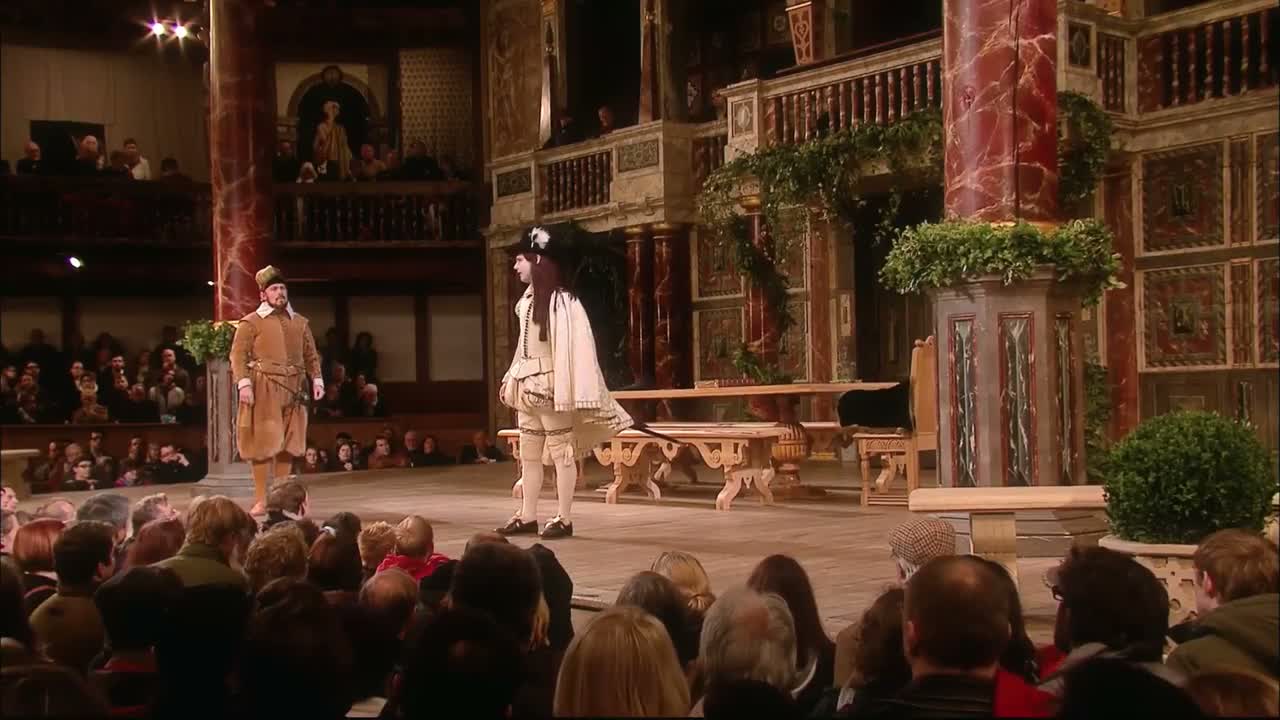
Your lord does know my mind. I cannot love him. Yet I suppose him virtuous, know him noble, of great estate, of fresh and stainless youth, in voices well divulged, free, learned, and valiant, and in dimension and the shape of nature, a gracious person. But yet, I cannot love him.
 Siguiente · 07could not butLa escena: Sebastian's Story and Olivia's Ring
She simply does not love him, no matter how noble or wealthy he is. She lists his good qualities and then says plainly, 'But yet, I cannot love him.'
Cesario imagines how he would woo Olivia if he were the suitor: a willow cabin at her gate, songs all night, and her name shouted to the hills.
It means the deepest, quietest part of the night. Cesario says he would sing 'even in the dead of night,' meaning he would not stop or hide his devotion.
Cesario's passionate speech moves her. She invents an excuse to see him again, asking him to return and tell her how Orsino takes the refusal.
She tries to reward him for his trouble, but he refuses, saying his master, not he, is the one who deserves reward.