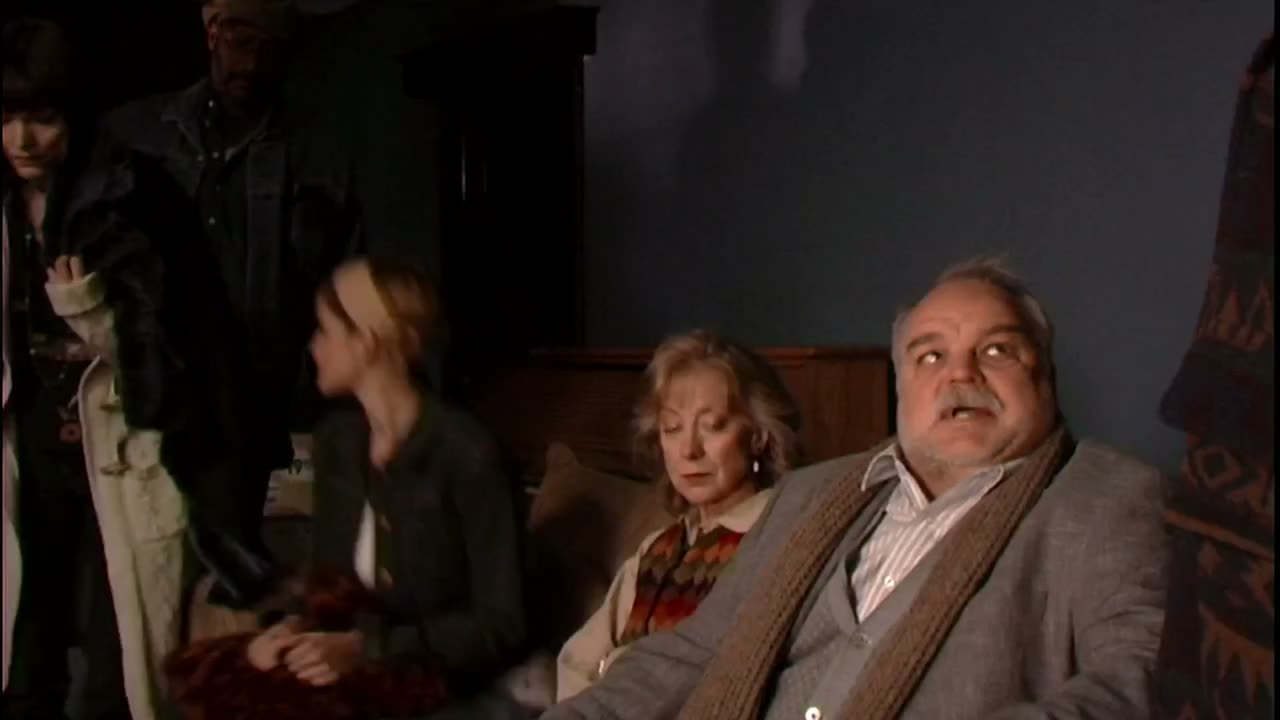
“You know, we stopped, fell down, didn't get up, Started to smell bad, come apart.”
Death becomes a short list of bodily facts, and that plainness is what makes it hard to shake.
Informal
Chapter 6 of 10 · 2'34"
Someone asks John what he thinks of dying and whether he fears it. The picture that follows is physical: people stop, fall, smell, and come apart. Underneath sits a harder claim, that everyone else ages and dies "but not me," while other people pass like "Ripples in a wheat field, blown by the wind."
❝ Monologue · 13 lines A Body Stops, Falls, and Comes Apart
❝ Monologue · 4 lines People Vanish Like Wheat in the Wind
The Question of Survivor's Guilt
John is asked whether he fears death and how primitive people regarded it. The reply is physical: people fall, smell, and come apart, while injuries make sense and aging does not. A line adds that others grow old and die, but not the speaker. Time is called turbulence: meet someone, learn a name, say a word, they are gone, like ripples in a wheat field.
Someone keeps asking John what dying means to him: fear, primitive ideas, a day versus a century. The answers stay blunt. A body stops, falls, smells, and comes apart. Injuries are understandable. Infection is "mysterious." Aging is "The biggest mystery of all." The bluntness turns personal. Others age and die, "but not me." Things follow. "I've owned castles, but why leave a lot if you're always leaving?" People do too. "I meet someone, learn their name, say a word, they're gone." The next image is "Ripples in a wheat field, blown by the wind." Company does not last. A complaint that they repeat the same mistakes gets the pronoun thrown back: "They." The following line names the split, "separate from the rest of humanity." "I didn't mean it that way." gives way to "I am." Asked if it is comfortable that everyone known has died, guilt "akin to survivor's guilt" is allowed, then left at "But what can I do about it?"
A1–C2 is the CEFR scale. Cards above the level you pick fade, and playback will not auto-pause on them.
“You know, we stopped, fell down, didn't get up, Started to smell bad, come apart.”
Death becomes a short list of bodily facts, and that plainness is what makes it hard to shake.
Informal
“I've owned castles, but why leave a lot if you're always leaving?”
The same verb first means keeping wealth and then means never staying, so the fortune loses its point.
literary
“I meet someone, learn their name, say a word, they're gone.”
Four quick steps shrink a whole meeting into a name, a word, and an exit.
literary
“They keep making the same stupid mistakes over and over.”
The insult and the repetition lock the judgment shut, which is why the next line can pounce.
Informal
“Then you see yourself as separate from the rest of humanity.”
It turns a loose they into a verdict: you have stood yourself outside everyone else.
Formal
“Are you comfortable knowing that you have lived while everyone you knew - Everyone you knew, John! - has died?”
The name breaks into the sentence so the question hits the man, not the idea of death.
Formal
Well, we had the practical concept. You know, we stopped, fell down, didn't get up, Started to smell bad, come apart. Injuries we could understand. If someone's insides were all over the ground. Infections... They were, uh, mysterious. Aging... The biggest mystery of all. You realized you were different. Longer to realize how I was different, to find a way to synthesize my experience into a view of myself. At first, I thought everybody had something wrong with them. They got old and they died, animals, too... but not me.
Turbulence. I meet someone, learn their name, say a word, they're gone. Others come like waves. Rise, fall. Ripples in a wheat field, blown by the wind.
Up next · 07on the ropesThe scene: Will's Wife Just DiedSomeone asks how primitive man regarded death. The answer calls it a practical concept: people stopped, fell down, did not get up, started to smell, and came apart. Injuries were understandable when a person's insides were on the ground. Infection is called mysterious, and aging the biggest mystery of all.
A line notes "You live simply." The reply is "I've owned castles, but why leave a lot if you're always leaving?" Right after that come "I have money" and a question about getting into AT&T at 50 cents. The reason given is that constant leaving makes a large holding useless.
A day, a year, or a century has just been called turbulence. The lines before the wheat field say: meet someone, learn their name, say a word, they're gone; others come like waves, rise and fall. "Ripples in a wheat field, blown by the wind" is that same coming and going.
It repeats the subject of "They keep making the same stupid mistakes over and over." The next sentence states the implication: "Then you see yourself as separate from the rest of humanity." What follows denies it, "I didn't mean it that way," and then accepts it, "But of course... I am."
After the question about living while everyone known has died, someone asks if there has been guilt "akin to survivor's guilt." One reply narrows it: "In the strict psychological sense?" The next is "I suppose I have," plus "Yeah." It ends on "But what can I do about it?" The guilt is granted, then left standing.