
“You're so... you're so money, and you don't even know it.”
Why it's great
One slang word plus a stutter of you're so makes the praise feel sincere and urgent.
Register
Informal
Use it yourself
You're so ready for this and you don't even know it.
Chapter 12 of 17 · 4'21"
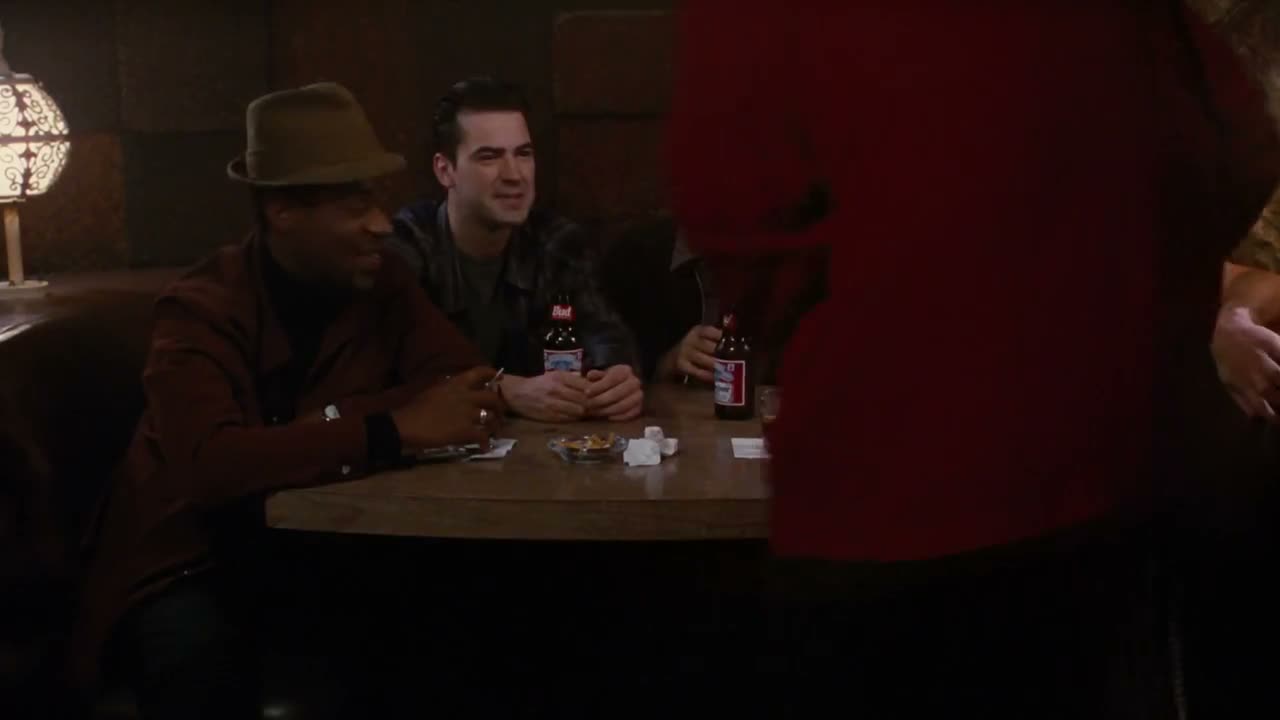
Mike bombs with a girl at the bar and calls himself a fool; his friends refuse to let him mope. "You're so money, and you don't even know it," one insists, then paints him as a big bear with claws and fangs who can only gently bat around a scared little bunny. Their cure is simple: go get her digits.
❝ Monologue · 16 lines Trent's Bear and Bunny Pep Talk
❝ Monologue · 10 lines the bad-man pep talk
Movie ratings become a pep talk, turning warm advice into a playable mission.
At a bar, Mike tries to flirt with a woman but realizes he recognizes her from a Starbucks where he once asked for a job, so the talk turns awkward fast. His friends, led by Trent, tell him he is 'money' and use a bear-and-bunny metaphor, then push him to go get the girl's number.
The joke and the comfort are the same scene. Mike is humiliated because he wanted to be seen as a smooth ladies' man and was instead recognized as the guy who once asked for a job at a Starbucks. He says it plainly — "She didn't like me, okay? I made a fool of myself" — and what his friends do next is the film's idea of friendship: they simply refuse the verdict. The bear-and-bunny metaphor is absurd on purpose. Mike is not a predator; he is a man so unsure of himself that, holding claws and fangs, he cannot work out how to catch a harmless bunny. Labeling him "so money" is not a compliment about wealth but an attempt to give him a self-image worth acting on, and the pep talk ends with a task, not a feeling: go over and get her digits.
A1–C2 is the CEFR scale. Cards above the level you pick fade, and playback will not auto-pause on them.
“You're so... you're so money, and you don't even know it.”
One slang word plus a stutter of you're so makes the praise feel sincere and urgent.
Informal
“Alright. I want you to go over to that girl and I want you to get those digits.”
The doubled I want you to turns a pep talk into a direct order you can act on.
Informal
“You know, I was Hamlet two months ago Off-Broadway, and I was good.”
Name-dropping Hamlet and then rating himself is vanity made funny by its honesty.
Informal
“She didn't like me, okay? I made a fool of myself.”
Two lines of surrender: she did not like me, and I made a fool of myself. Defeat and self-mockery at once.
Informal
You know what you are? You're like a big bear with claws and with fangs, man. - Big fuckin' teeth, man. - Yeah, big fuckin' teeth on ya. She's just like this little bunny who's just kinda cowering in the corner. - Shivering. - Yeah, man, just kinda... You know, you got these claws and you're staring at these claws, man. And you're thinkin' to yourself... with these claws, you're thinkin', "How am I supposed to kill this bunny?" And you're pokin' at it, man. You're pokin' at it. Yeah, you're not hurtin' it. You're just kinda gently battin' the bunny around. You know what I mean? And the bunny's scared Mike. The bunny is scared of you. - And it's shivering. - You got the fucking claws! These claws and these fangs, man! You're looking at your claws and you're looking at your fangs. You're thinking to yourself, "I don't know what to do, man. I don't know how to kill the bunny." With this, you don't know how to kill the bunny! Do you know what I mean. You're like a big bear, man.
Alright. I want you to go over to that girl and I want you to get those digits. - You're money. - Come here a second. Listen to me. Look it, when you go up to talk to her, man... I don't want you to be the guy in the PG-13 movie... everyone's really hoping makes it happen. I want you to be like the guy in the rated-R movie, you know? The guy you're not sure whether or not you like yet. You're not sure where he's coming from, okay? You're a bad man. You're a bad man. You're a bad man. Bad man.
 Up next · 13industry standardThe scene: The Three-Day Rule for Calling
He tried to flirt with a woman but recognized her as the Starbucks employee who once took his job application. His attempt to explain the coincidence only made the encounter more awkward.
He says Mike is a big bear with claws and fangs who cannot bring himself to catch a harmless bunny: Mike has every advantage but no belief, so he only gently bats the girl around.
They think his self-image is the problem, not his looks or charm. By calling him 'money' and telling him he is a 'bad man,' they try to replace his story of failure with one worth acting on.
He turns the pep talk into a specific task. Getting her number would prove the new image right and force Mike to act instead of talking himself down.