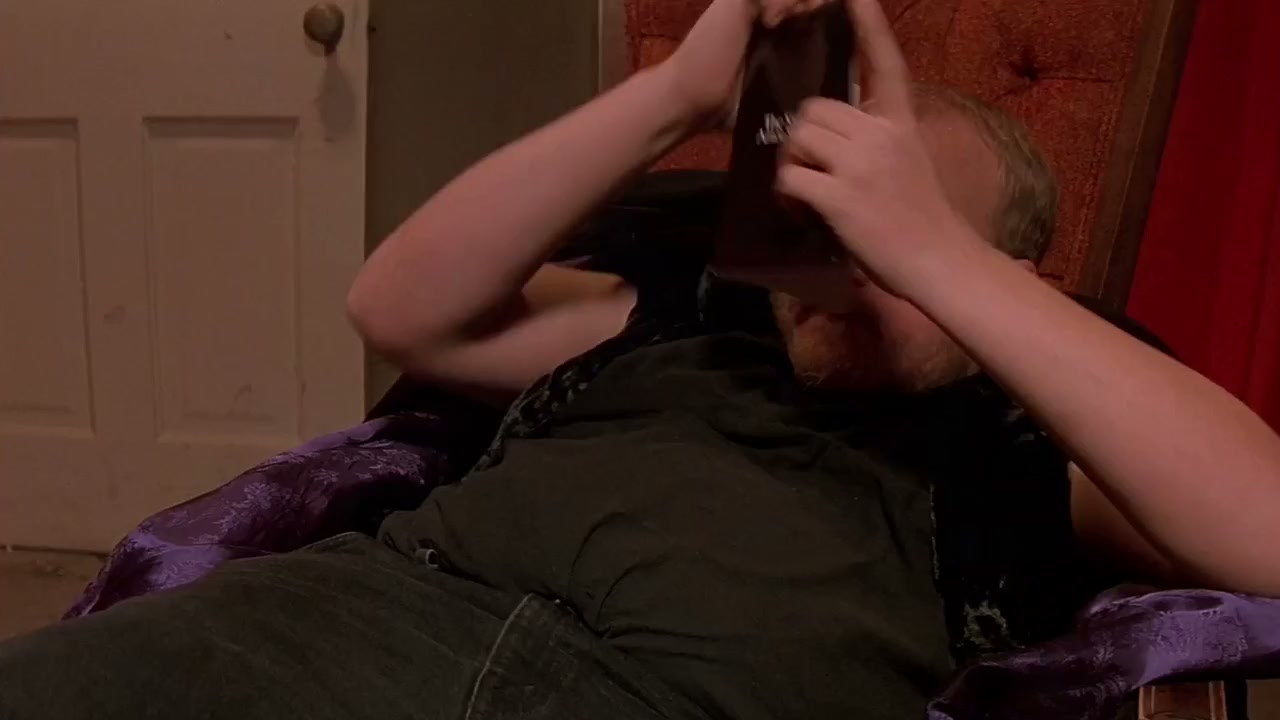
“No clearer way to evaluate whether or not you're alive.”
A flat essay voice states a violent test without raising the volume, and that calm is what makes the line stick.
literary
Chapter 7 of 10 · 2'06"
A voice turns fighting into an essay. On the surface it asks what a fight means and why a man alone in the universe hits someone else. Underneath, "Final analysis. To fight: A reason to live" collides with the claim that reasoned fighting builds the government an anarchist says he rejects.
❝ Monologue · 19 lines To Fight Is a Reason to Live
The Ladder Ends at None
Someone delivers an essay on fighting. A punk, still a man, is alone and connects by hitting others. Pain becomes proof of life. The verdict is that to fight is a reason to live. He then calls himself an anarchist who wants no rules, only chaos, and admits that a fight with a reason creates a system, which is government, not anarchy. He framed it and still does not understand.
The monologue pretends to be a proof and then eats itself. A man alone in the universe has one connection: "They hit each other." Pain is not a side effect. "Life is pain," so a fight with a reason becomes life with a reason, and the verdict follows: to fight is a reason to live. The second half will not let that stand. The speaker calls himself an anarchist who believes "there should be no rules, only chaos." A pit at a show can stay chaos. A fight against someone different, taken on for a cause, has a system. Fighting for chaos is still a structure; structure establishes power; power is government; government is war; war is fighting. Even freedom, once forced on someone else, "is still a rule." In the fall of '85 the contradiction was becoming clear. He framed it and still does not understand it. "It goes against my beliefs as a true anarchist, but there it was." Asked for the point, the essay answers "None."
A1–C2 is the CEFR scale. Cards above the level you pick fade, and playback will not auto-pause on them.
“No clearer way to evaluate whether or not you're alive.”
A flat essay voice states a violent test without raising the volume, and that calm is what makes the line stick.
literary
“Now, to fight is a reason to feel pain. Life is pain.”
The second sentence shrinks to three beats, so the idea lands as a stamp instead of a discussion.
literary
“Final analysis. To fight: A reason to live.”
Final analysis dresses a fragment like a finished proof, which is why the short stamp stays in the ear.
literary
“I believe that there should be no rules, only chaos.”
A full belief-clause runs straight, then two blunt words shut the door.
literary
“We fight for what we stand for... chaos. But fighting is a structure.”
The ellipsis holds the breath, and the shorter second sentence drops into a dry shrug.
literary
“It goes against my beliefs as a true anarchist, but there it was.”
The first half keeps a long level pace, and the last four words break it with a blunt stop.
Informal
Problems and contradictions: I am an anarchist. I believe that there should be no rules, only chaos. Fighting appears to be chaos, and when we slam in a pit at a show, it is. But when we fight for a reason, like rednecks, there is a system. We fight for what we stand for... chaos. But fighting is a structure. Fighting is to establish power, power is government... and government is not anarchy. Government is war, and war is fighting. The circle goes like this: Our redneck skirmishes... are cheaper versions of conventional warfare. War implies extreme government... because wars are fought to enforce rules or ideals, even freedom. But other people's ideals forced on someone else... even if it is something like freedom, is still a rule. Not anarchy. This contradiction was becoming clear to me in the fall of '85. Even as early as my first party, why did I love to fight? I framed it, but I still don't understand it. It goes against my beliefs as a true anarchist, but there it was.
Up next · 08getting oldThe scene: Punks Debate Structure and ChaosA man alone in the universe connects when people hit each other. The voice says there is "No clearer way to evaluate whether or not you're alive," then ties a fight to pain and pain to life: to fight with reason is to be alive with reason. The verdict is "To fight: A reason to live."
He says he believes there should be no rules, only chaos. Slamming in a pit at a show can be chaos, but a fight for a reason has a system. Fighting establishes power, power is government, and government is not anarchy. Forcing an ideal on someone, even freedom, is still a rule.
"The circle goes like this": the skirmishes are cheaper versions of conventional warfare. War means extreme government, because wars enforce rules or ideals, even freedom. That return to a rule is what he has already called not anarchy.
He lists groups taking turns beating the next, from rednecks and punks through mods, skinheads, and metal guys, down to new wavers who did nothing and were the new hippies. He asks what the point is, calls it a final summation, and answers, "None."
No. He says the contradiction was becoming clear in the fall of '85, even as early as his first party. He framed it and still does not understand it. It goes against his beliefs as a true anarchist, but there it was.