
“I know what it's like to be sick, Sylvia.”
Why it's great
She claims shared suffering to soften the cruelty she is about to justify.
Register
Neutral
Use it yourself
I know what it's like to lose a job you loved.
Chapter 13 of 16 · 2'53"
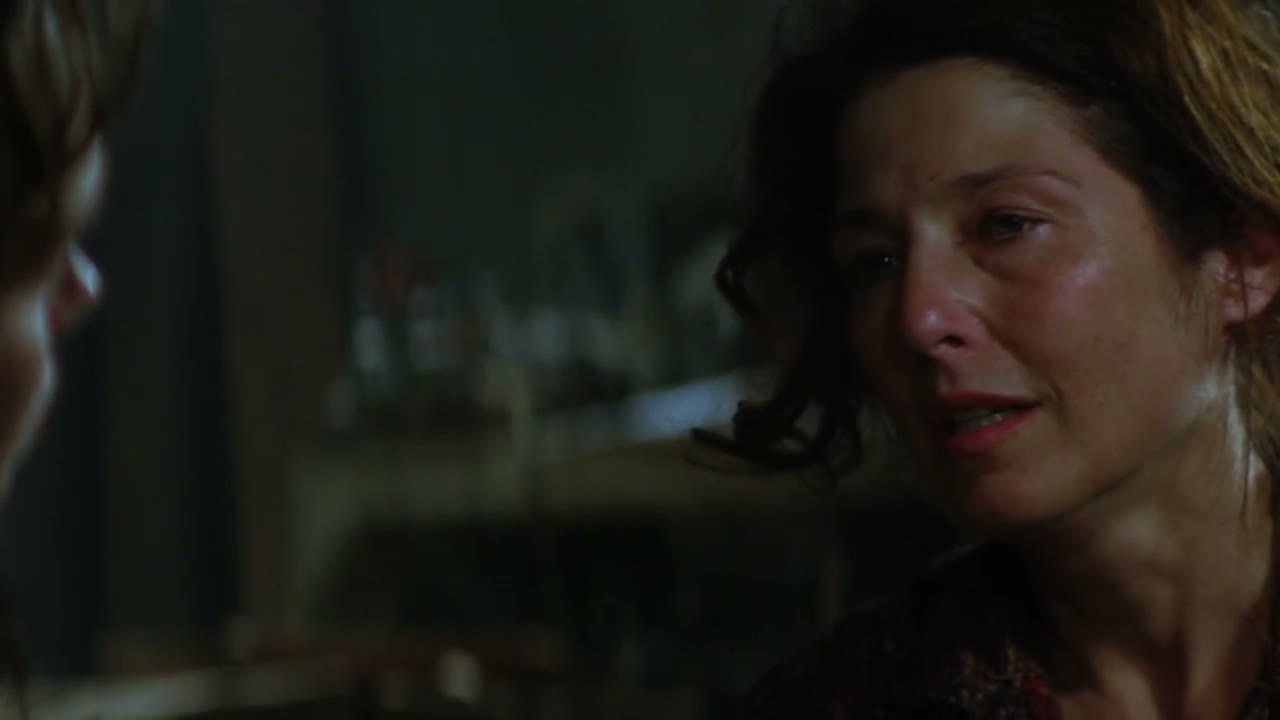
Alone with Sylvia, Gertrude says she won't hurt her — then spends the scene explaining herself: her sickness, her children, the husband who left. "I know what it's like to be sick, Sylvia" is how she opens the door, and the whole speech is really a case for why she can't be blamed.
Gertrude Says She Won't Hurt Sylvia
Gertrude Explains Why She Can't Stop
In the basement, Gertrude sits with Sylvia and tells her she isn't going to hurt her. What follows is Gertrude's own story: she has been sick for a long time, can't discipline her kids, and barely knows what she's doing when she takes her medicine. She talks about Paula, born when she was about Sylvia's age, the children who came after, and the husband who left.
The scene is a confession that never admits anything. Gertrude keeps saying she won't hurt Sylvia, which only makes sense because Sylvia has every reason to expect it. Then she turns the room into her own story: illness, exhaustion, children she can't control. "I'm punishing you I known, but..." is as close as she gets to owning it — and she immediately blames her medicine. From there the speech builds a defense: she had Paula at Sylvia's age, she's doing everything to keep her family together, she needs to protect her children. The logic quietly puts Sylvia outside that family, as a threat to it. "These kids... they're all I've got" frames every cruelty as survival.
A1–C2 is the CEFR scale. Cards above the level you pick fade, and playback will not auto-pause on them.
“I know what it's like to be sick, Sylvia.”
She claims shared suffering to soften the cruelty she is about to justify.
Neutral
“There has to be something better.”
It turns despair into a stubborn refusal to accept things as they are.
Neutral
“And I need to protect my children.”
She turns harm into protection, the confession's most chilling excuse.
Neutral
“And I care for you, so much.”
Affection is used to dress up control and cruelty.
Informal
 Up next · 14get to the bottom of somethingThe scene: Reverend Collier Visits Gertrude
She's justifying herself. Instead of apologizing, she explains her illness, her children, and her fear of losing her family, so the punishment seems forced on her.
She says she has been sick a long time and that her medicine leaves her not knowing what she's doing. The film leaves it unclear how much is illness and how much is excuse.
She says so — "I had her, when I was, just about your age." It's part of how she links Paula to Sylvia and explains why she treats Sylvia as a bad influence.
No. Gertrude does all the talking. Sylvia's silence is the scene's point: she has no power to answer or to leave.