
“It seemed to me I was hearing the voice of God.”
Por qué es buena
It turns an overwhelming musical feeling into a single religious image.
Registro
literary
Úsala tú
It seemed to me I was standing in a cathedral.
Capítulo 4 de 25 · 4'02"
Salieri describes a Mozart melody to the priest: the winds creep in like a rusty squeezebox until an oboe rises above them, and he calls it the voice of God. Then he turns on the same God: "Why would God choose an obscene child to be his instrument?" In Vienna, the court weighs Mozart's gifts against his excess.
❝ Monólogo · 7 frases Salieri Hears the Voice of God
The Court Debates Mozart
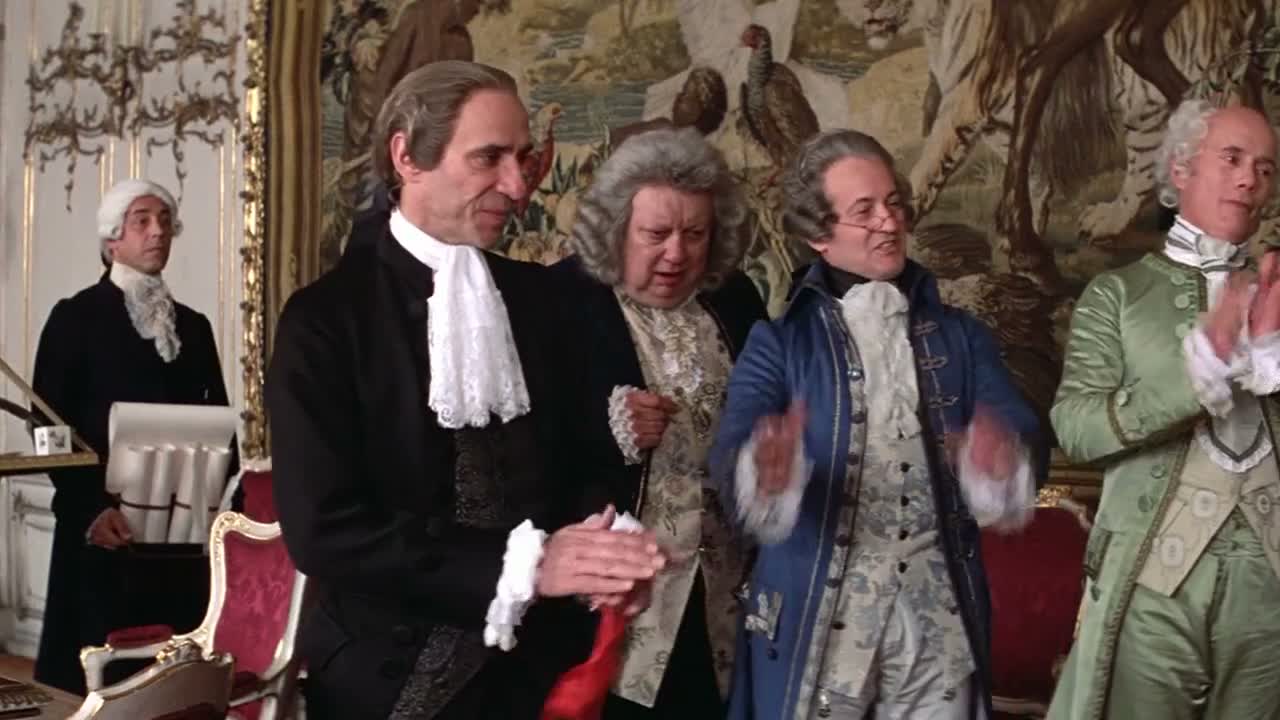
In the asylum, Salieri tells Father Vogler about a Mozart piece that first sounds ordinary - like a rusty squeezebox - then lifts into a single unwavering oboe note. He says it made him feel he was hearing the voice of God, and asks why God would choose an obscene child as his instrument. At court, the Emperor and his advisers debate Mozart's Idomeneo and decide to invite him to Vienna.
The scene runs on a contradiction Salieri cannot resolve. He hears a piece so pure that it seems divine - "It seemed to me I was hearing the voice of God" - yet the man who wrote it is, in his eyes, vulgar and childish. His question, "Why would God choose an obscene child to be his instrument?", is not really about Mozart; it is the beginning of his grievance against heaven. The cut to the court makes the same puzzle social. The Emperor's men measure Mozart by taste and manners - too much spice, too many notes - and nearly talk themselves out of hiring a genius. Salieri, still praising him, quietly keeps himself in the middle of the decision.
A1–C2 es la escala MCER. Las tarjetas por encima del nivel elegido se atenúan y la reproducción no se pausa en ellas.
“It seemed to me I was hearing the voice of God.”
It turns an overwhelming musical feeling into a single religious image.
literary
“Why would God choose an obscene child to be his instrument?”
It frames jealousy as a theological puzzle: genius in a filthy child.
literary
“He's remarkable,Majesty. I heard an extraordinary opera of his last month.”
Two weighty adjectives make the praise formal and sincere.
Formal
“A young man trying to impress beyond his abilities.”
A participle phrase sums up overreach, cutting and polite at once.
Formal
“We could use a good German composer in Vienna,surely?”
Could use makes a hiring plan sound casual, but the politics are obvious.
Neutral
Filled with such longing, such unfulfillable longing. It seemed to me I was hearing the voice of God. Excuse me. But why? Why would God choose an obscene child to be his instrument? It was not to be believed. This piece had to be an accident. It had to be.
 Siguiente · 05down to businessLa escena: Mozart Meets the Emperor
A melody by Mozart, starting with winds that sound almost comic and then rising to a single oboe note. He tells Father Vogler it made him feel he was hearing the voice of God.
He means it as an insult about Mozart's crude behavior and humor, not his age. To Salieri the man is vulgar, which is why the beauty of his music feels like a divine injustice.
It is Italian for bad or wicked, said with a smile. The Emperor is teasing Salieri for praising Mozart while clearly working to keep his own position safe.
They admire his talent but distrust his taste. One adviser calls Idomeneo tiresome and overstuffed, and the debate turns on whether opera should be in German rather than on Mozart himself.
He decides to bring him to Vienna, saying he wants to meet the young man and asking for a pleasant welcome. He also proposes a German opera for the National Theater, setting up the conflict to come.