
“Do you not know that His Majesty has expressly forbidden ballet in operas?”
Por qué es buena
The rhetorical question uses a rule as a club, condescending and final.
Registro
Formal
Úsala tú
Do you not know that parking here is banned?
Capítulo 18 de 25 · 2'58"
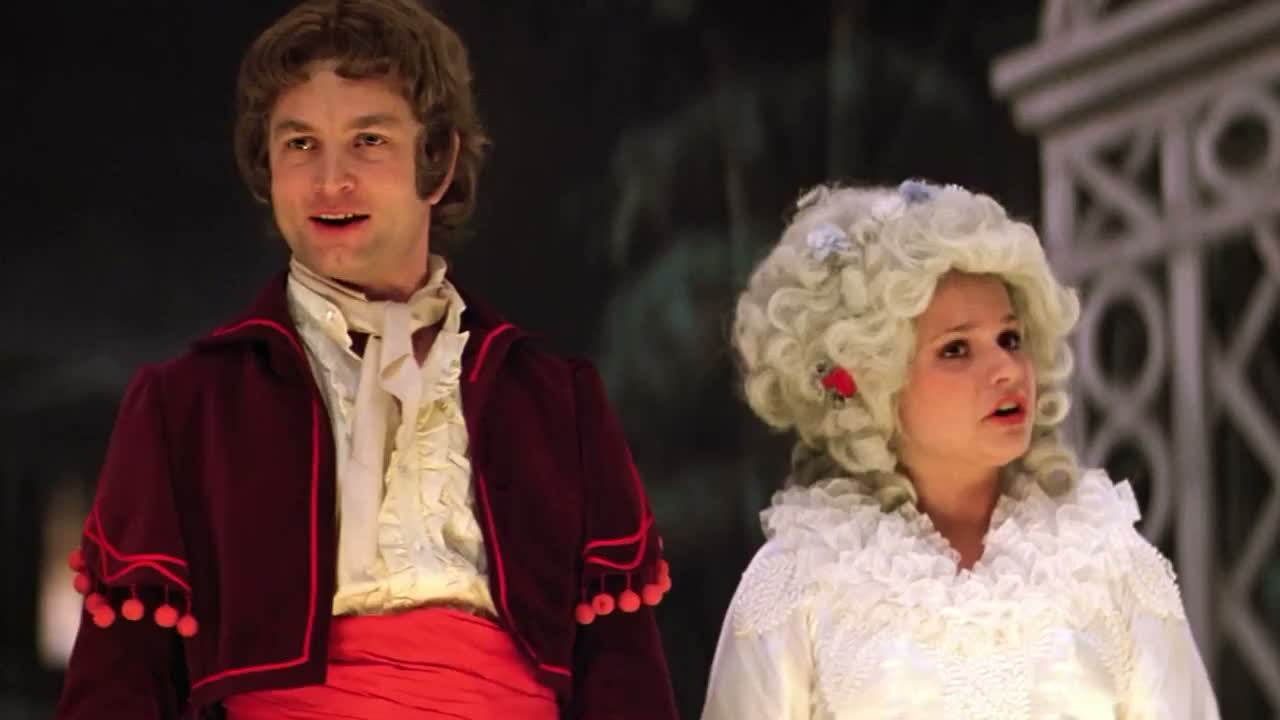
Officials cut the ballet from Mozart's new opera, and he is furious: "Do you not know that His Majesty has expressly forbidden ballet in operas?" Mozart insists it is only a dance, but the argument is really about who gets to decide what art may contain.
The Emperor's Ballet Ban
Mozart Has No One to Turn To
Backstage at the opera, the court director confronts Mozart about the dance he has slipped into the third act of Figaro. The Emperor has banned ballet in operas, and the pages are torn from the score. Later, furious and humiliated, Mozart tells a sympathetic visitor that the opera is perfect as it is, and that he cannot rewrite what is perfect.
On the surface this is a bureaucratic quarrel about a dance. Underneath, it is a fight over power and ownership: who is allowed to decide what an artist may put in his own work. Mozart's plea, "Surely, His Majesty didn't mean no dancing when it's in the story," is reasonable on paper and useless in practice; the director answers that it is "dangerous to interpret his edicts" and simply removes the pages. What stings is not the edit itself but the humiliation, and Mozart says so plainly: "It's unfair that a man like that should have power over our work!" The quieter turn comes when he admits he has no one else to turn to. For all his genius, he has no real standing at court, and the scene keeps reminding us that talent and influence are not the same thing.
A1–C2 es la escala MCER. Las tarjetas por encima del nivel elegido se atenúan y la reproducción no se pausa en ellas.
“Do you not know that His Majesty has expressly forbidden ballet in operas?”
The rhetorical question uses a rule as a club, condescending and final.
Formal
“I have no one else to turn to.”
A plain line that shows complete helplessness.
Neutral
“But it's perfect as it is.”
As it is rejects any change without room for argument.
Neutral
“I could kill him! I mean,really! Kill him!”
Repeating kill him three times turns fury into a comic crescendo.
Informal
“It's unfair that a man like that should have power over our work!”
The should-clause turns personal anger into a question about fairness.
Formal
 Siguiente · 19accept the factLa escena: Salieri Explains the Emperor's Yawns
The Emperor has expressly forbidden ballet in operas. When the court director learns that Mozart has slipped a dance into the third act of Figaro, he tears those pages out of the score on the spot.
No. "I could kill him" is pure frustration about the official who cut his music; he says it to show how humiliated he feels, not as any kind of plan.
He believes the work is already perfect as it is, and he tells his visitor that he cannot bring himself to rewrite what is perfect.
He believes the Emperor is the only person who can overrule the ban, and he has no other ally with enough standing at court to make that case for him.