
“Yes! You don't know where you are.”
Por qué es buena
A plain line that teases someone for being lost, playful rather than cruel.
Registro
Informal
Úsala tú
Relax, you don't know where you are yet.
Capítulo 3 de 25 · 2'21"
Mozart turns everything backwards — walking, singing, even the talk — and hides a real question inside the game. "Marry me" arrives as a joke, meets a flat "I'm not gonna marry you," then finally flips into "But I love you."
Everything Goes Backwards in Mozart's World
Marry Me, Said Backwards
Alone together, Mozart and Constanze kill time by turning everything backwards. In their game, people walk, dance, sing and even talk in reverse. It builds to a sideways proposal — "Marry me" — which is turned down flat, until a reversed "But I love you" finally slips out.
On the surface it's two people being silly with a party trick. Underneath, Mozart is doing what he always does: refusing to be serious, because seriousness is where he loses. He can't simply say he loves Constanze or ask her to marry him, so he buries it in a game — "Marry me" and "But I love you," both hidden inside backwards words. Constanze plays along and answers just as sharply, "I'm not gonna marry you," which is less a rejection than a dare. Both of them use the game as cover: they can flirt, insult and even propose, and if it goes wrong they can pretend they were only joking. The joke is the only way either of them can mean it.
A1–C2 es la escala MCER. Las tarjetas por encima del nivel elegido se atenúan y la reproducción no se pausa en ellas.
“Yes! You don't know where you are.”
A plain line that teases someone for being lost, playful rather than cruel.
Informal
“People walk and dance and sing and even talk backwards.”
A pile of verbs paints the absurd picture and makes the rule easy to remember.
Informal
“Yes,you are. You are very sick.”
She answers the nonsense straight-faced, and the joke is in the deadpan.
Informal
“I'm not gonna marry you. You're a fiend.”
Casual gonna plus a mock-serious fiend turns a refusal into play.
Informal
“- I'm not playing! - Say it,it's serious.”
The clash between quitting and insisting it is serious makes the joke.
Informal
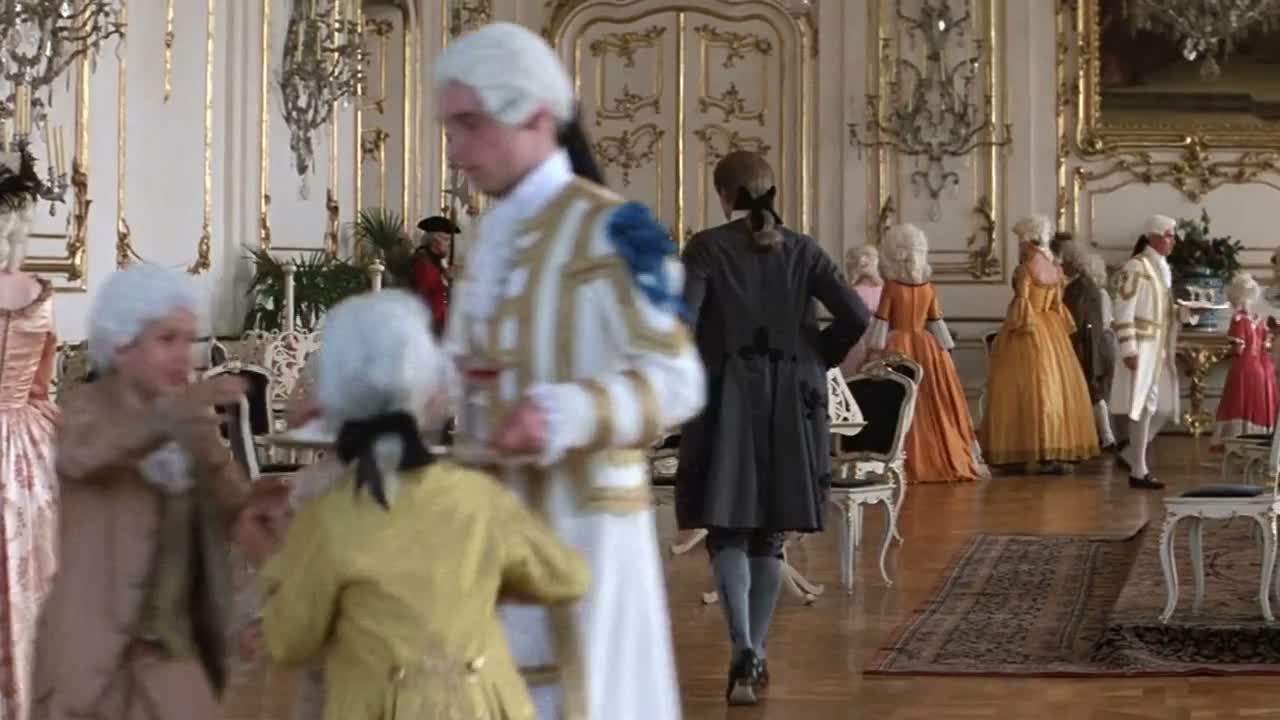 Siguiente · 04beyond his abilitiesLa escena: Salieri Hears the Voice of God
It's his whole way of being: he refuses the court's idea of dignity, so he turns the world upside down for fun. The backwards talk is him showing off — and hiding what he actually wants to say.
No — it's part of the game. Calling him a fiend and refusing to marry him are the teasing she does instead of saying yes, while the reversed "But I love you" shows where she really stands.
Literally a monster or a wicked person, but here it's affectionate name-calling: a lover's insult that means the opposite. It keeps the flirtation at arm's length while letting the real feeling show.
Both. Coded into the backwards game, "Marry me" can be laughed off if the answer is no, and kept if it's yes. The reversed "But I love you" is the moment the joke stops being only a joke.