
“I will hinder and harm your creature on earth...”
Por qué es buena
Two verbs in a formal oath turn jealousy into a declared war.
Registro
literary
Úsala tú
I will hinder and harm nothing that is honest.
Capítulo 12 de 25 · 3'42"
Alone, Salieri renounces God and vows, "From now on, we are enemies." He promises to hinder and harm God's creature and swears it. Then he goes to the Emperor and quietly accuses Mozart of improper conduct with a pupil. When Mozart appears to beg for help, the man he is sabotaging is the same man he is plotting against.
❝ Monólogo · 12 frases Salieri Declares War on God
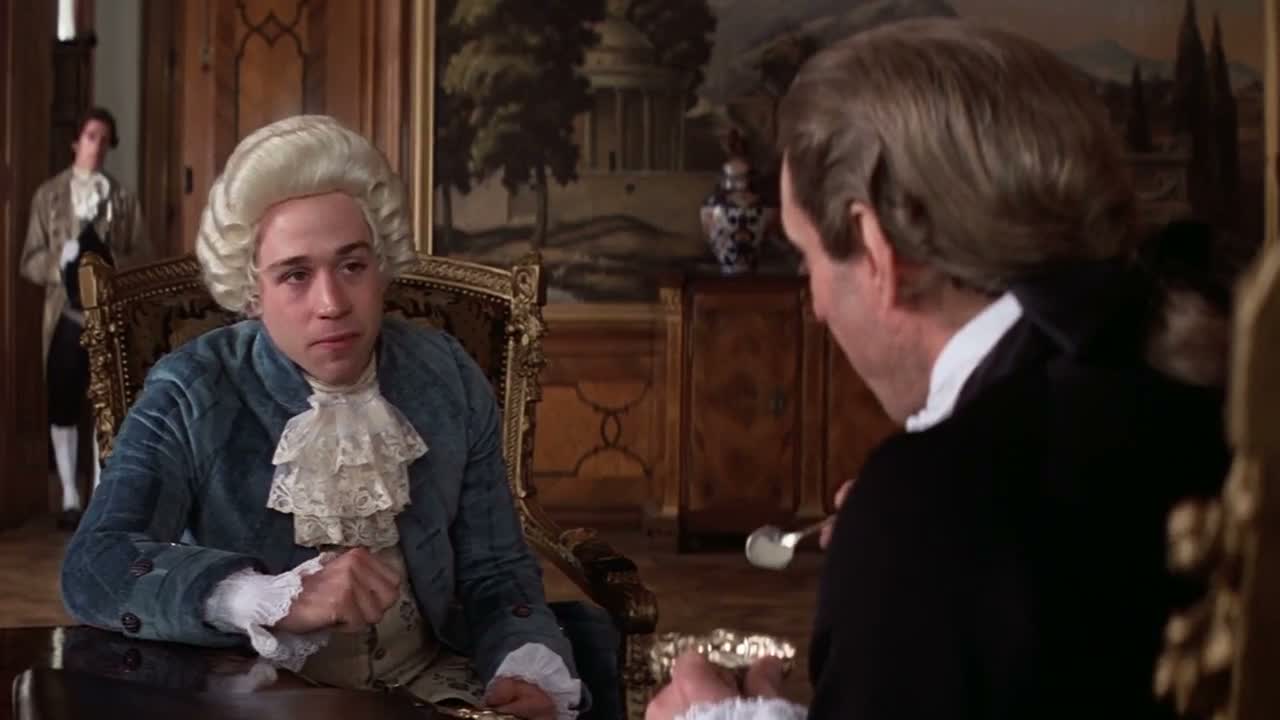
Alone in his room, Salieri renounces God for giving genius to a vulgar boy and vows that from now on they are enemies. He swears to hinder and harm God's creature on earth. He then tells the Emperor that Mozart cannot be trusted alone with young ladies. Soon Mozart arrives, desperate: he has lost the post to a mediocrity and asks Salieri for help - and for a loan.
Salieri's war is declared in private and fought in public. The vow - "From now on, we are enemies" - is aimed at God, but every move that follows lands on Mozart, who never learns he is the target. The slander to the Emperor shows the method: he does not attack the music, which cannot be beaten, but the man, claiming Mozart "is not entirely to be trusted alone with young ladies." Meanwhile Mozart comes to Salieri as a supplicant, broke and begging for a loan, because he still believes the court composer is a colleague. The scene's cruelty is structural: Salieri is both the man Mozart asks for help and the man engineering his failure.
A1–C2 es la escala MCER. Las tarjetas por encima del nivel elegido se atenúan y la reproducción no se pausa en ellas.
“I will hinder and harm your creature on earth...”
Two verbs in a formal oath turn jealousy into a declared war.
literary
“Mozart is not entirely to be trusted alone with young ladies.”
Not entirely leaves a polite gap that is enough to ruin a reputation.
Formal
“No,no. He has yet to achieve mediocrity.”
Saying he has yet to reach mediocrity insults him through a backhanded standard.
Formal
“I can't lose this post. I simply can't.”
Repeating the sentence with simply turns panic into a refrain.
Informal
“You don't mean you're living in poverty?”
Don't mean pretends disbelief while naming the poverty out loud.
Informal
From now on,we are enemies. You and I. Because you choose for your instrument... ... a boastful,lustful,smutty,infantile boy... ... and give me for reward only the ability to recognize the incarnation. Because you are unjust... ... unfair... ... unkind... ... I will block you. I swear it. I will hinder and harm your creature on earth... ... as far as I am able.
 Siguiente · 13explode like a bombLa escena: Mozart Borrows Money From Salieri
Because God gave genius to Mozart, a man Salieri finds vulgar and unworthy, while granting Salieri only the ability to recognize that genius. He decides to take revenge on the creator through the creature.
He cannot compete with Mozart's music, so he attacks his reputation. The accusation about a pupil is vague enough to plant doubt without a formal charge, which is exactly how it damages Mozart.
Mozart is broke despite successful concerts, because no one will hire him or let him teach their daughters. He still trusts Salieri enough to ask him for money.
The committee passes him over for Herr Zummer, whom Mozart calls a fool. The rejection reflects how the court prefers safe, unthreatening mediocrity to a difficult genius.
No. He listens, offers sympathy and sends Mozart away when the music starts. His vow to hinder and harm God's creature is being kept even while Mozart believes he has an ally.