
“Every action is a positive action.”
Why it's great
A flat slogan that labels even destruction positive, which makes it both funny and chilling.
Register
Neutral
Use it yourself
Every rehearsal is a positive action, even the bad ones.
Chapter 18 of 22 · 3'13"
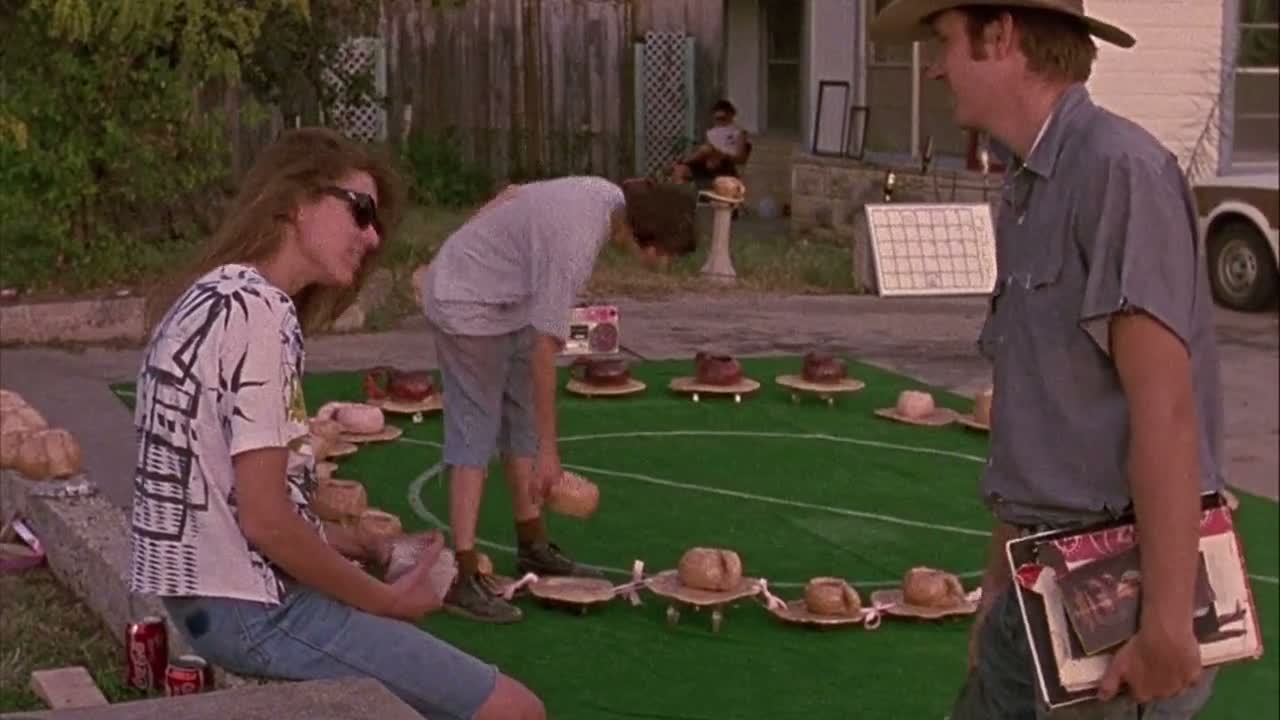
One man hands over a dubbed tape and rants about the myth that most of the brain goes unused. Then a woman offers oblique strategy cards, asking a passer-by to think of something and draw one. The cards deliver lines like "It's not building a wall, but making a brick."
❝ Monologue · 8 lines A Short Life in a Blaze of Glory
A man passes on a dub of a tape and argues that the idea of dormant potential, of unused brain power, only frustrates people. He praises a film where a man goes out in a blaze of glory. Later, a woman offers oblique strategy cards and lets people draw one at random.
The scene is a portrait of a subculture built on borrowed ideas and used objects. The first man is handing out a dubbed tape and a theory he half understands: everyone believes in unused brain power, he says, and it just makes them unhappy. His praise for a film that ends in violence — "What could be better than a short, uncomplicated life?" — is the closest the film comes to a creed for its drifters. Then the scene turns to the cards, which are the perfect object for this world: random instructions that feel like wisdom. "No two cards are alike. Think about whatever you want and take a card." The advice, "It's not building a wall, but making a brick," lands on a day he calls a breakthrough, which is funny because nothing has happened.
A1–C2 is the CEFR scale. Cards above the level you pick fade, and playback will not auto-pause on them.
“Every action is a positive action.”
A flat slogan that labels even destruction positive, which makes it both funny and chilling.
Neutral
“What could be better than a short, uncomplicated life?”
A light rhetorical question that quietly idealizes dying young.
Neutral
“No two cards are alike. Think about whatever you want and take a card.”
A plain sentence that gives the whole deck an air of mystery.
Neutral
“"It's not building a wall, but making a brick."”
The whole task shrinks to one brick, which is the only way to start anything large.
Neutral
He has this-this unending potential, this dormant potential... this stupid idea that 95% of the brain is unused... and that if we could tap into that we would just have... we would have Superman or something absurd like that. All it does is frustrate man. All it does is remind him of his limitations and frustrate him. It's just a concoction of lies... a dynamic that drives man to do things.
 Up next · 19safety in numbersThe scene: Chaos, Cartoons and Scooby Snacks
He says the belief in dormant potential, especially the idea that most of the brain is unused, is a lie that only frustrates people. He calls it a concoction of lies that drives people to act.
In the film he is passing on, a man destroys his own camera and goes out in a blaze of glory. That romantic, violent ending is what the man admires.
She shuffles them and offers one to anyone who passes, asking them to think about something first. She says no two cards are alike and they can draw as many as they like.
He reads it as a perfect description of his day, and says he is having a breakthrough day. The card simply says it is about making a brick rather than a wall.
She uses them to show a menstrual cycle, with twenty-eight cups and different colours for the days before a period. It is part of the scene's mix of theories and everyday facts.