
“Oh, better than a sharp stick in the eye, I always say.”
Why it's great
A folksy joke answers a plain greeting and hides how shabby his life is.
Register
Informal
Use it yourself
How's the new job? Better than a sharp stick in the eye, I guess.
Chapter 17 of 22 · 2'59"
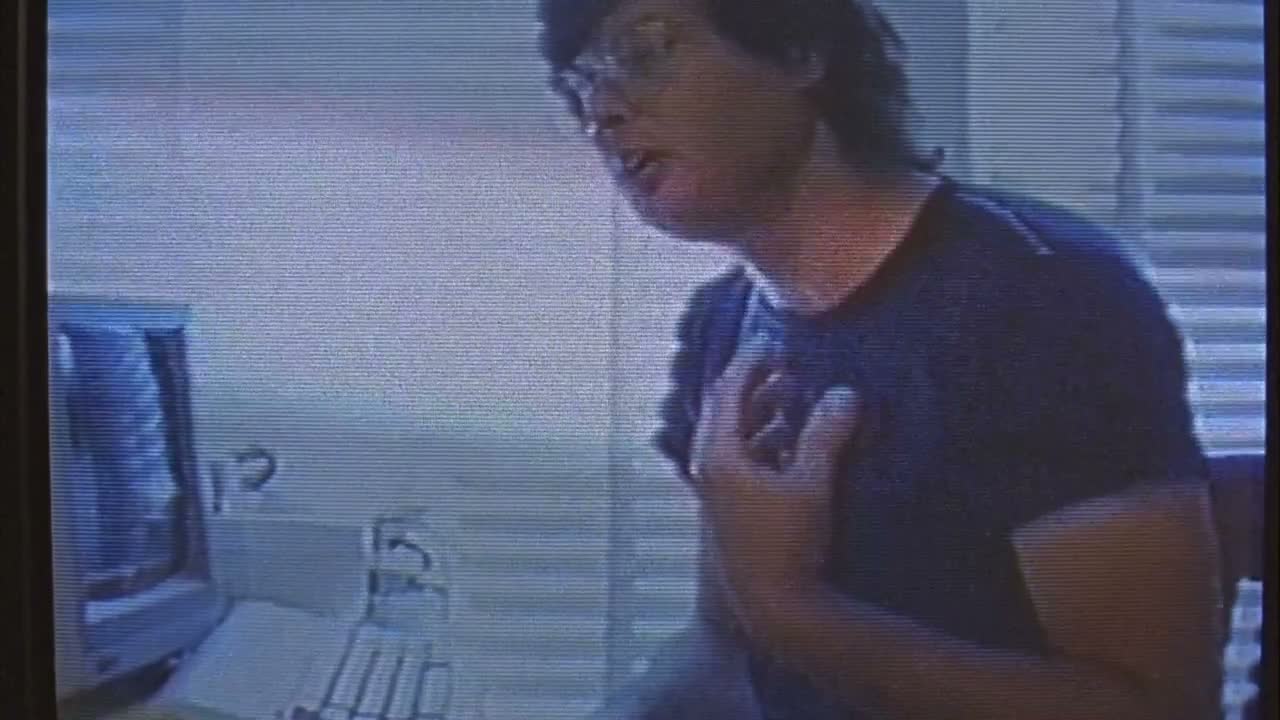
A visitor is welcomed into a room full of running televisions by a man who says he is "better than a sharp stick in the eye." He argues that a recorded image is more powerful than the real event, and tells of seeing a stabbing he could not pause or rewind.
❝ Monologue · 18 lines I Can't Press Rewind
A man lives among dozens of televisions, all of them left on, and he sees this as a working relationship. He explains to his visitor that the televised image has a power the real event lacks, and he proves it with a story about a stabbing he once saw. Then he plays a tape of a graduate student who took his committee hostage.
The scene is the film's most complete portrait of a certain kind of mind, someone who has replaced the world with screens and then built a philosophy to justify it. He is friendly, funny and completely sincere: he offers Pop-Tarts and insists that a recorded image beats the real thing. The story he tells to prove it is grotesque and revealing. A man fell in front of him with a knife in his back, and what troubles him is not the violence but his inability to control the footage: "I can't press rewind. I can't put it on pause." He is explicit that reality failed him — "I was seeing it for real, but it just wasn't right." That is the joke and the tragedy at once: for him, the world is a badly edited tape. The tape he then plays, about a student who held his committee hostage, is just one more story passed hand to hand.
A1–C2 is the CEFR scale. Cards above the level you pick fade, and playback will not auto-pause on them.
“Oh, better than a sharp stick in the eye, I always say.”
A folksy joke answers a plain greeting and hides how shabby his life is.
Informal
“I was seeing it for real, but it just wasn't right.”
It captures a paradox: the real thing felt less real than a recording.
Neutral
“Did you hear about him? He took his whole thesis committee hostage.”
It drops a wild campus crime like gossip, which makes you lean in.
Informal
“I can't press rewind. I can't put it on pause.”
Two remote-control buttons sum up everything he misses about real life versus tape.
Informal
Well, we all know the psychic powers of the televised image... But we need to capitalize on it... and make it work for us instead of us working for it. - Like how? - Well, like, to me, my thing is... a video image is much more powerful and useful... than an actual event. Like back when I used to go out, when I was last out... I was walking down the street and... this guy came barrelling out of a bar... fell right in front of me and he had a knife right in his back... landed right on the ground. And - I have no reference to it now. I can't refer back to it. I can't press rewind. I can't put it on pause. I can't put it on slo-mo and see all the little details. And the blood, it was all wrong. It didn't look like blood. The hue was off and I couldn't adjust the hue. I was seeing it for real, but it just wasn't right. And I didn't even see the knife impact on the body. I missed that part.
 Up next · 18blaze of gloryThe scene: Oblique Strategy Cards on the Street
He believes the televised image has a psychic power, and that a recorded event is more powerful and useful than the real event, so people should make it work for them.
He saw a man fall in front of him with a knife in his back, and his complaint is that he could not rewind, pause or adjust the colour, so the real event was worse than a recording.
A graduate student from the history department recorded it before his thesis defence; he took his whole committee hostage and was killed by a SWAT team.
The man says the committee would not approve his research because it was too radical, so he taped himself before going to see them.
It means to press the rewind button and go back over something you have already seen. He uses it about not being able to review a real event.