
“If you're here to steal something, you've come to the wrong place.”
Why it's great
It names the worst assumption with a grin, then offers coffee anyway.
Register
Informal
Use it yourself
If you want a refund, you've come to the wrong place.
Chapter 15 of 22 · 3'56"
An old man in a diner lectures a young visitor on the anarchist who shot McKinley, insisting there was "such a thing as belief put into action" in those days. He claims to have fought in Spain, then declares he has always wanted to blow up the Texas Legislature.
❝ Monologue · 7 lines Belief Put Into Action
❝ Monologue · 7 lines the Guy Fawkes dream
A fantasy of blowing up the legislature slides into contempt for fake libertarians.
In a small diner, an old man draws a young visitor into his version of history. He introduces the anarchist Leon Czolgosz and mourns a time when belief could be put into action. He says he fought in Catalonia, keeps his union card, and, out on the street, dreams aloud of blowing up the Texas Legislature.
The scene is a monologue delivered by a man who has outlived the world he believed in, and it is both funny and a little frightening. He starts politely enough, offering coffee, then explains that the great figure of American history is Leon Czolgosz, the man who shot McKinley. What he admires is not the act but the conviction: "There was such a thing as belief put into action in those days." From there he moves through Spain, Orwell, the workers in the saddle, and on to his own plan to blow up the Texas Legislature. The film never undercuts him: the daughter rolls her eyes, but the camera stays with the old man, and his nostalgia for political violence is allowed to be charming, ridiculous and real at once. He is, in the film's terms, one more story being passed along.
A1–C2 is the CEFR scale. Cards above the level you pick fade, and playback will not auto-pause on them.
“If you're here to steal something, you've come to the wrong place.”
It names the worst assumption with a grin, then offers coffee anyway.
Informal
“There was such a thing as belief put into action in those days.”
It mourns a lost era of conviction in one calm sentence.
literary
“They don't give a damn about improving the world.”
A blunt curse cuts through the pose of caring about freedom.
Informal
“I've always dreamed of pulling a Guy Fawkes on the Texas Legislature.”
He admits a terrorist fantasy the way others admit a hobby, and that is the joke.
Informal
One of the true heroes of American history. Leon Czolgosz. The man who assassinated William McKinley. He was an unknown Polish émigré who happened to be an anarchist... of the "propaganda by the deed" variety. If there were a hundred like him around today... you could change the world.
I've always dreamed of pulling a Guy Fawkes on the Texas Legislature. Just blow the damn thing sky high. I've got maps in my room and I'll do it some day. Texas is so full of these so-called modern-day libertarians... with all their goddamn selfish individualism. Just the opposite of real anarchism. They don't give a damn about improving the world.
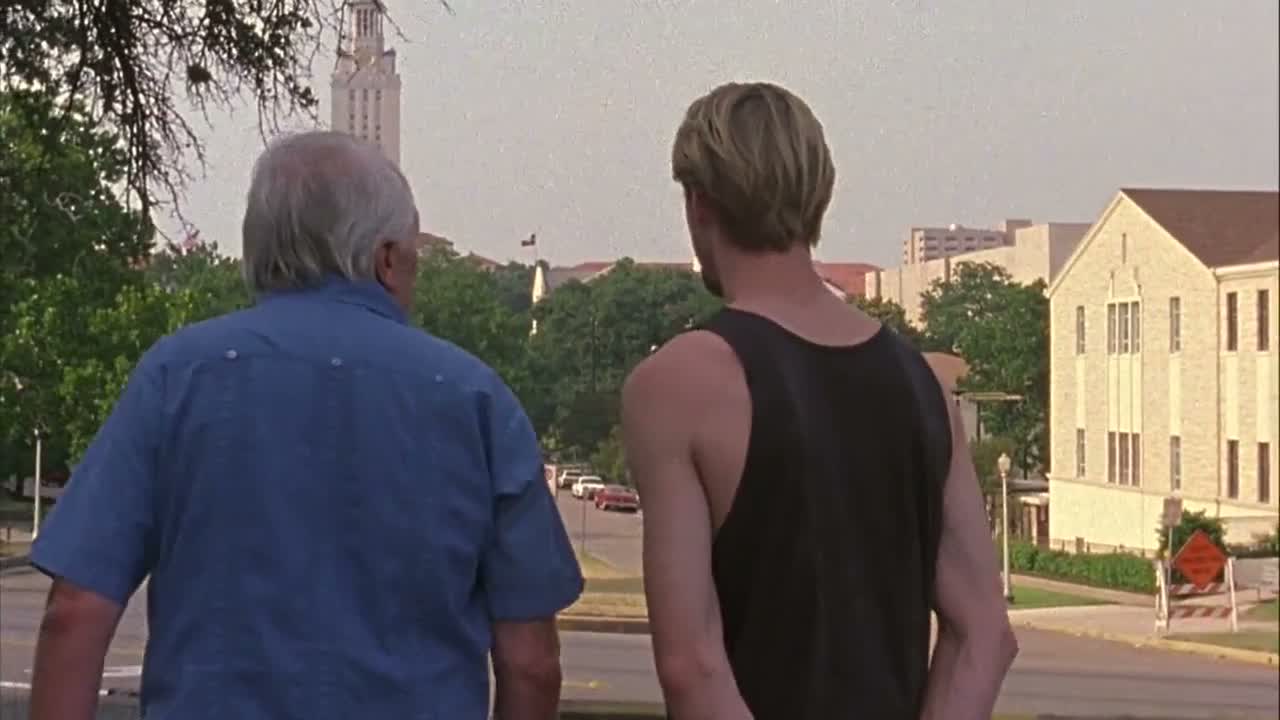 Up next · 16more likeThe scene: An Old Man Tells War Stories
He was the anarchist who assassinated President William McKinley. The old man presents him as a hero because he acted on his beliefs.
It is not the killing he praises but the conviction behind it. He says a hundred people like him could change the world.
He says he was in Catalonia and fought alongside Orwell during the revolution, and that he still keeps his C.N.T. union card.
He says he has always dreamed of blowing it up, like Guy Fawkes and the English parliament, and that he keeps maps in his room.
It means in control or in power. He uses it to describe the workers during the revolution in Barcelona.