
“To us, it was better than Citibank.”
Why it's great
Comparing a robbery to a bank turns crime into finance, with a straight face.
Register
Informal
Use it yourself
To us, that little noodle stall was better than any fancy restaurant.
Chapter 5 of 28 · 2'34"
Henry explains that the airport wasn't a target so much as an ATM: relatives on the inside tipped them off, and a union strike scared anyone who got in the way. "Whenever we needed money, we'd rob the airport," he says — and to him, that made perfect sense.
The Airport Was Their ATM
❝ Monologue · 7 lines To Live Any Other Way Was Nuts
Henry narrates the airport racket: he grew up beside Idlewild, had friends and relatives working all over it, and got tipped off about what was coming in and going out. When truckers or airlines pushed back, Paulie sent union men to scare them with a strike. Jimmy ran the whole operation, and the crew robbed the airport whenever they needed money.
The chapter is Henry's most cheerful description of crime, which is exactly the point. He talks about the airport the way a businessman talks about a branch office: informants on the inside, a union threat as a negotiation tool, and "Whenever we needed money, we'd rob the airport." He even ranks it — "To us, it was better than Citibank." Then comes the crew roll call, a parade of nicknames that turns a criminal organization into a family album. That warmth is what makes the last stretch land: he calls ordinary working people 'dead,' says "They had no balls," and describes taking whatever they wanted as second nature. "For us, to live any other way was nuts." The voiceover never asks for sympathy — it simply shows how completely Henry has swapped normal values for mob ones.
A1–C2 is the CEFR scale. Cards above the level you pick fade, and playback will not auto-pause on them.
“To us, it was better than Citibank.”
Comparing a robbery to a bank turns crime into finance, with a straight face.
Informal
“If we wanted something, we just took it.”
Seven plain words lay out a whole lawless logic as if it were obvious.
Informal
“For us, to live any other way was nuts.”
It flips normal and crazy, showing how completely the crew has rewritten the rules.
Informal
“Whenever we needed money, we'd rob the airport.”
Crime is described as casually as a cash withdrawal, which is the whole joke.
Informal
For us, to live any other way was nuts. To us, those goody good people who worked shitty jobs for bum paychecks... and took the subway to work every day and worried about bills, were dead. They were suckers. They had no balls. If we wanted something, we just took it. If anyone complained twice, they got hit so bad they never complained again. It was just all routine. You didn't even think about it.
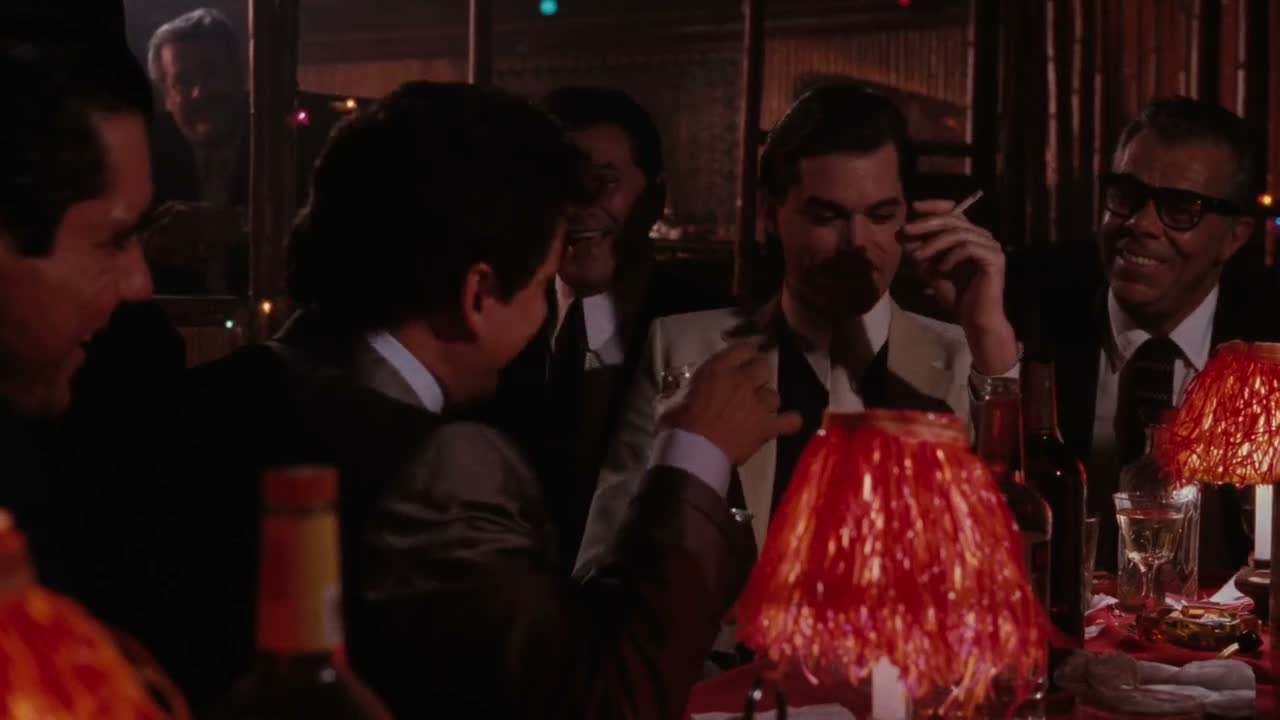 Up next · 06like a clownThe scene: Tommy Asks Henry If He's Funny
The crew grew up beside it and had friends and relatives working inside, who tipped them off about what was moving. When truckers or airlines resisted, Paulie used a union strike to scare them.
A threatened strike is pressure that looks ordinary but stops the flow of goods. It forces truckers and airlines to back down without the crew having to commit an obvious crime, which is why Henry calls it beautiful.
Jimmy Conway. Henry says the airport racket made more money than the numbers business and that Jimmy was in charge of it all.
Because he sees their lives as pointless. He says people who took the subway and worried about bills had no balls, and that living any other way would be nuts to him.
From saying everything twice. Henry's example is 'I'm gonna go get the papers, get the papers,' the habit that earned him the name.