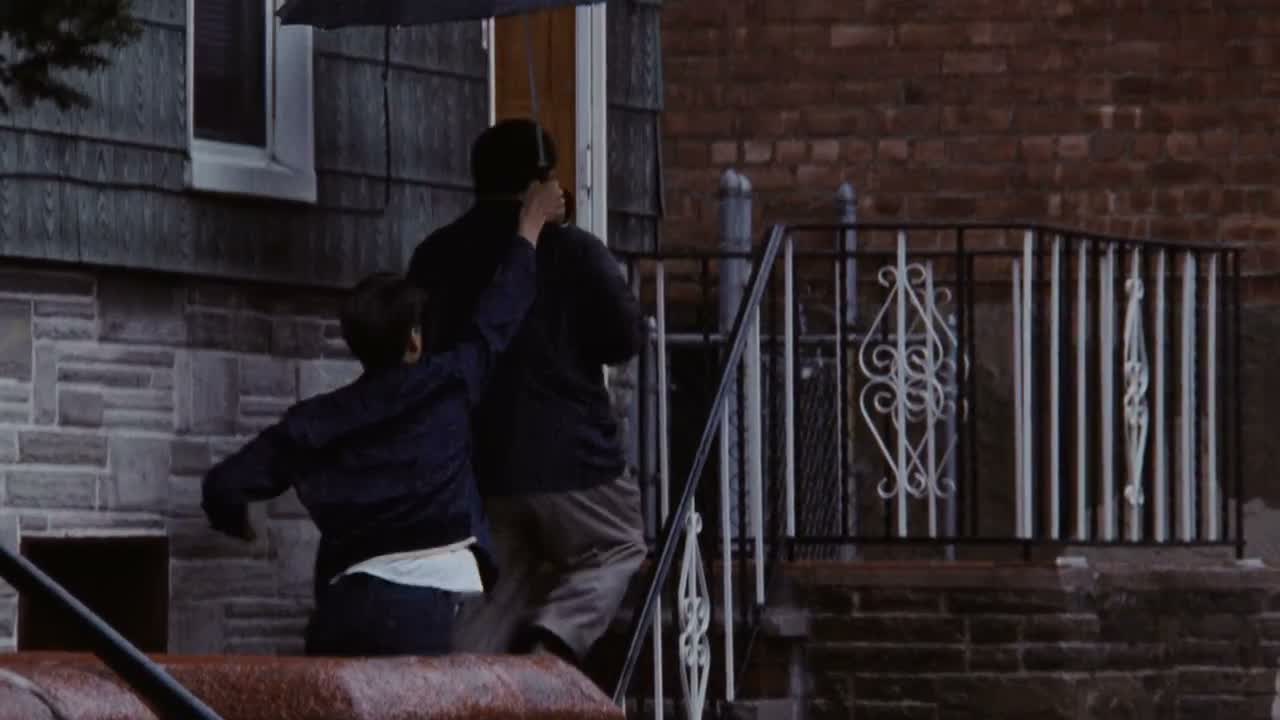
“People like my father could never understand, but I was a part of something.”
One sentence holds both a father's blind spot and a boy's need to belong.
Neutral
Chapter 2 of 28 · 2'45"
It looks like a school problem and a family fight, but the film is showing something else: a boy already choosing the street over the classroom. "I belonged. I was treated like a grown up," the narration says, and when the school letters keep coming, the men around the cabstand simply make sure they never reach his house.
Young Henry Learns to Belong at the Cabstand
❝ Monologue · 4 lines the father's rant
Each short sentence lands harder, turning disappointment into open shame.
Young Henry spends his days at the cabstand instead of school, parking Cadillacs for the wiseguys and feeling, for the first time, that he belongs. When a letter reveals he has not been to class in months, his father calls him a bum and beats him. The men at the cabstand then lean on the mailman so no more school letters reach the house.
The scene is built around a trade the boy cannot name yet. The cabstand gives him money, status, and the feeling of being somebody, while school offers only boredom and rules, so the beating from his father does not push him back to class — it pushes him further toward the men who protect him. "I belonged. I was treated like a grown up" is the line that explains everything: what he wants is not the money but the rank. The mailman scene makes the lesson explicit, because the gang does not persuade the school or the family, it simply removes the evidence. Henry ends up proud that no letters arrive at all, and the final image of refusing to pledge allegiance shows the choice is already made.
A1–C2 is the CEFR scale. Cards above the level you pick fade, and playback will not auto-pause on them.
“People like my father could never understand, but I was a part of something.”
One sentence holds both a father's blind spot and a boy's need to belong.
Neutral
“I belonged. I was treated like a grown up.”
Two short beats name exactly what a boy wants: to belong and to be taken seriously.
Neutral
“Here I am, this little kid, I can't even see over the steering wheel...”
The self-mocking image of a boy too small for the wheel, parking big cars all day.
Informal
“I was living in a fantasy.”
A short confession that he mistook a dangerous life for a dream.
Neutral
It says you haven't been there in months. In months! You're a bum ! Want to grow up to be a bum?
Up next · 03rip someone offThe scene: Paulie's Protection RacketBecause it is the only place that treats him as important. He gets money, errands, and adult respect, and that matters more to him than class, which is why the beatings never change his mind.
It means to get hit hard, usually repeatedly. Here Henry uses it almost casually, saying everyone takes a beating sometimes — a line that shows how normal violence has already become to him.
He cannot really stop it. The men around the cabstand have more power in the neighborhood than he does, so once they decide to handle the school letters, the father is left out of the loop entirely.
The men Henry works for, the local crew running the cabstand. Nobody debates the father or the school; they simply make the letters disappear, which is their way of protecting their investment in the boy.