
“"Business is bad? Fuck you, pay me. Had a fire? Fuck you, pay me.”
Why it's great
One blunt phrase repeated kills every excuse, turning extortion into a catchphrase.
Register
Informal
Use it yourself
Lost your wallet? Fuck you, pay me.
Chapter 8 of 28 · 2'52"
Henry lays out how the restaurant racket works: Paulie is your partner when there's trouble, but his money has to come in every week no matter what. The surface is business advice; underneath it's a loan shark's rulebook, ending with a match and a burnt-out shell.
❝ Monologue · 7 lines Henry on milking the place dry
It lays out theft, resale and arson as a tidy business process, calm and chilling.
He Wants a Big Score
Henry explains the deal that comes with Paulie as a partner: any problem can go to Paulie, from a bill to the cops to Tommy. In return, the weekly money has to arrive no matter what, and when nothing is left, you burn the place down and call it profit. The back half shows the other kind of favor, a friend asking Henry to help him chase a woman.
The first half is a cold manual for a protection racket, and Henry narrates it the way someone explains a recipe. Being Paulie's partner sounds like insurance — "Any problems, he goes to Paulie" — but the insurance runs one way: "the guy's gotta come up with Paulie's money every week... no matter what." Henry's examples turn the squeeze into a punchline, ending with the rule that a bad year still means paying. The logic is total: brick by brick the place is stripped, the deliveries sold off the back door, and the burned shell filed under "It doesn't matter. It's all profit." Then the chapter flips to a smaller, uglier kind of debt: a friend who won't take no for an answer, calling in favors and blaming the woman's 'prejudice' when she won't be alone with him. Favors go one way here too.
A1–C2 is the CEFR scale. Cards above the level you pick fade, and playback will not auto-pause on them.
“"Business is bad? Fuck you, pay me. Had a fire? Fuck you, pay me.”
One blunt phrase repeated kills every excuse, turning extortion into a catchphrase.
Informal
“It doesn't matter. It's all profit.”
Six words show the whole cold logic: someone's ruin is just another profit line.
Neutral
“Maybe the family owns the whole block. You may wind up with a big score.”
It prices a date like an investment, blunt and absurd at once.
Informal
“What the fuck is this world coming to?”
A foul-mouthed way to say the world has gone wrong, and it fits the character.
Informal
When deliveries are made at the front door... you move the stuff out the back and sell it at a discount. It doesn't matter. It's all profit. Then finally, when there's nothing left... Fucking shame. ...when you can't borrow another buck or buy another case of booze... you bust the joint out. You light a match.
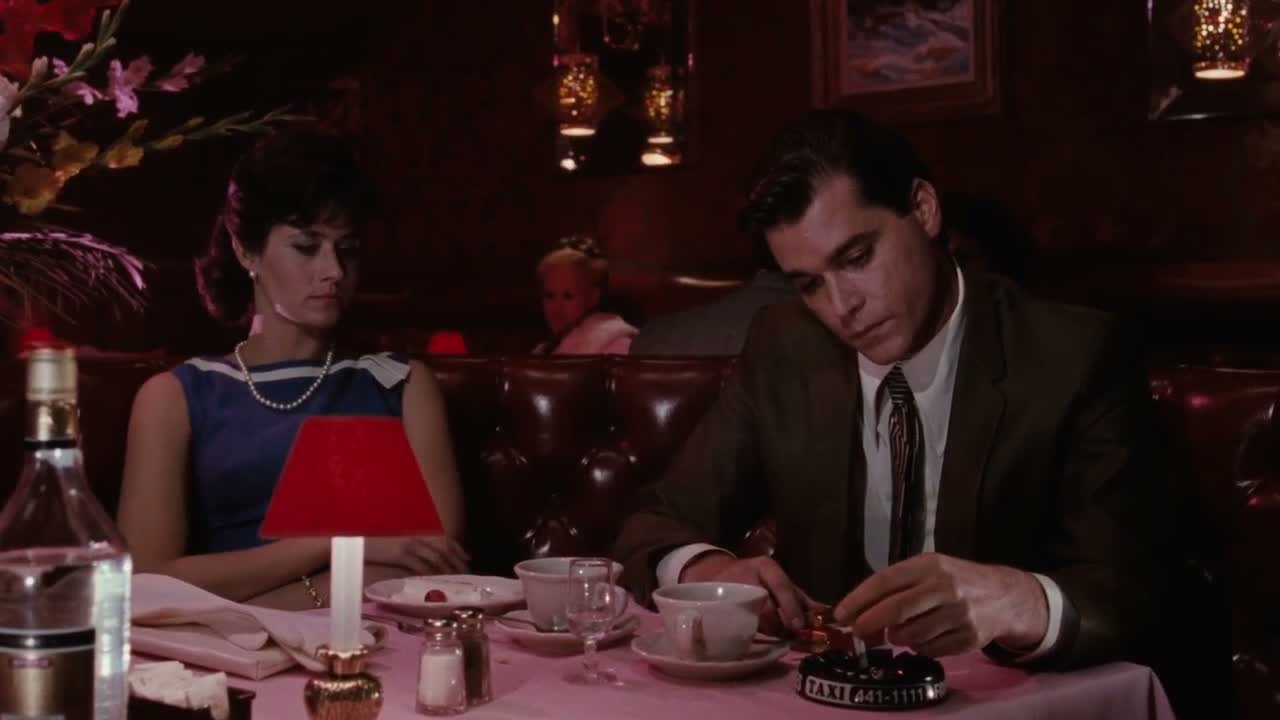 Up next · 09got some nerveThe scene: Karen Blasts Henry for Standing Her Up
Because being his partner is protection, not charity. He settles problems with bills, cops and Tommy, but the weekly payment is fixed, so bad business or a fire never excuses it.
It means to strip a business down and then burn it, wiping out the debt, which Henry lists as the final step once nothing is left.
It is dark irony. Once the goods are stolen and sold cheap and the place is burned, the loan is never really paid, so to the mob every loss still counts as profit.
Because the woman won't go out with him alone; she only agrees if her girlfriend joins. He wants Henry to come as a date for the girlfriend so he can get his chance.
He says she won't date Italians alone and calls her prejudiced, ignoring that he is mostly interested in her family's money and her looks.