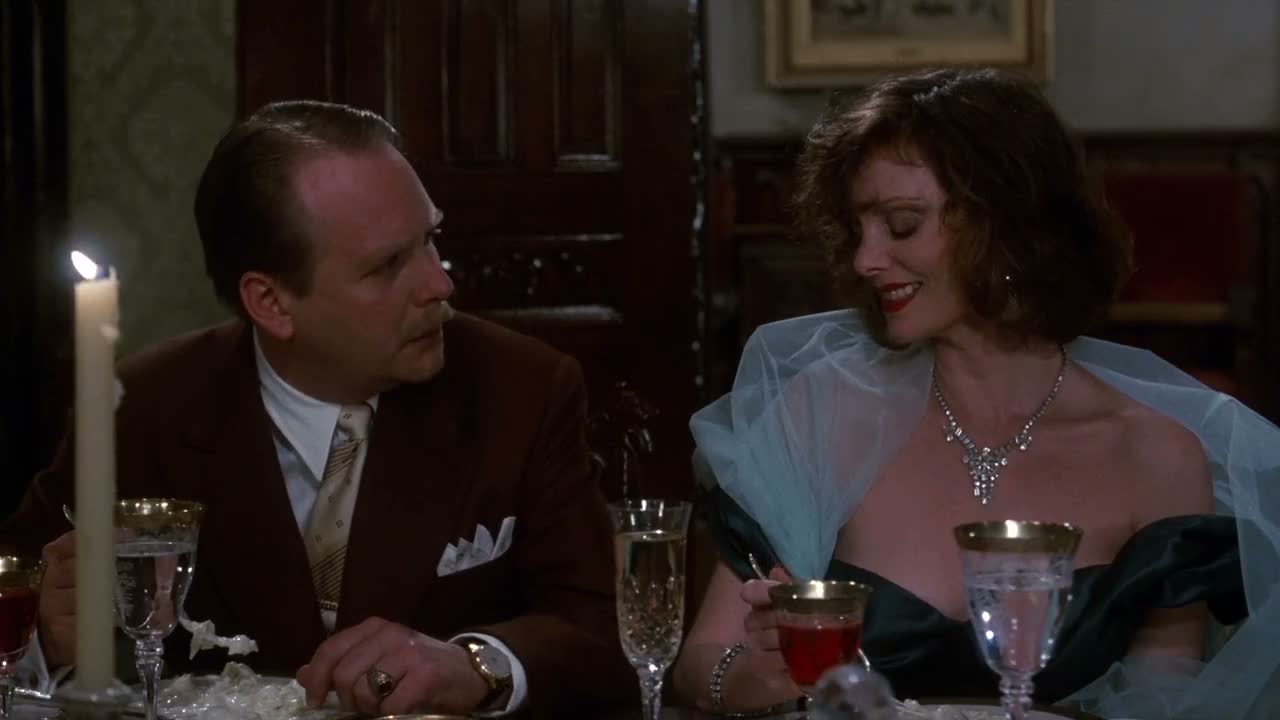
“Well, someone's got to break the ice and it might as well be me.”
One line claims the awkward room without sounding pushy, a social move anyone can borrow.
Informal
Chapter 1 of 17 · 3'03"
Mrs. Peacock tries to get the evening talking, but every polite remark is a probe. "I know who you are," one guest says, and suddenly the small talk is about who is hiding what. The ice breaks; the secrets start to leak.
❝ Monologue · 5 lines The Guests Try to Break the Ice
Professor Plum Diagnoses Mrs. Peacock
At a mansion dinner party, a group of strangers meet for the first time. Mrs. Peacock, used to playing hostess, volunteers to break the ice and start the ball rolling. As the guests trade questions about their work and where they live, small talk turns into quiet probing of who each of them really is.
The scene looks like etiquette, but it runs on suspicion. Everyone has been told not to reveal who they are, so introductions become a game of extraction: one guest announces, "I know who you are," and another presses, "Aren't you gonna tell us?" Mrs. Peacock cannot stop talking, which lets Professor Plum diagnose her with "pressure of speech" — a joke that is also a threat, since it quietly establishes that he is a doctor and can read people. Her hostess chatter is armor; his clinical calm is a flex. Even the harmless "Practice makes perfect" lands as innuendo. Under the manners, each guest is measuring the others and deciding how much to give away.
A1–C2 is the CEFR scale. Cards above the level you pick fade, and playback will not auto-pause on them.
“Well, someone's got to break the ice and it might as well be me.”
One line claims the awkward room without sounding pushy, a social move anyone can borrow.
Informal
“But then I forgot, we're not supposed to say who we really are, though heavens to Betsy I don't know why.”
The mock apology lands because it names the silly rule and questions it in one breath.
Informal
“But if I wasn't trying to keep the conversation going, then we would just be sitting here in an embarrassed silence.”
A counterfactual turns an awkward dinner into a vivid picture everyone at the table recognizes.
Neutral
“I mean, I have absolutely no idea what we're doing here or what I'm doing here or what this place is about, but I am determined to enjoy myself.”
She admits total confusion but chooses to enjoy herself anyway, a stance anyone can borrow at a bad party.
Informal
Well, someone's got to break the ice and it might as well be me. I mean, I'm used to being a hostess. It's part of my husband's work. And It's always difficult when a group of new friends meet together for the first time to get acquainted. So, I'm perfectly prepared to start the ball rolling. I mean, I have absolutely no idea what we're doing here or what I'm doing here or what this place is about, but I am determined to enjoy myself.
Clue: your progress
Chapter 1 of 17 · about 46 min to go
Up next · 02over my dead bodyThe scene: Guests Arrive at the MansionThey were invited under a condition of secrecy, so no one may simply introduce themselves. The joke is that everyone already knows more than they admit, which keeps turning polite small talk into quiet interrogation.
It is a clinical phrase for talking too much and too fast, as if you cannot stop yourself. Professor Plum uses it on Mrs. Peacock as much to show his expertise as to needle her.
Yes. He says he knows psychological medicine, calls himself a doctor, and adds that he doesn't practice. Later he says he works for a branch of the United Nations, the World Health Organization.
She says she is used to being a hostess and cannot bear an awkward silence. Her chatter fills the pauses, but it also gives the others something to read her by.
The guests discover they share the same city, and the coincidence only grows as the night goes on. It is the first hint that none of them ended up at this house by accident.