
“Very well, I know who did it.”
Why it's great
After all the chaos, one calm sentence flips the whole scene into a reveal.
Register
Neutral
Use it yourself
Very well, I know what broke the build.
Chapter 12 of 17 · 3'08"
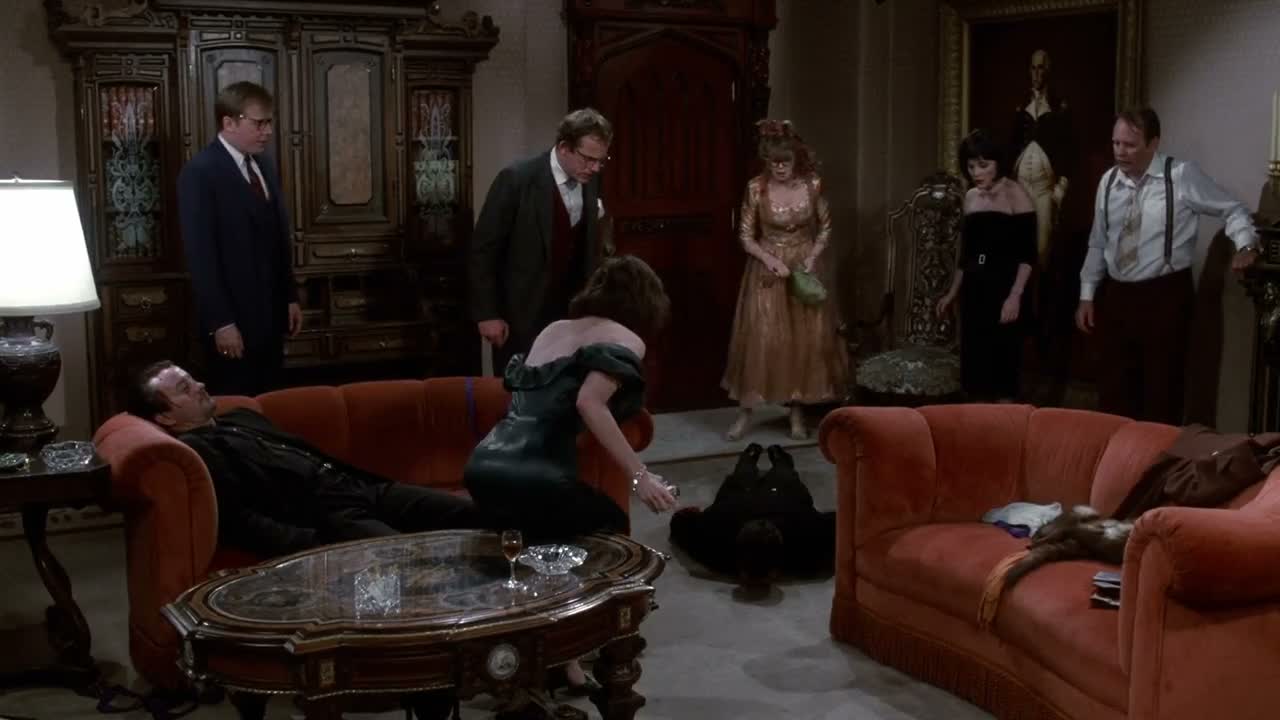
Having announced "I know who did it," Wadsworth walks the guests room by room, reenacting the whole evening step by step. The others squirm as he narrates doorbells, coats and champagne — and beg him to "get on with it." The polite tour is really an accusation in slow motion.
❝ Monologue · 7 lines I Know Who Did It
Rewalking the Whole Evening
Wadsworth announces that he knows who committed the murders and offers to show how it was done. He leads the guests through the house, narrating the evening in order: Yvette with the champagne, the doorbell, each guest's arrival. The group grows impatient and urges him to get to the point.
The scene is a reconstruction, and its pleasure is watching Wadsworth control the room. He begins with an offer no one can refuse — 'Very well, I know who did it' — and then turns the guests into an audience, moving them from room to room step-by-step. The details sound innocent (champagne, coats, a doorbell), but each stop quietly places someone. Wadsworth's calm narration is the opposite of a confession, yet it does the same work. The others can feel the trap closing, which is why they keep interrupting with 'Get on with it!' — impatience and dread sounding exactly alike.
A1–C2 is the CEFR scale. Cards above the level you pick fade, and playback will not auto-pause on them.
“Very well, I know who did it.”
After all the chaos, one calm sentence flips the whole scene into a reveal.
Neutral
“At the start of the evening, Yvette was here by herself, waiting to offer you all a glass of champagne.”
The quiet opening picture makes the violence that follows feel even colder.
literary
“And the cook was in here, alive, sharpening knives, preparing for dinner.”
The word alive lands like a knife because the audience knows how the evening ends.
literary
“And I prevented you from telling me your real name because I didn't want any of you to use any name other than your pseudonym.”
He explains a strange rule as if it were obvious, and the calm delivery hints this meeting was planned.
Formal
In order to help you understand what happened, I shall need to take you through the events of the evening step-by-step. At the start of the evening, Yvette was here by herself, waiting to offer you all a glass of champagne. I was in the hall. I know because I was there. Then I hurried across to the kitchen. And the cook was in here, alive, sharpening knives, preparing for dinner.
 Up next · 13get your hands onThe scene: Wadsworth Reveals the Secret Passage
He says he knows who did it and wants them to understand how it was all done, so he reenacts the evening step by step, using each room as evidence.
The guests count them up: 'Two murders,' then three, until someone says 'Six, all together,' and another adds, 'This is getting serious.'
That's the guests' first theory — someone heard the front door slam, and one says the murderer 'must've run out.' Wadsworth's reconstruction means to replace that guess.
The maid. Wadsworth's account begins with her alone in the room at the start of the evening, waiting to offer the guests champagne.