“So I'm sure you can understand our need to cut corners around here.”
It wraps a layoff in the language of thrift, asking Lester to agree with his own bad news.
Formal
Chapter 1 of 14 · 2'32"
The company says it only needs a job description. "This is your one chance to save your job," Brad tells Lester, dressing a threat as advice. Under the friendly talk about being one of the good guys, the message is that someone is about to be cut.
Cutting Corners Means Cutting People
Brad's Friendly Warning to Lester
Lester and Carolyn Fight Over a Tree
At Media Monthly, Lester sits down with Brad, who says management wants everyone to write out a job description. The tone stays friendly — Brad calls himself one of the good guys — but the subtext is a layoff: times are tight, the company must cut corners, and managers will decide who is expendable. Lester jokes about selling his soul rather than being unemployed.
Nothing in the conversation is really about the job description. Brad keeps offering reassurance — "I'm one of the good guys, Les." — while delivering a threat, and the softer the words get, the clearer the message becomes: write it or you are out. The phrase "cut corners" does the dirty work, turning layoffs into a matter of budget discipline, and "It's just business." makes the decision sound impersonal. Lester names what he hears — "You don't think it's weird and kind of fascist?" — but he also knows the stakes, since he jokes about selling his soul rather than facing unemployment. The scene shows how a firing lands long before it happens: as a request, wrapped in sympathy, that the employee help write the case against himself.
A1–C2 is the CEFR scale. Cards above the level you pick fade, and playback will not auto-pause on them.
“So I'm sure you can understand our need to cut corners around here.”
It wraps a layoff in the language of thrift, asking Lester to agree with his own bad news.
Formal
“This is your one chance to save your job.”
It frames a threat as a favor: take the hint or lose the job.
Neutral
“Let's sell our souls and work for Satan because it's more convenient.”
Hyperbole turns a filing task into a deal with the devil and mocks how easy surrender is.
Informal
“I wouldn't have the heart to cut down something if it wasn't partially mine.”
A line about a tree quietly argues that ownership, not feeling, decides what he does.
Neutral
American Beauty: your progress
Chapter 1 of 14 · about 37 min to go
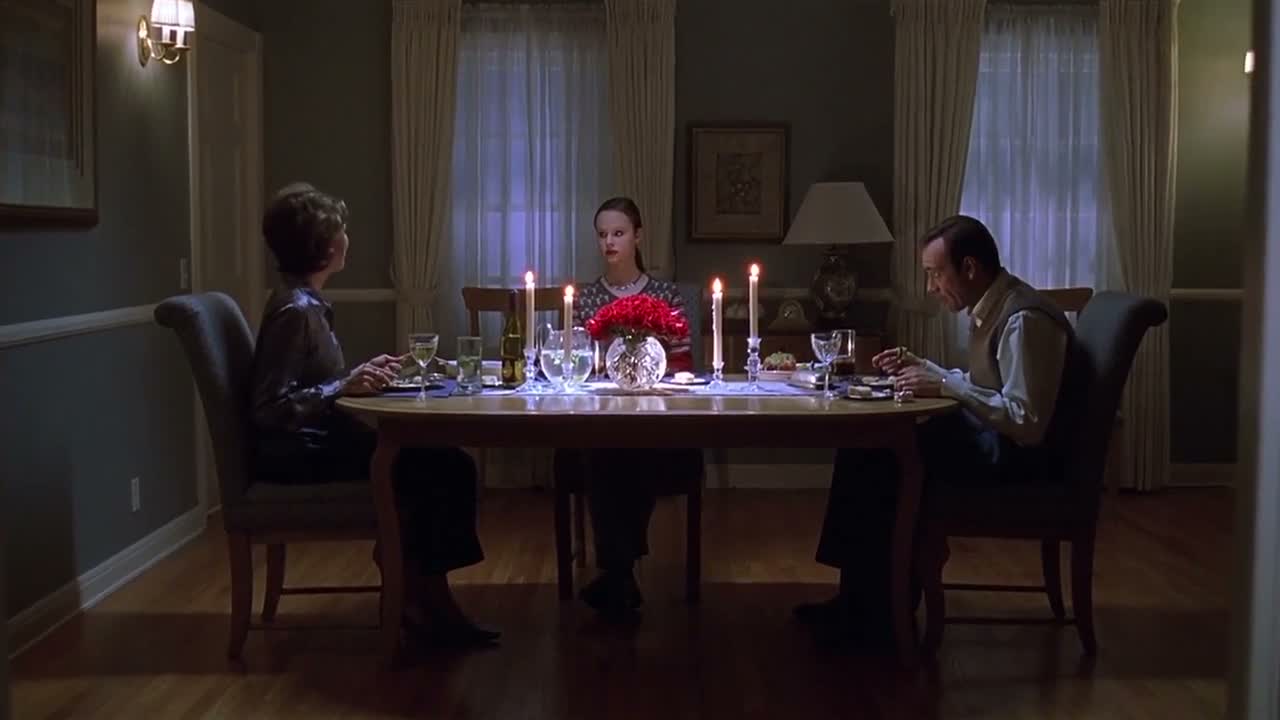
Up next · 02come right out and sayThe scene: The Burnhams' Cold DinnerManagement is deciding who is valuable and who is expendable. A written job description lets the company measure each employee against its budget, so the request is really the start of a round of cuts.
He says he is one of the good guys and wants to level with Lester, and he does warn him directly. But the warning is also pressure: cooperate with the evaluation and he might keep his job.
He pushes back, calling the job description weird and kind of fascist, then jokes that they might as well sell their souls and work for Satan. In the end he writes it anyway.
The scene strongly suggests it. Brad says nobody is getting fired yet, but he also says this is Lester's one chance to save his job, which means the decision is already in motion.