
“Never known pack ice come that far south before, sir.”
Why it's great
An old hand states the anomaly flatly, and the missing panic is what makes it ominous.
Register
Informal
Use it yourself
Never known the server to crash twice in one day.
Chapter 3 of 14 · 2'13"
On the surface, the wireless room is just routine: ice reports coming in, telegrams going out. Underneath, the film shows why the warnings will fail — the operators are swamped with passengers' private messages, and the answer to 'Serious?' is only "we shall keep a sharp look out." The most dangerous words here are the calm ones.
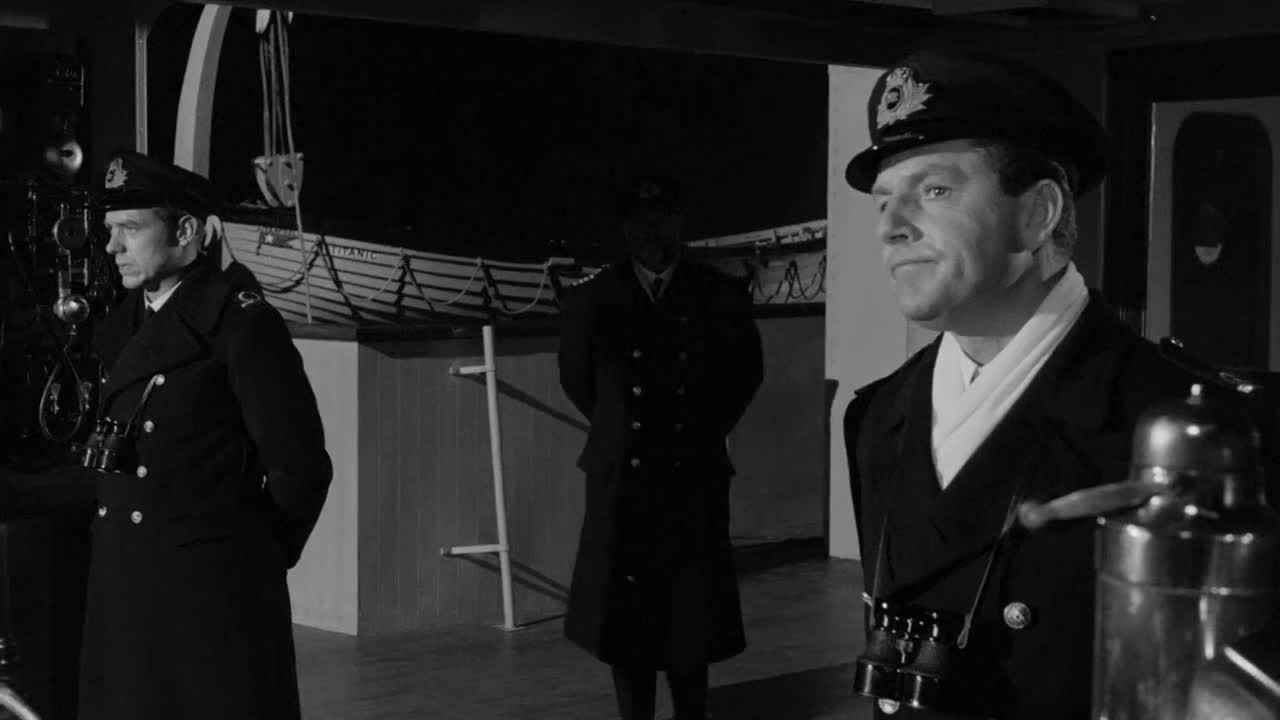
The Crew Notes the Ice Is Far South
Titanic's Traffic Blocks Out the Ice
Aboard ship at night, the crew note that pack ice has drifted unusually far south and agree to 'keep a sharp look out.' In the wireless room, the operator is busy relaying Titanic's traffic — mostly private and financial messages — as ice warnings arrive from ships ahead. At the end he is told to send a report to every vessel.
The scene is quiet, and that is the point. Everyone behaves correctly: the officers discuss the ice and promise to watch for it — "we shall keep a sharp look out" — while the wireless operator does his real job, which is selling messages for Titanic's passengers. "Private stuff," he says, half amused, as the rich chat about money and greetings. The film lets us see the priorities without commenting on them: the ship paying the most attention to the ice is not the ship whose operator is busy making money. When word finally comes to "Get this off to all ships," it is a warning sent out, not one received in time. The irony sits entirely in the calm, ordinary tone everyone uses.
A1–C2 is the CEFR scale. Cards above the level you pick fade, and playback will not auto-pause on them.
“Never known pack ice come that far south before, sir.”
An old hand states the anomaly flatly, and the missing panic is what makes it ominous.
Informal
“- Serious? - Oh, we shall keep a sharp look out.”
A worried question meets a calm, formal promise; the understatement is the drama.
Formal
“They've been at it for the best part of the day.”
A single casual phrase measures a whole day of work and quietly mocks the effort.
Informal
“- Get this off to all ships, will you. - Yes, sir.”
A crisp order softened by will you; it keeps authority but sounds less harsh.
Neutral
 Up next · 04keep their eyes skinnedThe scene: Lightoller Warns the Lookouts
A mild winter in the Arctic has let the ice drift further south than usual, carried down on the Labrador current. The crew note that they have never seen it come this far before.
They are handling Titanic's wireless traffic, which is mostly passengers' private and financial messages. That is why they have been 'at it for the best part of the day.'
It means a ship's first-ever voyage. Titanic is on her maiden voyage, which is why so much attention and so many passengers are focused on her.
Because of the ice ahead. Sending the report out to every vessel shows the danger is being shared, even though the warnings that matter most are the ones not properly received.
The message is sent from the S.S. Californian. The scene closes on the operator sending out ice reports to all ships, a warning that history records as reaching Titanic too late or not at all.