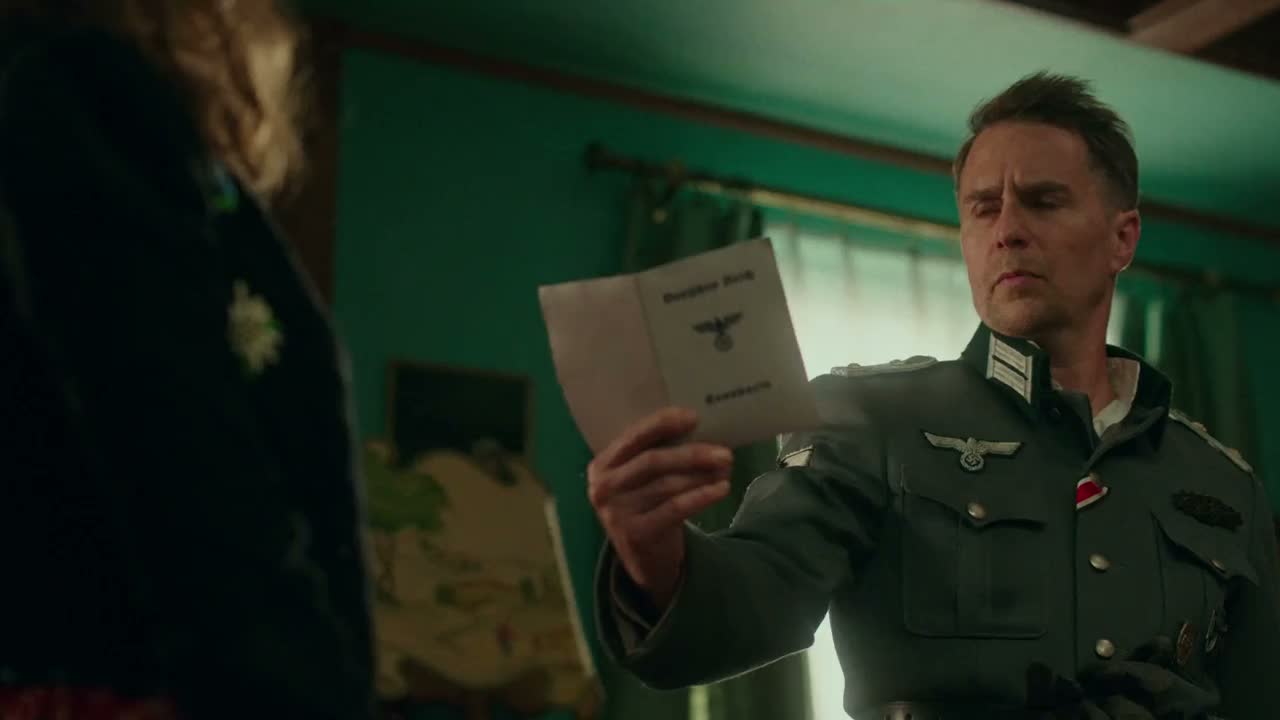
“You and your friends may have heard a rumor that Hitler only has one ball.”
It delivers a crude rumor in the flattest official tone, and that mismatch is the joke.
Informal
Chapter 14 of 18 · 4'14"
The Gestapo pays a 'routine inspection' visit, and the danger runs under a layer of jokes. They inspect Jojo's room, mock Hitler's anatomy, question him about his mother's comings and goings, and notice his missing knife. The comedy escalates until the visit turns on the girl upstairs: 'Papers, Miss Betzler. Quickly, please. We don't have all day.'
The Gestapo Search Jojo's Room
❝ Monologue · 9 lines The Gestapo Demand the Girl's Papers
Captain Klenzendorf and his men arrive at Jojo's house for what they call a routine inspection. They joke about Hitler's anatomy, question Jojo about his mother, and spot that his Hitlerjugend knife is missing. Upstairs, the knife turns out to be in the hands of the girl hiding there, who is using his sister's name, and the men demand her papers.
The scene's tension comes from how ordinary the intruders act. They poke around a boy's bedroom, trade jokes about Hitler's testicles and warn him against believing rumors, all while they are there to search the house. 'I wish more of our young boys had your blind fanaticism,' one of them says, which is both praise and a threat: the system values exactly the unquestioning child Jojo has been trained to be. The visit tightens when the men notice his knife is gone and the girl upstairs claims to be his sister, and the polite request for her papers — 'I don't suppose I could see your papers, could I?' — is the moment the comedy turns into a trap. Everything is said in the calm register of bureaucracy, which is what makes it frightening.
A1–C2 is the CEFR scale. Cards above the level you pick fade, and playback will not auto-pause on them.
“You and your friends may have heard a rumor that Hitler only has one ball.”
It delivers a crude rumor in the flattest official tone, and that mismatch is the joke.
Informal
“I wish more of our young boys had your blind fanaticism.”
It is praise and a warning at once, and the calm delivery makes it chilling.
Formal
“Sometimes he'd prefer if I was dead.”
A domestic sentence carries a death wish, and the casual tone makes it heavier.
Informal
“It really is quite rude.”
It calls persecution merely rude, and that understatement is what makes it sting.
Formal
“Papers, Miss Betzler. Quickly, please. We don't have all day.”
Three clipped commands escalate, and the polite please makes the pressure worse.
Formal
“I don't suppose I could see your papers, could I?”
The politest possible form carries the least refusable demand.
Formal
You see, we deal with an inordinate number of reports, denunciations and general investigations. And, of course, we are indeed interested in problems of crime and anti-party sentiment, but we still have one greater concern, that of the "Goldilockses." Sneaking around, eating other people's food, sleeping in their beds. It really is quite rude. I don't suppose I could see your papers, could I?
Up next · 15give someone a ringThe scene: Officers Praise Jojo's Book on JewsBecause it lets them search the house without alarming the family. The phrase sounds dull and procedural, but the visit is really about checking on the household and the hidden girl.
Because she is hiding and cannot give her real name. Claiming to be Jojo's sister gives the officials an answer that fits the house, even though it is a dangerous lie.
The knife belongs to Jojo, and the girl is holding it. It gives the inspectors a reason to demand her papers and to push closer to discovering who she really is.
Because the regime prizes unquestioning loyalty. To the adult it is a compliment, but the word 'blind' also shows how the system uses children.
It is a mocking code name for Jews, taken from the fairy tale about a girl who enters someone else's home. The officials use the children's story to hide their real target.