
“I knew all week it would come to this!”
Por qué es buena
It fuses a week of dread into one line, so the disaster feels long foreseen.
Registro
Neutral
Úsala tú
I knew all month the launch would come to this.
Capítulo 12 de 29 · 3'38"
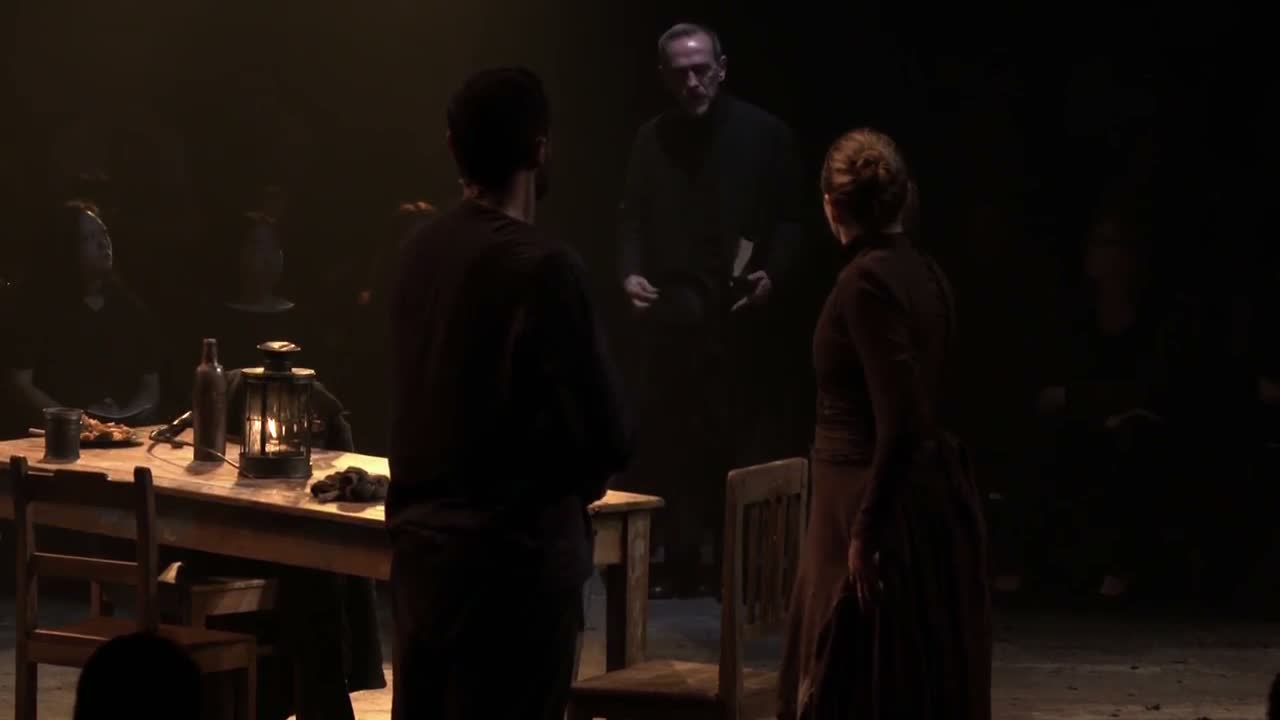
The fight isn't about the trial anymore; it's about Abigail. Elizabeth is sure she wants John back — "She thinks to take my place, John" — and she asks him to go and break any promise Abigail imagines between them. John refuses, and the argument turns on his honesty: "She has an arrow in you yet, John Proctor."
Elizabeth Fears the Noose
Elizabeth Says Abigail Still Has an Arrow in Him
Elizabeth is certain Abigail means to destroy her: 'I knew all week it would come to this,' she says, and 'She thinks to take my place.' She begs John to go to Abigail and break whatever promise the girl believes in. John refuses, insisting he is honest, and Elizabeth's final charge — that Abigail still has 'an arrow' in him — ends the scene.
The scene is a marriage argument wearing the mask of a witch-trial argument. Elizabeth has spent the week expecting the accusation — 'I knew all week it would come to this' — and she reads Abigail's motive plainly: 'She thinks to take my place, John.' Her request that John go and 'break' any promise is really a request that he choose her over the past. John resists, and his resistance is what damns him: he says he will not 'plead' and insists 'I am honest,' but Elizabeth hears evasion. Her image — 'She has an arrow in you yet, John Proctor, and you know it well' — turns the whole quarrel into a verdict on his heart. The trial outside is terrible, but the private wound is the one that can't be argued away.
A1–C2 es la escala MCER. Las tarjetas por encima del nivel elegido se atenúan y la reproducción no se pausa en ellas.
“I knew all week it would come to this!”
It fuses a week of dread into one line, so the disaster feels long foreseen.
Neutral
“There be a thousand names; why does she call mine?”
The old there be makes the crowd of names feel vast, so being singled out stings more.
literary
“It is her dearest hope, John, I know it.”
She names her rival's wish, then seals it with I know it, leaving no room for doubt.
Neutral
“Because it speaks deceit, and I am honest!”
It answers an accusation with a principle, turning honesty into a counterattack.
Formal
“She has an arrow in you yet, John Proctor, and you know it well!”
The arrow image ends the fight on a wound still open, so the last word stays with her.
Informal
“You have a faulty understanding of young girls.”
It dresses an insult as a diagnosis, which lands colder than an outright jab.
Formal
 Siguiente · 13God forbidLa escena: Hale Visits the Proctors at Night
Because out of thousands of names, Abigail named hers. Elizabeth believes Abigail wants her dead so she can take her place as John's wife.
She asks him to go to Abigail and break any promise the girl believes exists between them. She wants him to end the connection once and for all.
He says going would mean speaking deceit, and he insists he is an honest man. He also resents Elizabeth treating him as if he were base.
It means Abigail still has a hold on John — an old wound or attraction that hasn't gone away. Elizabeth uses it as her final accusation.
On the surface it's about the witch trial and Abigail's accusation. Underneath, it's about whether John has truly broken with Abigail, and whether Elizabeth can trust him.