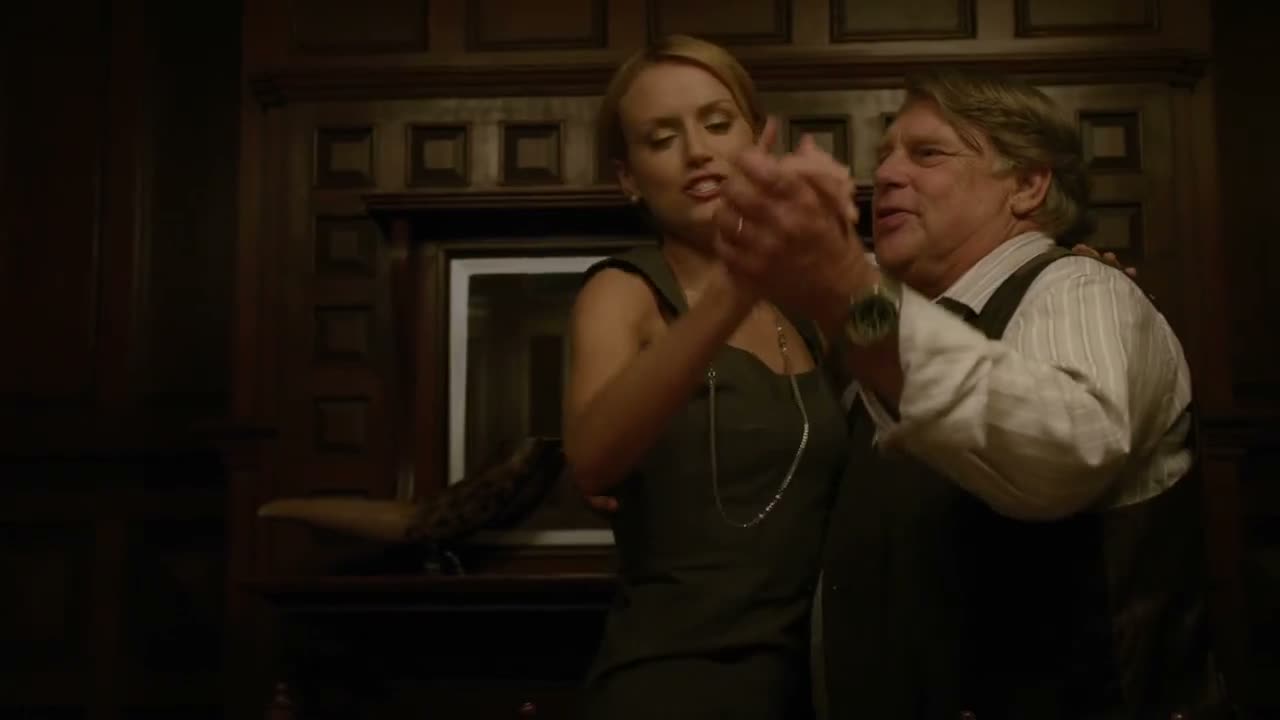
“I would never ask anyone to take a risk I wasn't willing to take.”
It ties every risk he asks of others to the risk he is willing to bear himself.
Neutral
Capítulo 13 de 16 · 2'46"
Dagny, as president of the John Galt Line, commissions a Rearden Metal bridge from Hank Rearden and reveals that a group of industrialists is funding it. She shows him a mysterious engine prototype. Then a call arrives: the Equalization of Opportunity Bill has passed, and Rearden can only own one company.
Dagny Commissions Rearden's Bridge
❝ Monólogo · 4 frases The Bill Passes and Rearden Loses His Companies
Dagny Taggart, now president of the John Galt Line, commissions a Rearden Metal bridge for Wyatt Junction. Rearden agrees at once, and when she explains that industrialists are funding it, he matches the difference himself. She then shows him a prototype engine she found. Before they can discuss it, a call reports that the Equalization of Opportunity Bill has passed, limiting him to one company.
The chapter moves from a handshake to a phone call, and that shift is the story. Private people do business on trust: Dagny commissions a bridge, explains that 'Ellis Wyatt, Ted Nielsen, Lawrence Hammond, Kenneth Danagger' are putting up the money, and Rearden answers by matching the difference — 'I would never ask anyone to take a risk I wasn't willing to take.' It is cooperation without coercion. Then the call comes: the Equalization of Opportunity Bill has passed, and the law says that 'nobody can own more than one company.' Rearden's answer is to give up his other holdings rather than his metal — 'I'll sign away my other companies, but they are not getting my metal' — and he insists the bridge will be built 'on time and on budget.' The closing exchange about the ore mine shows the new world: a promise of trust ('You can trust me') meeting a man who deals only in ownership — 'I either own the property or I don't.'
A1–C2 es la escala MCER. Las tarjetas por encima del nivel elegido se atenúan y la reproducción no se pausa en ellas.
“I would never ask anyone to take a risk I wasn't willing to take.”
It ties every risk he asks of others to the risk he is willing to bear himself.
Neutral
“I'll sign away my other companies, but they are not getting my metal.”
He concedes the companies in one breath and draws the line at his metal in the next.
Neutral
“I either own the property or I don't.”
Two blunt alternatives leave no space for a favor dressed up as friendship.
Neutral
“If you intend to keep your word, then keep it.”
It hands the promise back to the other man and makes keeping it his job, not a favor.
Neutral
“Nobody can own more than one company.”
The whole law is reduced to one flat sentence, and it sounds final.
Neutral
“You're a good man, Hank Rearden.”
The full name turns a plain compliment into a serious verdict on his character.
Neutral
“I've never given you any reason to mistrust me.”
The double negative pushes the suspicion back onto the man who raised it.
Neutral
If you intend to keep your word, then keep it. If you wanna give me first call on the ore produced, fine. If you intend to double-cross me... ...so be it.
Siguiente · 14get on the bandwagonLa escena: A Toast and a ConfessionA Rearden Metal bridge for Wyatt Junction, as president of the John Galt Line. Rearden agrees immediately and starts rolling the metal.
A group of industrialists — Ellis Wyatt, Ted Nielsen, Lawrence Hammond and Kenneth Danagger — put up the money. Rearden matches the difference himself.
It limits any person to owning a single company. Once it passes, Rearden must give up his other holdings, though he refuses to give up his metal.
It means to do what you promised. Rearden says, 'If you intend to keep your word, then keep it,' meaning promises should be kept, not just made.
Someone promises Rearden he will always treat the mine as his, and asks to be trusted. Rearden refuses the half-measure, saying he either owns the property or he doesn't, and ends with 'so be it.'