
“But on the whole, I'm sorry to say, we're a failed species.”
Why it's great
It turns a dinner rant into a verdict on the whole human race.
Register
Neutral
Use it yourself
But on the whole, I'm sorry to say, the plan failed.
Chapter 1 of 16 · 5'03"
Boris opens the film by ranting to his friends and then straight to the camera, blaming religion, politics and human nature for everything wrong with the world. He lands on his verdict about people and his own philosophy: 'My story is, whatever works.' Then he warns the audience that they are watching the wrong kind of movie.
Boris on Religion and Human Nature
❝ Monologue · 39 lines Whatever Works and the Feel-Good Warning
Boris sits in a diner and launches into a monologue, first to his friends and then directly to the audience. He attacks religion as a money-making racket, argues that every good idea fails because it assumes people are decent, and concludes that we are a failed species. His advice is simple: whatever works.
The scene sets the tone for the whole film and announces what kind of narrator Boris is. He argues that every noble system fails for the same reason, and then he says the line that gives the movie its title: "My story is, whatever works. You know, as long as you don't hurt anybody." The joke is that a man this sour is also the film's most honest character, and his bleakness is offered as a kind of relief rather than a warning. When he turns to the audience and tells them this is not a feel-good movie, he is both mocking the people watching and inviting them in. The fourth wall break is not a gimmick: it turns his rant into a conversation and makes the viewer complicit in his low opinion of humanity.
A1–C2 is the CEFR scale. Cards above the level you pick fade, and playback will not auto-pause on them.
“But on the whole, I'm sorry to say, we're a failed species.”
It turns a dinner rant into a verdict on the whole human race.
Neutral
“My story is, whatever works. You know, as long as you don't hurt anybody.”
A whole philosophy in two beats: do what works, but do no harm.
Informal
“Any way you can filch a little joy in this cruel, dog-eat-dog, pointless, black chaos. That's my story.”
The piled-up adjectives make survival sound like a small, stolen pleasure.
literary
“And just so you know, this is not the feel-good movie of the year.”
It breaks the fourth wall and warns the audience what kind of film this is.
Informal
“Like my mother used to say, "If my grandmother had wheels, she'd be a trolley car."”
A folk absurdity deflates every regret about what might have been.
Informal
Why would you want to hear my story? Do we know each other? Do we like each other? Let me tell you right off, okay? I'm not a likeable guy. Charm has never been a priority with me. And just so you know, this is not the feel-good movie of the year. So if you're one of those idiots who needs to feel good, go get yourself a foot massage. - Mom, that man's talking to himself! - Come away, Justin. What the hell does it all mean anyhow? Nothing. Zero. Zilch. Nothing comes to anything, and yet there's no shortage of idiots to babble. Not me. I have a vision. I'm discussing you. Your friends, your co-workers, your newspapers, the TV. Everybody's happy to talk, full of misinformation. Morality, science, religion, politics, sports, love. Your portfolio, your children, health. Christ. If I have to eat nine servings of fruits and vegetables a day to live, I don't want to live. I hate goddamn fruits and vegetables. And your omega-3's and the treadmill and the cardiogram and the mammogram and the pelvic sonogram and, oh, my God, the colonoscopy! And with it all, the day still comes when they put you in a box and it's on to the next generation of idiots who'll also tell you all about life and define for you what's appropriate. My father committed suicide because the morning newspapers depressed him. And could you blame him? With the horror and corruption and ignorance and poverty and genocide and AIDS and global warming and terrorism and the family-value morons and the gun morons! "The horror," Kurtz said at the end of Heart of Darkness. "The horror." Lucky Kurtz didn't have the Times delivered in the jungle, then he'd see some horror. But what do you do? You read about some massacre in Darfur or some school bus gets blown up, and you go, "Oh, my God, the horror!" And then you turn the page and finish your eggs from free-range chickens. Because what can you do? It's overwhelming. I tried to commit suicide myself. Obviously, it didn't work out. But why do you even want to hear about all this? Christ, you got your own problems. I'm sure you're all obsessed with any number of sad little hopes and dreams. Your predictably unsatisfying love lives. Your failed business ventures. "Oh, if only I'd bought that stock!" "If only I had purchased that house years ago!" "If only I had made a move on that woman." If this, if that. You know what? Give me a break with your "could haves" and "should haves." Like my mother used to say, "If my grandmother had wheels, she'd be a trolley car."
Whatever Works: your progress
Chapter 1 of 16 · about 70 min to go
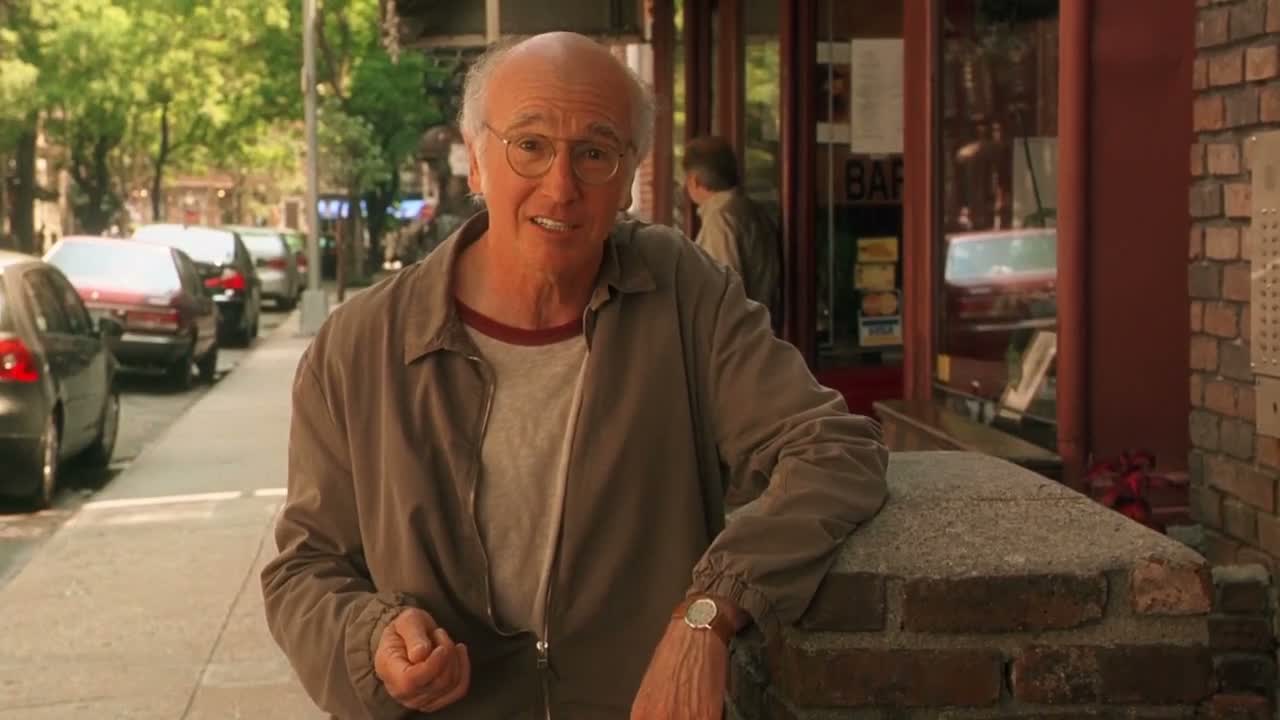 Up next · 02eke out a livingThe scene: Boris Panics and Jumps Out the Window
He breaks the fourth wall throughout the film, speaking to the audience as if they are in the room. In this opening speech he introduces himself and his opinion of people.
He says he has nothing against the original teachings, only the professionals who turn faith into a business. He calls it the God racket, a place with big money.
Whatever works, as long as you do not hurt anyone. He believes life is chaos, so you should take whatever small joy you can find.
He pretends the viewers paid to watch him, mocking them for it. It is part of the joke that he treats his friends as if they cannot see the people watching.
He is a misanthrope who once tried to kill himself and failed. He describes the world as a chamber of horrors but keeps going anyway.