
“We burn a hot fire here; it melts down all concealment.”
Why it's great
The furnace image makes the court's power feel physical, melting every hidden thing.
Register
literary
Use it yourself
We burn a hot fire here; every fudged number melts down.
Chapter 18 of 29 · 4'56"
Proctor brings Mary Warren's deposition to court, and Mary says flatly that the girls were pretending: "It were pretense." Danforth answers with a warning that his court "melts down all concealment," then probes Proctor's faith and, finally, offers him a deal — drop the charge and Elizabeth lives. He refuses.
Mary Says the Girls Were Pretending
❝ Monologue · 5 lines Proctor on What He Has Seen
He moves from plain speech to what he has witnessed, slowly exposing the whole trial.
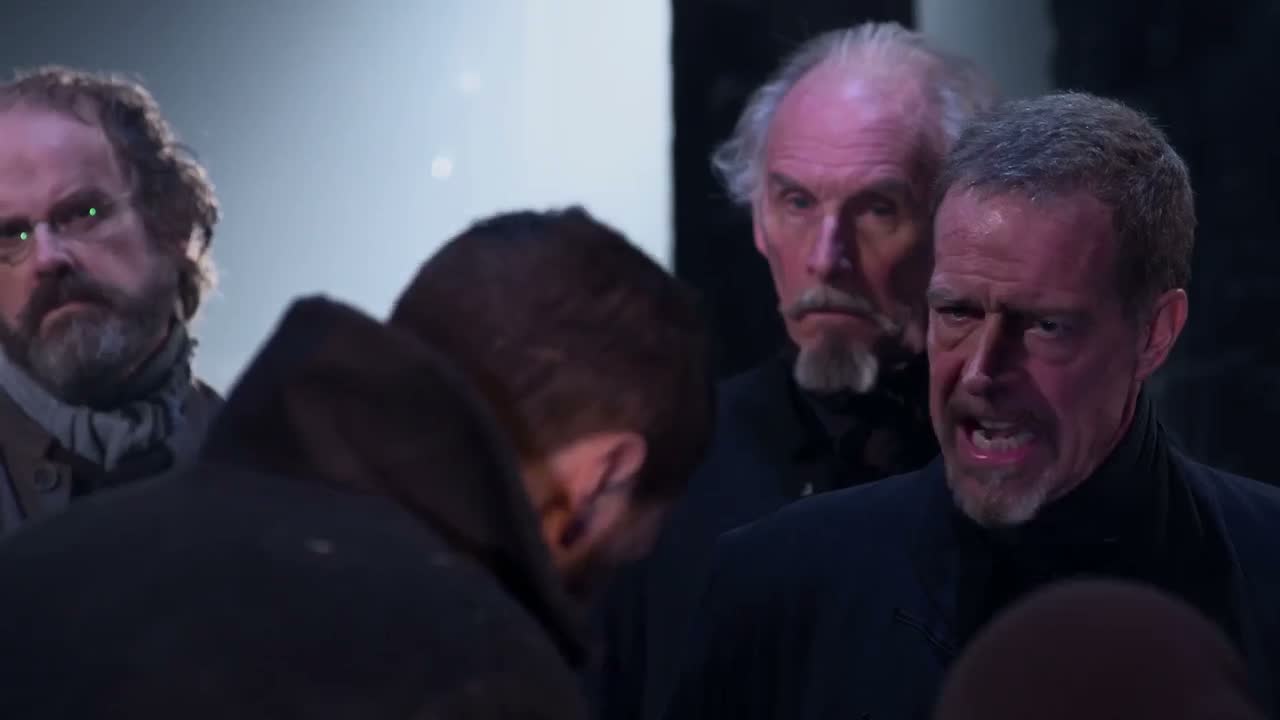
In the Salem courtroom, Proctor presents Mary Warren's deposition, and Mary admits the girls' visions were pretense. Parris calls Proctor a troublemaker. Danforth warns that his court burns away every concealment, questions Proctor's religious devotion, and then reveals that Elizabeth claims to be pregnant. He offers to spare her this year if Proctor drops the charge; Proctor refuses.
Proctor walks into court with a witness and walks out with a bargain he will not take. The deposition and Mary's admission — "It were pretense" — should end the trials, but Danforth makes clear that evidence is not what decides: "We burn a hot fire here; it melts down all concealment." From there the scene turns into a test of Proctor himself. Danforth asks whether he is "a Gospel Christian," brings up his plowing on Sunday and his refusal to attend Parris's church, and treats all of it as evidence. The offer that follows is the real trap: if Proctor drops the charge, Elizabeth can live another year. It trades his wife's life for the truth, and Proctor refuses, saying simply, "think I cannot." The court has learned that it cannot beat him with accusations, so it tries to buy him.
A1–C2 is the CEFR scale. Cards above the level you pick fade, and playback will not auto-pause on them.
“We burn a hot fire here; it melts down all concealment.”
The furnace image makes the court's power feel physical, melting every hidden thing.
literary
“Will you drop this charge?”
Five plain words put the whole bargain on the table: drop it or not.
Formal
“her But if she say she is pregnant, then she must That woman will never lie, Mr. Danforth.”
A flat never stakes a person's whole character, leaving no room to argue.
Neutral
“Beware this man, Your Excellency, this man is mischief.”
Calling a man mischief turns a warning into a verdict in one word.
literary
“Are you certain in your conscience, Mister, that your evidence is the truth?”
Asking if he is certain in his conscience makes the question about honesty, not facts.
Formal
I tell you straight, Mister - I have seen marvels in this court. I have seen people choked before my eyes by I have seen them stuck by pins and slashed I have until this moment not the slightest that the children may be deceiving me. Do you understand my meaning?
 Up next · 19put-uponThe scene: Francis Nurse Presents the Petition
Mary signed a deposition saying the girls never saw spirits and were only pretending. Proctor wants her to testify so the court will free Elizabeth.
He is testing whether Proctor is credible. By asking about church attendance and plowing on Sunday, he builds a case that Proctor is not a good Christian.
If Proctor drops the charge against Abigail, Elizabeth will be spared for at least another year, since she says she is pregnant. Proctor refuses the bargain.
Dropping it would mean admitting the accusations are true and abandoning the other accused. He says he cannot, even though the deal would save his wife.
It is Danforth's warning that the court burns away every concealment. He is telling Proctor that secrets will not survive the trial.