
“Get the hell out of my room.”
Why it's great
Thrown out of his own room, the boy has nothing left but this blunt line.
Register
Informal
Use it yourself
Get the hell off my porch before I call someone.
Chapter 5 of 18 · 2'21"
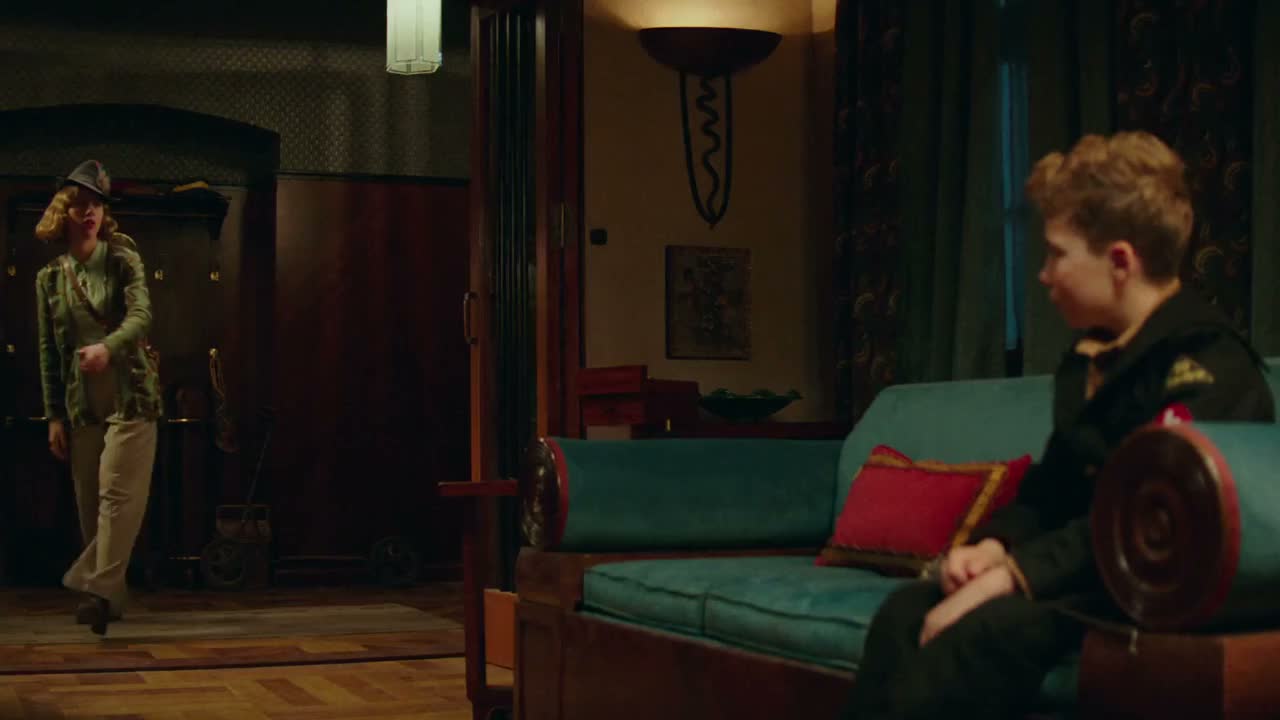
Jojo tries to bully Elsa out of the house and gets thrown out of his own room for his trouble. His imaginary friend Adolf then offers a strategy instead of force: make her feel safe, let her guard drop, and take control. The trick gets a name — reverse psychology — and Jojo listens carefully.
❝ Monologue · 20 lines Adolf Teaches Jojo a Trick in the Attic
Jojo tells the girl hiding in the attic to find somewhere else to live, and she orders him out of his own room. His imaginary friend Adolf arrives with advice: use the situation to his advantage. Instead of fighting, Jojo should make her feel safe so she drops her guard, and then he will be in control.
The scene is a comedy about strategy between two children, one of them imaginary. Jojo has no power over Elsa and can only shout at a wall, so Adolf reframes the problem: the intruder in the attic can be turned into an asset. "In fact, you could use it to your advantage," he says, and then gives the plan a slick name, reverse psychology. What makes it funny is that it is nonsense dressed as military wisdom, borrowed from Adolf's own fantasy of surviving the assassination attempt. But it also plants a real idea in Jojo's head: that the way to deal with Elsa is not to get rid of her but to win her over, which is the direction the whole story will take.
A1–C2 is the CEFR scale. Cards above the level you pick fade, and playback will not auto-pause on them.
“Get the hell out of my room.”
Thrown out of his own room, the boy has nothing left but this blunt line.
Informal
“Stop offering me damned cigarettes! I'm ten!”
A ten-year-old using grown-up language against a grown-up habit lands the joke.
Informal
“In fact, you could use it to your advantage.”
One turn of phrase reframes a problem as an asset, which is the whole trick of the scene.
Neutral
“The only reason I survived, apart from having bombproof legs, is because I outwitted old von Stauffy.”
He credits his legs and his wit for surviving a bomb, and the swagger is the joke.
Informal
“make her feel safe and then she'll drop her guard and then you will be the one in control.”
A three-step battle plan for two children, delivered with total confidence.
Neutral
“We're having unicorn for dinner at my place tonight.”
One mythical dinner dismantles the seriousness of the whole plan.
Informal
“That's just my two Pfennige.”
A German coin stands in for two cents, and one word sets the time and place.
Informal
Okay, let's talk like turkeys. You can't tell your mother or that Jew will cut off your Nazi head, but there's no reason this thing in the attic needs to ruin your life. In fact, you could use it to your advantage. How? When someone tries to use mind powers on me, know what I do? Use mind powers back on them. Remember last year when that one-arm pirate von Stauffenberg tried to blow me up with a table bomb? Yeah, you survived. Correctomundo. The only reason I survived, apart from having bombproof legs, is because I outwitted old von Stauffy. I let him think that I was dead, when in actual fact, I was absolutely fine. By pretending I was dead, I drew out all the traitors. So what are you going to do? Pretend I'm dead? Exactly. Wait, no. No, what I mean is this: make her feel safe and then she'll drop her guard and then you will be the one in control. - Reverse psychology. - Don't complicate things. Just use my backwards mind power trick, and everything will be fine.
 Up next · 06get overThe scene: Rosie Calms Jojo and Warns Elsa
Because she is a Jew hiding in his house, which his ideology tells him to hate and fear. He tries to order her out, but she refuses to be intimidated by a ten-year-old.
Because direct force has failed. He tells Jojo to make her feel safe so she lets her guard down, and then he can control the situation, which he calls reverse psychology.
He listens closely, and the idea stays with him: dealing with Elsa by winning her over rather than driving her out shapes much of what follows in the story.
Because it lets him cast a simple trick as battlefield wisdom. The story about pretending to be dead is how he dresses up the advice as a proven tactic, which is part of the joke.