
“There's nothing in the deal about my staying here!”
Why it's great
It names the gap in the deal and refuses to let a favor become an obligation.
Register
Neutral
Use it yourself
There's nothing in the contract about weekend work.
Chapter 7 of 19 · 4'11"
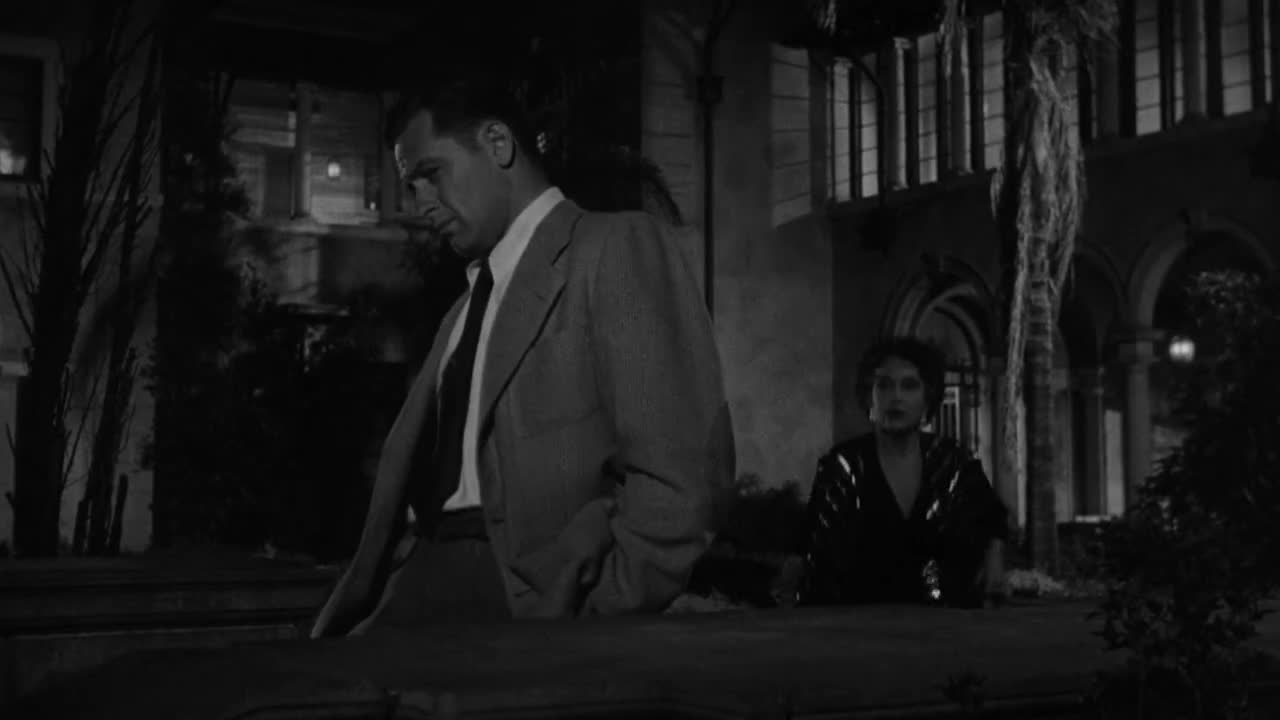
Norma has already moved Joe's clothes into the house and paid his debts, so the job comes with a room whether he likes it or not. Joe protests, 'There's nothing in the deal about my staying here!' but he takes the money. The scene shows how she turns a contract into a trap.
❝ Monologue · 5 lines The editing grind
Five voice-over lines move from greed to suffocation, pricing the job he took.
Norma Refuses to Be Cut from Her Script
❝ Monologue · 5 lines Portrait of a sleepwalker
Repetition and metaphor build a cold little poem about her self-absorption.
Norma Watches Her Own Films
Norma Desmond has Joe's belongings brought upstairs and his rent paid off, making it plain that he is expected to live in the mansion while he rewrites her script. Joe objects that the arrangement was never part of the deal, but he needs the money and stays. When he tries to cut a scene without her, she insists it go back in.
Everything here is done for Joe and nothing is negotiated with him. Norma pays his debts and has his clothes unpacked before he can agree, then asks the one question that decides it: 'Do you want this job or don't you?' Joe takes the money — 'I wanted the dough' — and tells himself he will escape in a couple of weeks. What he cannot do is edit her. When he cuts the slave-market scene, she hears only that she is being removed: 'Cut away from me?' Her ownership of the film is not vanity but identity, which is why Joe describes her as a sleepwalker and refuses to argue. The mansion, the silent pictures, the tuberoses: all of it is a world built to keep time away.
A1–C2 is the CEFR scale. Cards above the level you pick fade, and playback will not auto-pause on them.
“There's nothing in the deal about my staying here!”
It names the gap in the deal and refuses to let a favor become an obligation.
Neutral
“Suppose you make up your mind. Do you want this job or don't you?”
Two questions in a row leave no room to stall; it is Norma closing a deal her way.
Informal
“I wanted the dough, and I wanted to get out of there as quickly as I could.”
Greed and escape in one breath, the whole position of a man without options.
Informal
“You don't yell at a sleepwalker. He may fall and break his neck.”
A sleepwalker image explains why he humors her: not kindness exactly, but caution.
Informal
“They were always her pictures. That's all she wanted to see.”
Two flat sentences capture the self-absorption and the fear behind it.
Neutral
I wanted the dough, and I wanted to get out of there as quickly as I could. I thought if I really got going, I could finish it up in a couple of weeks. But it wasn't so simple getting some coherence into those wild hallucinations of hers. And what made it even tougher was that she was around all the time, hovering over me, afraid I'd do injury to that precious brainchild of hers.
She was still sleepwalking along the giddy heights of a lost career. Plain crazy when it came to that one subject, her celluloid self, the great Norma Desmond. How could she breathe in that house so crowded with Norma Desmonds, more Norma Desmonds and still more Norma Desmonds?
 Up next · 08a matter of life and deathThe scene: Norma Buys Joe New Clothes
She wants him close while he rewrites her script, and she argues he cannot work in an apartment where he owes three months' rent. She has already paid what he owes.
He needs the money and has nowhere better to go. He tells himself he will finish the job and get out of there as quickly as he can.
Cutting it would remove her from the scene. She does not see an edit, she sees herself being taken out of her own picture.
He treats her like a sleepwalker: he believes that confronting her illusions directly would only make her fall, so he humours her instead.
Her own silent films. Max runs the projector, and Joe notices she sits close and clutches his arm, forgetting she is his employer.