
“But you can do anything you want. You are bound by nothing.”
Why it's great
It frames freedom as both a gift and a burden, which is exactly Will's problem.
Register
Neutral
Use it yourself
You are bound by nothing, so go and see the world.
Chapter 17 of 21 · 5'02"
Sean asks whether Will has anyone who truly challenges him, and Will answers with a reading list of dead writers. "But you can do anything you want. You are bound by nothing" is Sean's real charge: the problem is not Will's talent but his refusal to use it for anything he cares about.
❝ Monologue · 37 lines The NSA takedown
He starts with one code and escalates to war and oil, dismantling the whole machine with ridicule.
Sean Asks Will About a Soul Mate
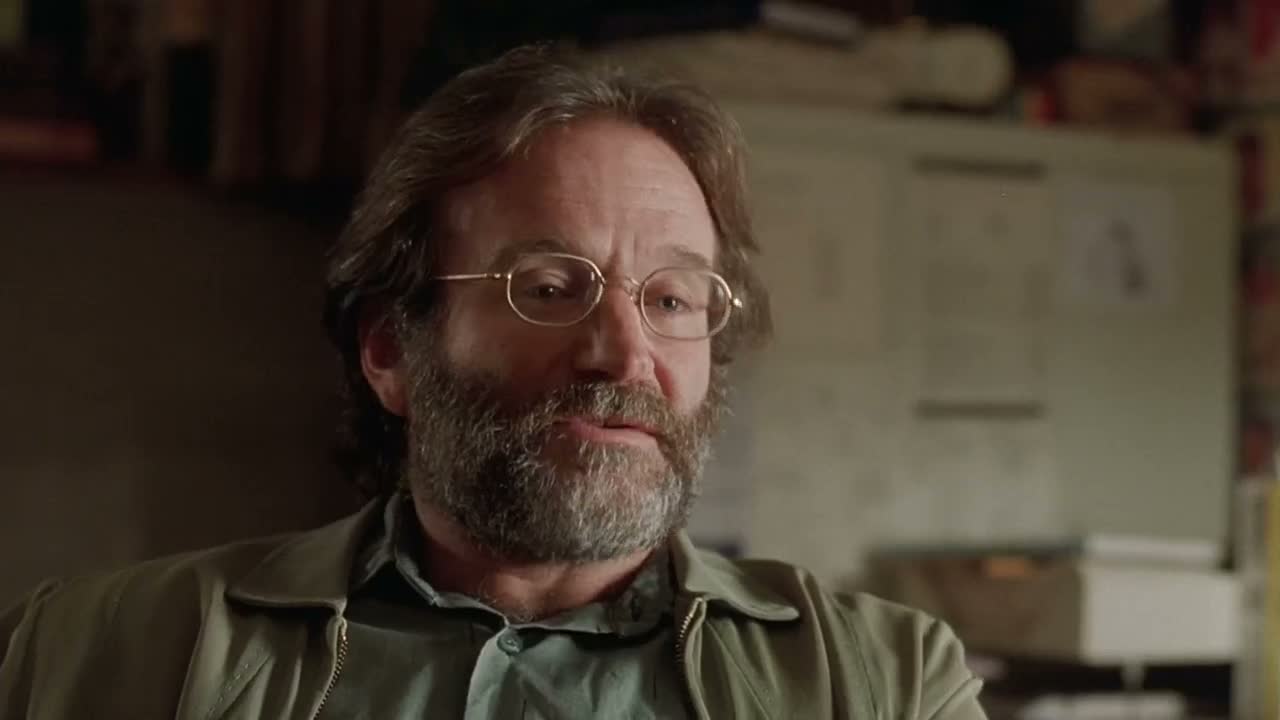
Will interviews with the NSA and answers the recruiter by tracing the job to a chain of disasters, ending with a joke about becoming president. Later, with Sean, he is asked whether he has a soul mate; he names dead authors instead of people. Sean presses him on what he actually cares about and accuses him of hiding behind "I didn't ask for this."
Will can dismantle any argument and answer any test, and this scene shows the cost of that skill. With the NSA he turns a job offer into a chain of consequences that ends in absurdity, which is both a real critique and a way of never having to say yes or no. With Sean the same habit appears as evasion: asked about a soul mate, he lists Shakespeare and Nietzsche rather than risk naming a living person. "You'll never have that kind of relationship in a world" where you flinch from the first step, Sean tells him, and the diagnosis is not that Will lacks options but that he refuses to want anything. Sean's counter, "What are you passionate about? What do you want?", is the question Will has spent years avoiding.
A1–C2 is the CEFR scale. Cards above the level you pick fade, and playback will not auto-pause on them.
“But you can do anything you want. You are bound by nothing.”
It frames freedom as both a gift and a burden, which is exactly Will's problem.
Neutral
“You'll never have that kind of relationship in a world...”
It suspends the thought on purpose, so the coming clause lands harder.
Neutral
“What are you passionate about? What do you want?”
Two plain questions strip the scene down to what Will actually wants.
Neutral
“He'd lie down in fuckin' traffic for you.”
An extreme image for loyalty that makes real friendship impossible to forget.
Informal
Why shouldn't I work for the N.S.A.? That's a tough one, but I'll take a shot. Say I'm workin' at the N.S.A. And somebody puts a code on my desk. Somethin' no one else can break. Maybe I take a shot at it, and maybe I break it. And I'm real happy with myself 'cause I did my job well. But maybe that code was the location of some rebel army in North Africa or the Middle East. And once they have that location, they bomb the village where the rebels are hidin'. Fifteen hundred people that I never met, never had no problem with, get killed. Now the politicians are sayin', "Oh, send in the marines to secure the area. " 'Cause they don't give a shit. It won't be their kid over there gettin' shot. Just like it wasn't them when their number got called... 'cause they were all pullin' a tour in the National Guard. It'll be some kid from Southie over there takin' shrapnel in the ass. He comes back to find that the plant he used to work at... got exported to the country he just got back from... and the guy who put the shrapnel in his ass got his old job... Meanwhile, he realizes the only reason he was over there in the first place... was so that we could install a government that would sell us oil at a good price. And, of course, the oil companies used a little skirmish over there to scare up domestic oil prices. A cute little ancillary benefit for them... They're takin' their sweet time bringin' the oil back, of course. Maybe they even took the liberty of hirin' an alcoholic skipper... who likes to drink martinis and fuckin' play slalom with the icebergs. It ain't too long till he hits one, spills the oil... and kills all the sea life in the North Atlantic. So now by buddy's out of work. He can't afford to drive... so he's walkin' to the fuckin' job interviews, which sucks... because the shrapnel in his ass is givin' him chronic haemorrhoids. And meanwhile, he's starvin' 'cause every time he tries to get a bite to eat... the only blue plate special they're servin' is North Atlantic scrod with Quaker State. So what did I think? I'm holdin' out for something better. I figure, fuck it. While I'm at it, why not just shoot my buddy... take his job, give it to his sworn enemy... hike up gas prices, bomb a village, club a baby seal... hit the hash pipe and join the National Guard? I can be elected president.
 Up next · 18cash in your chipsThe scene: Will Wants to Be a Shepherd
He turns the offer into a chain of disasters, but the real reason is that he will not commit to anything. Refusing lets him stay free of any future someone could judge.
Will offers Chuckie, but Sean says Chuckie is family — someone who would lie down in traffic for him. A soul mate, in Sean's sense, is different: someone who challenges you and opens things up.
It means to take an easy excuse instead of doing what is expected. Sean accuses Will of copping out by hiding behind "I didn't ask for this."
He is arguing that ordinary work carries honor. His father did hard labor so Sean could get an education, which is why Will's contempt for ordinary jobs strikes a nerve.
He has Chuckie, whom he calls family, but Sean distinguishes loyalty from the kind of person who stretches you. That gap is the loneliness the scene is really about.