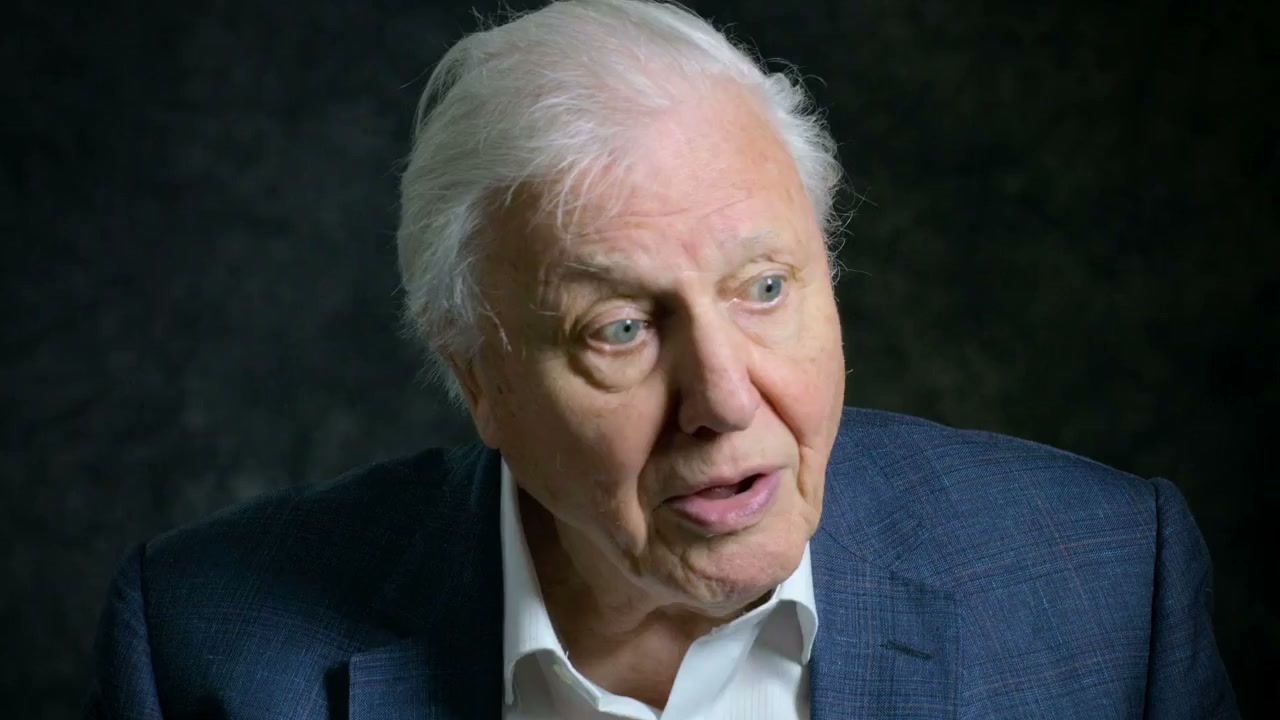
“Orangutan mothers have to spend ten years with their young, teaching them which fruits are worth eating.”
Care becomes a ten-year craft whose result is knowing which fruit is edible.
Formal
Chapter 7 of 10 · 3'31"
A curtain of green, with a few birds, looks almost intact. "And beyond that strip, there is nothing but regimented rows of oil palms." The dizzying mix of rainforest trees has been replaced by one crop, and the calm green is only a half-mile strip hiding the rows.
Why the Orangutan Needs Ten Years
❝ Monologue · 7 lines Beyond the Strip, Only Oil Palms
❝ Monologue · 5 lines Anything We Can't Do Forever
The narration moves through a tropical rainforest where orangutan mothers spend ten years teaching their young which fruits are worth eating. A small patch may hold 700 tree species, as many as in North America. That mix is turned into a monoculture of oil palm. A curtain of green looks perhaps okay from the ground, but a helicopter shows a strip half a mile wide and regimented rows beyond.
On the ground a curtain of green with a few birds can pass for forest. "and you think it's perhaps okay." A helicopter shows the trick: "that is a strip about half a mile wide," and "beyond that strip, there is nothing but regimented rows of oil palms." Orangutan mothers spend ten years teaching their young which fruits are worth eating. Without that, "they would not complete their role in dispersing seeds," and "The future generations of many tree species would be at risk." What replaced that diversity is blunt: "A monoculture of oil palm. A habitat that is dead in comparison." Cutting pays twice, timber and then the land left behind, which is why "we've cut down three trillion trees" and half the rainforests "have already been cleared." The orangutan population on Borneo is down by two-thirds since that first sight. The close is plain: "anything that we can't do forever is by definition unsustainable," until damage hits "a point where the whole system collapses."
A1–C2 is the CEFR scale. Cards above the level you pick fade, and playback will not auto-pause on them.
“Orangutan mothers have to spend ten years with their young, teaching them which fruits are worth eating.”
Care becomes a ten-year craft whose result is knowing which fruit is edible.
Formal
“And yet, this is what we've been turning this dizzying diversity into.”
And yet turns wonder into blame, and the final into leaves the damage hanging.
Formal
“And beyond that strip, there is nothing but regimented rows of oil palms.”
Nothing but empties the view, and regimented turns neatness into an accusation.
Formal
“What we see happening today is just the latest chapter in a global process spanning millennia.”
Calling today a chapter makes the loss feel old, organized, and unfinished.
literary
“The deforestation of Borneo has reduced the population of orangutan by two-thirds since I first saw one just over 60 years ago.”
A two-thirds drop turns personal once the count starts from the first time the speaker saw one.
Formal
“We can't cut down rainforests forever, and anything that we can't do forever is by definition unsustainable.”
One obvious limit is lent to every habit, so the verdict feels earned.
Formal
And yet, this is what we've been turning this dizzying diversity into. A monoculture of oil palm. A habitat that is dead in comparison. And you see this curtain of green with occasionally birds in it, and you think it's perhaps okay. But if you get in a helicopter, you see that that is a strip about half a mile wide. And beyond that strip, there is nothing but regimented rows of oil palms.
What we see happening today is just the latest chapter in a global process spanning millennia. The deforestation of Borneo has reduced the population of orangutan by two-thirds since I first saw one just over 60 years ago. We can't cut down rainforests forever, and anything that we can't do forever is by definition unsustainable. If we do things that are unsustainable, the damage accumulates ultimately to a point where the whole system collapses.
David Attenborough: A Life on Our Planet: your progress
Chapter 7 of 10 · about 9 min to go
← Previous
Up next · 08reap the open ocean harvestThe scene: The Ocean Starts to DieThe view is a curtain of green with occasional birds, and the narration says you think it's perhaps okay. From a helicopter that curtain is a strip about half a mile wide, with nothing but regimented rows of oil palms beyond it.
They are teaching them which fruits are worth eating. Without this training, the young would not complete their role in dispersing seeds, and the future generations of many tree species would be at risk.
People benefit from the timber and then benefit again from farming the land left behind. The narration calls that a double incentive to cut the forests down.
A monoculture of oil palm, called a habitat that is dead in comparison. The patch it replaces could hold 700 tree species, as many as there are in the whole of North America.