
“Have you been in my briefcase?”
Why it's great
A quiet question that puts him on the spot without raising his voice.
Register
Neutral
Use it yourself
Have you been in my desk drawer?
Chapter 15 of 20 · 2'16"
A DIA courtesy visit collapses when the host takes a call and says, "We're gonna have to cut this meeting short." Hanssen doesn't get angry—he asks whether the man's superior knows he's there, then leaves with "This visit was a courtesy." The calm is unnerving: he treats a brush-off as a test.
Hanssen Checks His Briefcase
Hanssen's Meeting Is Cut Short
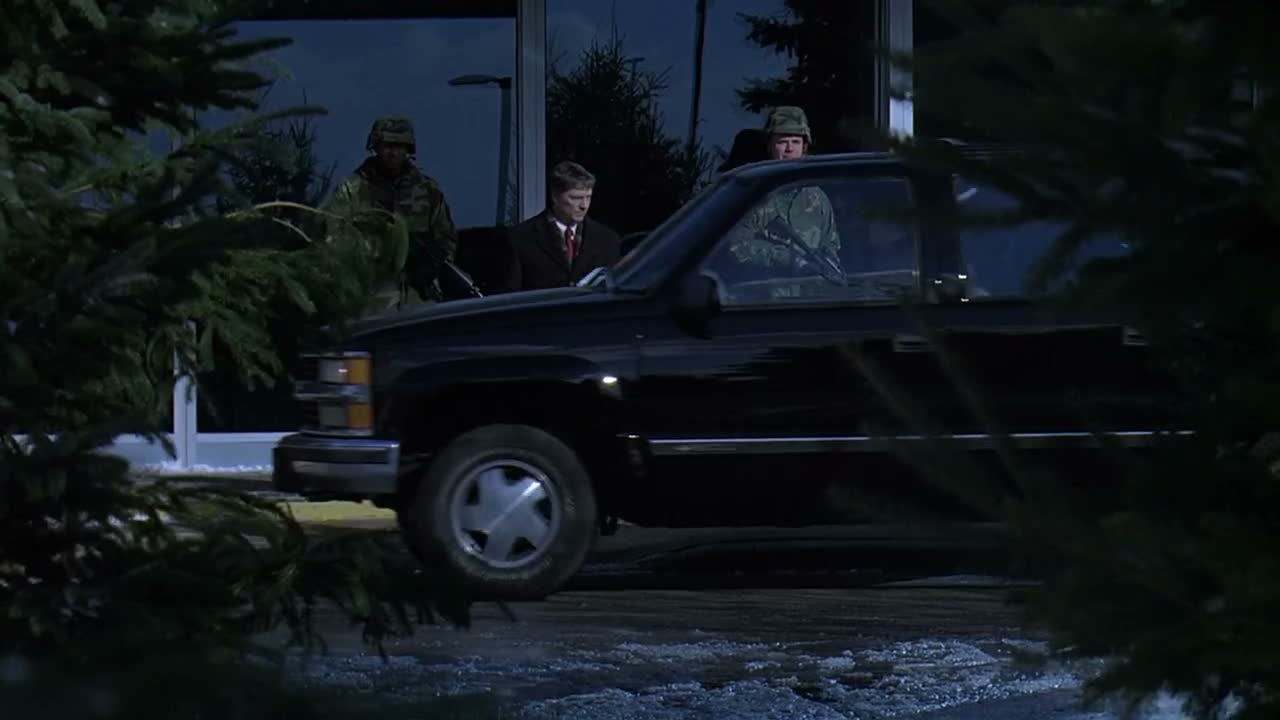
Hanssen and Eric arrive at the DIA for a courtesy meeting. It barely starts: their host takes a phone call, apologizes, and says his superior needs him, so he has to cut the meeting short and offers to reschedule. Hanssen asks a few pointed questions, then leaves, telling Eric to get the car.
On the surface this is routine scheduling. Underneath, Hanssen reads every small move as a signal. When the host says "We're gonna have to cut this meeting short," Hanssen doesn't protest; he immediately asks whether the superior knows he is there and knows who he is. That isn't small talk—it's a man calculating his exposure. The remark that "This visit was a courtesy" turns the brush-off around, letting him leave as the one who was doing them a favor. For a spy under surveillance, a cancelled meeting is never just a cancelled meeting.
A1–C2 is the CEFR scale. Cards above the level you pick fade, and playback will not auto-pause on them.
“Have you been in my briefcase?”
A quiet question that puts him on the spot without raising his voice.
Neutral
“This guy could park at the bottom of the Potomac and come out firing.”
One exaggerated image says more about his toughness than any adjective.
Informal
“We're gonna have to cut this meeting short.”
It delivers bad news plainly, leaving no room for negotiation.
Informal
“He wants me to reschedule at your convenience.”
A diplomatic line that reframes a cancellation as a rescheduling.
Formal
“This visit was a courtesy. Let's go.”
The politest word becomes the coldest exit line in the room.
Formal
“Maybe there's somebody else who can show us around.”
A soft offer that tries to keep the visit alive after a snub.
Neutral
 Up next · 16power playThe scene: Hanssen Dumps His Tail
Their host gets a phone call and tells Hanssen his superior has called him into an emergency meeting, so he has to end it early and offers to reschedule at Hanssen's convenience. Hanssen accepts no reschedule and leaves.
It's a status check. If the superior knows Hanssen is there and who he is, then the cancellation is a message aimed at him rather than a random scheduling problem, and Hanssen wants that on record before he goes.
He's flipping the rejection into a dismissal of his own. The meeting was a favor he was granting, not something he needed, so being sent away costs him nothing and he can leave first.
It's a half-hearted rescue of the visit: rather than accept the brush-off, someone suggests they could still be shown around by another person. It doesn't work—the order to get the car ends the scene.
The film keeps it ambiguous. He asks whether anyone has been in his briefcase, and the answer is that it was only moved to keep it dry; the episode shows how closely he watches his belongings and the people around him.