00:00 / 02:20
00:00 / 02:20

Hanssen's Letter to the KGB, Explained

Breach · 2007

Chapter 12 of 20 · 2'20"

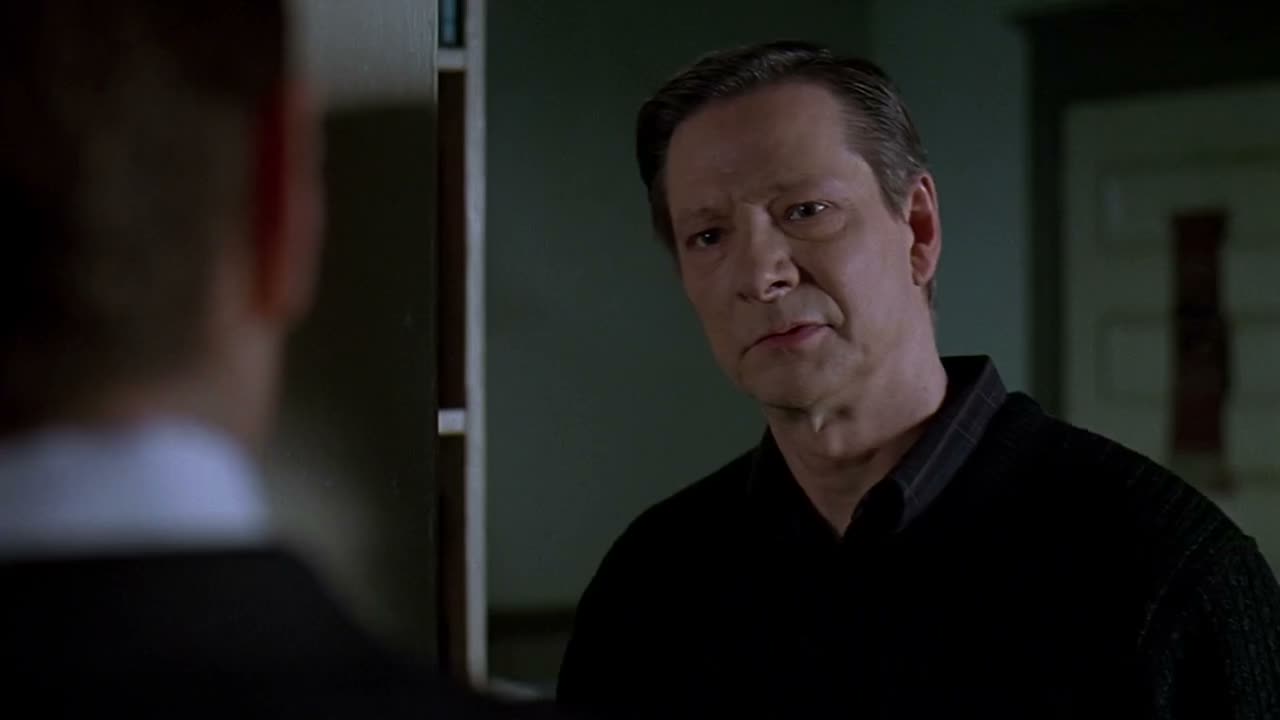
The surface is a spy's business letter — money, security, a warning about turned agents. Underneath, Ramon is rationing trust: "I am much safer if you know little about me." Then the same man corners Eric at home, all fatherly concern and quiet suspicion, asking where he really was last night.

MonologuesInterrogationsExplainingWarningBoss & employeeB2slowamericanClean

Key moments

Start here, then watch the full scene
  1. ❝ Monologue · 20 lines The Spy's Letter to Moscow

    0:02–1:26
    84s
  2. Hanssen Questions Eric's Alibi

    1:36–2:18
    42s
  1. ❝ MonologueLetter to his handler20 linesPractice page ↗

Hanssen's Letter to the KGB, explained

What happens

The scene opens on a letter read aloud: Hanssen, writing as "Ramon," thanks his Russian handlers for $50,000, explains why he never wants to be seen, betrays three Soviet agents working for the U.S., and signs off. It then cuts to Hanssen waiting for Eric, who has slipped away, and questioning him about where he was.

What's really going on

Ramon's letter is a spy covering his tracks, but it is also a man explaining himself. "Neither of us are children about these things," he writes, as if betrayal were simply professionalism, and he insists he is "insanely loyal" to something larger than a country. The confrontation that follows is the same instinct in person: Hanssen doesn't accuse Eric of lying, he performs concern — offering flowers, asking for his mother's address. That's the threat. He is showing Eric that he notices everything, including the pager he couldn't reach, and that a man who says he is 'much safer if you know little about me' knows exactly how to pry.

Key lines & what they mean

“As far as the funds are concerned, I have little need or utility for more than $100,000 at any one time.”
Ramon tells his handlers he doesn't want to be paid more than $100,000 at a time — a spy pretending money isn't the point.
“I am much safer if you know little about me.”
He refuses to share anything identifying, insisting that secrecy is what keeps him alive.
“Neither of us are children about these things.”
A cool way of saying 'we both know this is dirty business', used to shut down any moral hesitation.
“I like to know before I commit myself, as I'm sure you do also.”
He won't show up to an operation blind — a condition framed as mutual, professional caution.
“One might propose that I am either insanely brave, or quite insane.”
He voices what others might think of a man in his position, setting up his own self-defense.
“I'd answer neither. I'd say insanely loyal.”
His punchline: he rejects both labels and chooses 'loyal' — claiming his treason is really devotion.

Theme

  • Betrayal — Ramon sells out Soviet agents while calling himself 'insanely loyal', framing treason as a higher duty.
  • Secrets — The letter and the confrontation both hinge on what each side is allowed to know about the other.

What this chapter teaches

Teaching points

Review right after watching
My level2/7

A1–C2 is the CEFR scale. Cards above the level you pick fade, and playback will not auto-pause on them.

Breach: your progress

Chapter 12 of 20 · about 20 min to go

← Previous
Up next · 13boundariesThe scene: Juliana Confronts Eric About Hanssen

Takeaways

What you walk away with
  1. The letter is cold, precise, and almost tender.
  2. Liken A to B is a formal way to compare.
  3. The pager question is really an interrogation.
  4. Insanely loyal is how he repackages betrayal.

People also search

Questions, then the lines
Who is 'Ramon'?

Ramon is the codename Hanssen uses when writing to his Russian handlers. The letter is read in voice-over, but it is Hanssen's own words, signed with the alias.

Why does Hanssen say he is 'insanely loyal'?

In the letter he asks whether he seems insanely brave or simply insane, then rejects both and calls himself 'insanely loyal.' It is his way of framing his spying as devotion rather than greed or madness.

Why does Hanssen show up at Eric's place?

Eric slipped away without telling anyone where he was going, and Hanssen notices. Showing up unannounced — and offering flowers for Eric's mother — lets him remind Eric that he is always watching.

Why does Hanssen want the address of Eric's parents?

He says he wants to send flowers for Eric's mother, but asking for the address also tests Eric's story and gives Hanssen a detail he can check later. It is concern used as leverage.

What does the letter reveal about Hanssen's mindset?

He treats betrayal as a matter of professionalism — 'Neither of us are children about these things' — and insists he is loyal, not corrupt. He also coldly names three Soviet agents working for the U.S., exactly the kind of information that gets people killed.