
“You're one of us now, and this is it.”
Why it's great
It hands over belonging and closes the door in one breath; there is no arguing with it.
Register
Informal
Use it yourself
You're one of us now, and there's no going back.
Chapter 13 of 14 · 4'32"
It looks like a night of chaos, with looting, soldiers, and a child swept along, but the real battle is over who controls the street. "This city belongs to the Protestants!" one voice cries, while a mother hauls her son home and threatens anyone who drags him in again. Change arrives, and not everyone comes through it unscarred.
Buddy Comes Home With Stolen Washing Powder
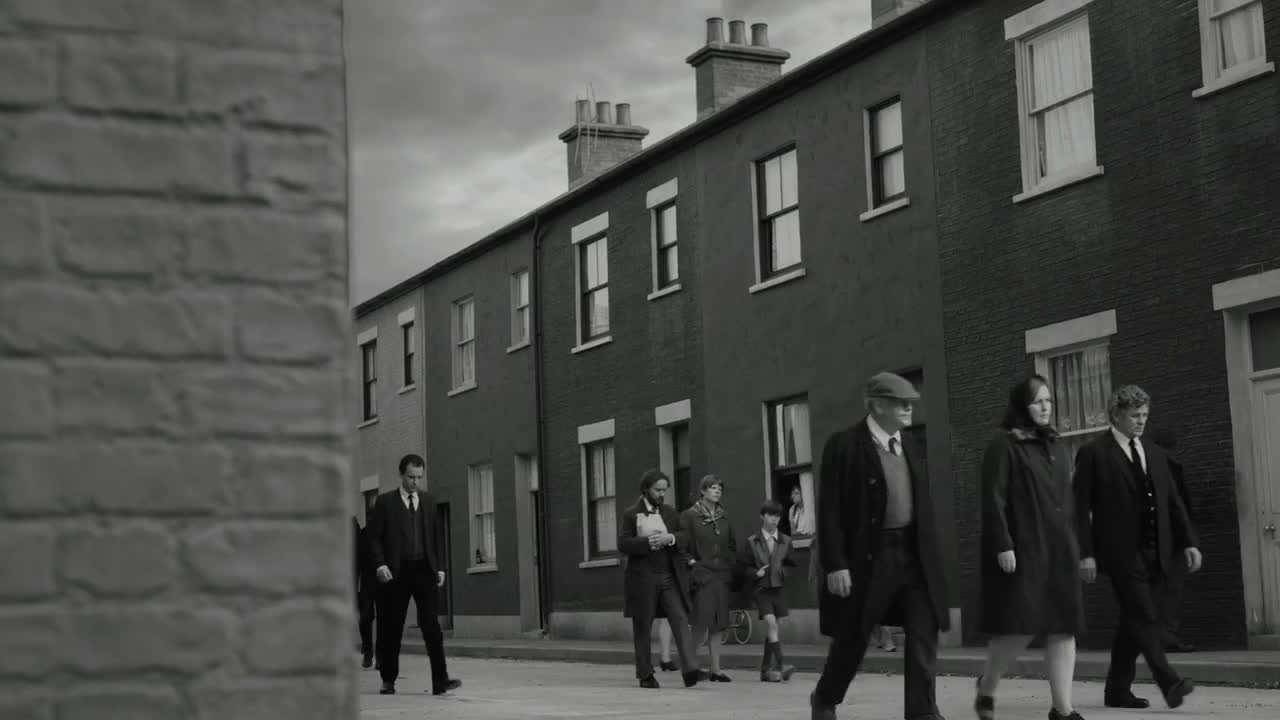
It is August 1969 in Belfast. After a day of betting slips, comics, and chips, the city erupts: gangs loot the supermarket, armored cars roll in, and soldiers order everyone off the streets. Buddy is caught up in the crowd before his mother drags him home and unleashes a furious warning on the men who would use him.
The violence is not random; it is a power grab, and the film keeps it at a child's eye level. Buddy is handed a place in the gang simply for staying quiet: "You're one of us now, and this is it." His mother answers with a threat of her own, because she knows exactly what that membership costs. When a man tells her "That's not the statement we're trying to make," the language of politics collides with a woman protecting her son. Later, the man taking over the street says it plainly: "Folks always have a problem with change," and "People like me run this town now." The scene is about a city being redivided, and a family deciding which side of that line it can live on.
A1–C2 is the CEFR scale. Cards above the level you pick fade, and playback will not auto-pause on them.
“You're one of us now, and this is it.”
It hands over belonging and closes the door in one breath; there is no arguing with it.
Informal
“Folks always have a problem with change.”
A plain piece of folk wisdom that names the crowd's weakness right before he presses his advantage.
Neutral
“That's not the statement we're trying to make.”
Grand phrasing from people holding stolen goods; the mismatch between words and scene is the point.
Neutral
“People like me run this town now.”
A short declaration that the balance of power has already changed on the street.
Informal
 Up next · 14one last timeThe scene: The Family Remembers Grandpa
Because he kept quiet when it mattered. He is told he did well for not grassing them to the police, and that earns him a place: "You're one of us now, and this is it."
He is one of the armed men holding the street. He says the two of them will guarantee safe passage for him and his men, and warns that running will cost the boy his life.
It is British slang for informing on someone to the police. Buddy is accepted because he did not give the gang up, which is exactly the loyalty they reward.
Because he came home with stolen goods, and she can see the gang using him. Her threat is not really about the washing powder; it is about keeping him out of something far worse.
Everyone else is grabbing valuables, and the boy proudly turns up with laundry soap, then insists it is "biological." The gap between the drama of a riot and the dullness of detergent is the joke.