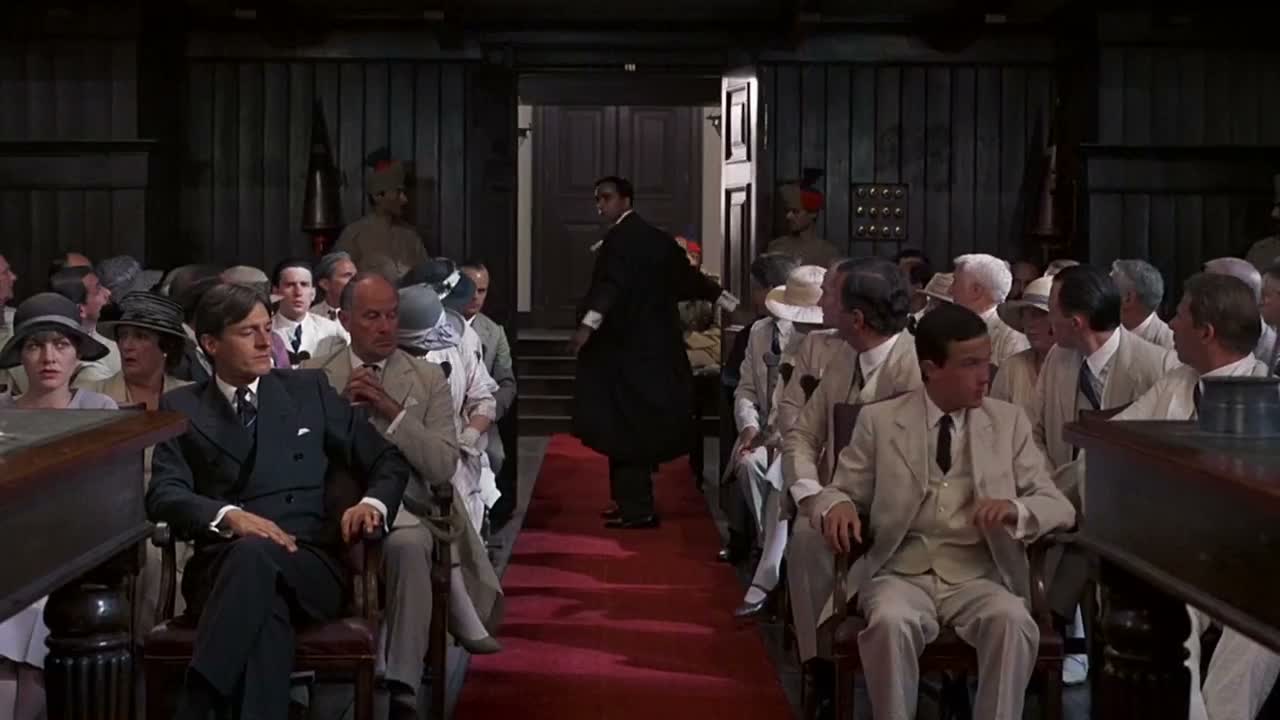
“I shall begin by reminding you of my contention that prisoner proposed the expedition with a premeditated intention of making advances to Miss Quested.”
A long opening sentence locks the charge in place with formal certainty.
Formal
Chapter 13 of 19 · 4'02"
McBryde opens the prosecution by arguing that Aziz planned the Marabar trip to get Adela alone. The room erupts when he names Mrs Moore, who has already left India. Mahmoud Ali's outburst — "This is English justice? This is your British Raj?" — turns the trial's tactics into a charge against the Empire itself.
❝ Monologue · 5 lines McBryde's opening
He builds from intention to expense, turning an outing into a planned crime.
The Trial Erupts Into a Protest
In the Chandrapore courtroom, the judge Das warns that disorder will not be tolerated. McBryde argues that Aziz proposed the caves trip with a premeditated intention of making advances to Adela, and that he made it his business to inspect the Marabar himself. When he blames Aziz for abandoning Mrs Moore, the room cries out for her, and the defence denounces the trial as a farce.
The prosecution's case is built less on what happened in the cave than on what the English already believe about Indians. McBryde supplies motive and atmosphere — an 'inaccessible, barren place,' servants paid off, a lady left behind — and the details are made to point one way. The room's cry, 'We want Mrs Moore!', exposes the weakest joint: the one witness who could settle the charge has been sent out of India. When defence counsel shouts, 'This is English justice? This is your British Raj?', the trial stops being about Aziz and becomes about who gets to be believed. The judge can only answer with procedure: 'I shall have to exercise my authority.' The charge against Aziz is on trial, but so is the machinery that made it inevitable.
A1–C2 is the CEFR scale. Cards above the level you pick fade, and playback will not auto-pause on them.
“I shall begin by reminding you of my contention that prisoner proposed the expedition with a premeditated intention of making advances to Miss Quested.”
A long opening sentence locks the charge in place with formal certainty.
Formal
“But she was kept from us!”
Five short words turn being kept away into an accusation.
Neutral
“This is English justice? This is your British Raj?”
Two questions in a row turn the whole system into an indictment.
Formal
“- This is no way to defend your case. - I'm not defending a case.”
He refuses the frame itself, not just the criticism.
Neutral
“And you are not trying one. We are both slaves!”
Calling them both slaves exposes the whole court as theatre.
Formal
I shall begin by reminding you of my contention that prisoner proposed the expedition with a premeditated intention of making advances to Miss Quested. I've made it my business to visit the Marabar during the last few days. It's an inaccessible, barren place, entailing, as you have heard, considerable planning and expense to get there. The caves themselves are dark, featureless, and without interest, except for a strange echo. A curious place for such an elaborate picnic.
Up next · 14carried him awayThe scene: Das Rules Mrs Moore Does Not ExistMcBryde describes Aziz abandoning an elderly lady, and the room realises he means Mrs Moore, who has already left India and cannot testify.
He is one of Aziz's defence lawyers. He objects to McBryde and finally shouts that the trial is a farce, nearly forcing the judge to act.
She has been sent out of the country. The judge rules that neither side called her, so neither may quote her testimony.
It is the period name for British rule in India. The defence uses it to say the trial is not justice but the Empire deciding against an Indian.
He claims Aziz chose the caves deliberately, paid off the servants, and used the trip to get Adela alone, so the assault was planned in advance.