00:00 / 05:01
00:00 / 05:01

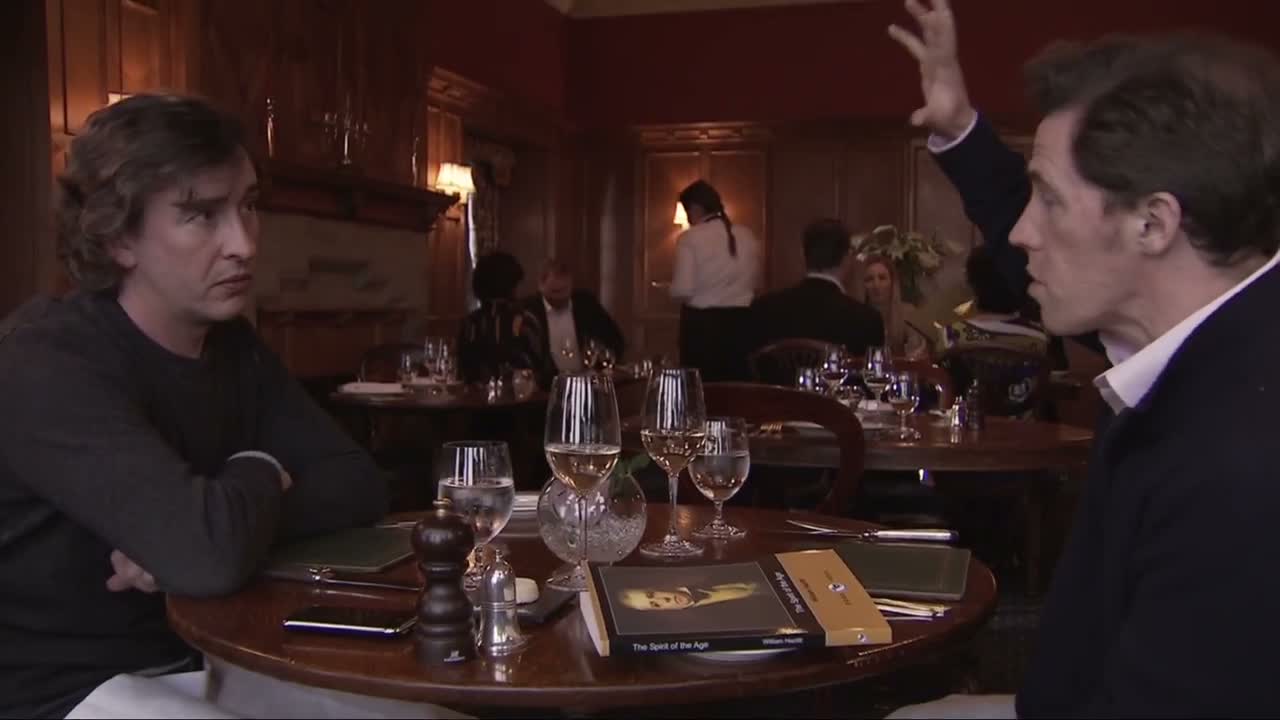
Steve and Rob at Greta Hall, Explained

The Trip · 2011

Capítulo 8 de 20 · 5'01"

On the surface they bicker about a loud impression, a self-catered night, and a view. Underneath, a passage on Coleridge turns into a verdict on the man listening. "In case you wanted to draw a parallel there" is the flinch: one friend hears the unpaid household and rushes to separate himself from it.

Travel & hotelsTeasingTeasingExplainingFriendsB2british

Key moments

Start here, then watch the full scene
  1. Method in the Early Shouting

    0:02–0:27
    26s

Steve and Rob at Greta Hall, explained

What happens

At Greta Hall, two friends self-cater in a house Coleridge soon left. Robert Southey remained with the wives and children. They joke about inhabiting a role, a night that never happened in the poet's bed, and a view too good to paint. Over scallops and pigeon, one reads a verdict: the work was done twenty years ago, and the man lives on the sound of his own voice.

What's really going on

The house tour keeps tilting toward the two men eating in it. A plan to make love in Coleridge's bed has already shrunk to chummy, and the story of a poet who fled domestic life sits beside a quick claim about maintenance payments. "In case you wanted to draw a parallel there" pretends to shut the comparison and leaves it open. Hazlitt's sentences finish the job. The important work was done twenty years ago. The man lives on the sound of his own voice, "wedded to no one in particular," and he pursues knowledge as a mistress. The listener does not correct the record. "Okay, it's about me" accepts the coat. Bob Balaban's "Never be hot. Always be warm" offers a way to live after the blaze, at a table where early brilliance is the thing neither friend wants measured too closely.

Key lines & what they mean

“Hello, hello, there's method in my madness.”
Spoken after the method-actor jokes, this insists the loud voices are deliberate craft. It also brushes off the complaint: what sounds like nonsense is supposed to have a plan.
“In case you wanted to draw a parallel there.”
Coleridge has just been described as a man who sent no money home. The line warns a friend not to line that absence up with the speaker's own maintenance payments.
“"And wedded to no one in particular."”
Read aloud at the table, it says Coleridge belonged to no single art and to nobody in particular. The listener takes the portrait as his own a moment later.
“Bob Balaban said, " Never be hot. Always be warm."”
Offered between a warning about early glory and the phrase supernova moments: do not chase the hottest peak, stay warm. Here it is a way to live with work that peaked years ago.

Theme

  • Ambition — Hazlitt's faded genius and Balaban's "Never be hot. Always be warm" turn a poet's decline into a rule for surviving early success.
  • Friendship — One friend reads a hard portrait of Coleridge and the other tries the description on before it can be pinned to him.

Qué aprendes en este capítulo

Puntos de enseñanza

Repasa justo después de ver
Mi nivel0/5

A1–C2 es la escala MCER. Las tarjetas por encima del nivel elegido se atenúan y la reproducción no se pausa en ellas.

The Trip: tu progreso

Capítulo 8 de 20 · quedan unos 62 min

← Anterior
Siguiente · 09contend withLa escena: Steve and Rob Rank Their Careers

Ideas clave

Lo que te llevas
  1. Inhabit the role as living the part
  2. Premier Cru as a wine rank
  3. Method in madness as ordered chaos

Preguntas frecuentes

La pregunta, luego la frase
Why does he mention maintenance right after Coleridge?

The talk has just established that Coleridge probably sent no money home while Southey kept the household. "I'm very consistent with my maintenance, Rob" jumps in before anyone can match that absence to the speaker. The next line admits the parallel was the whole point.

Is Hazlitt's portrait really about the man at the table?

Hazlitt was writing about Coleridge, and the friend only reads it aloud. The listener is the one who closes the gap: "Okay, it's about me. I didn't realize, but carry on." Nothing in the passage names him. He recognizes a man who peaked early and now lives on his own voice.

Why quote Bob Balaban's "Never be hot. Always be warm"?

It arrives while they are saying a big success is hard to hold. The supernova image comes a moment later, and Balaban's advice sits between them: do not chase the peak, stay warm. It answers Hazlitt's portrait of a man who could not keep his early pace, not the wine.

What happened to the night in Coleridge's bed?

One of them had meant to bring Mischa and make love in the bed Coleridge slept in, hoping for a poetic frisson. Mischa is not there. What remains is "Still be romantic, just the two of us," which drops at once into "chummy" and "bumless chums."

Are they fighting about the impressions?

The noise opens the scene: too early, too loud, unpleasant. He claims he inhabits the role, gets parked "right up there with Pacino," and only then offers "there's method in my madness." It is needling, not a split.