
“Do you have to antagonize everybody?”
Por qué es buena
The question format makes the rebuke hard to argue with and easy to reuse.
Registro
Informal
Úsala tú
Do you have to antagonize everybody at the table?
Capítulo 27 de 30 · 3'11"
Humbert visits Lolita in the hospital, where she is recovering and noticeably cold to him. He is jealous and suspicious of everyone around her, and the visit becomes a small war of remarks about flowers, sunglasses and the nurse.
Humbert Suspects the Nurse
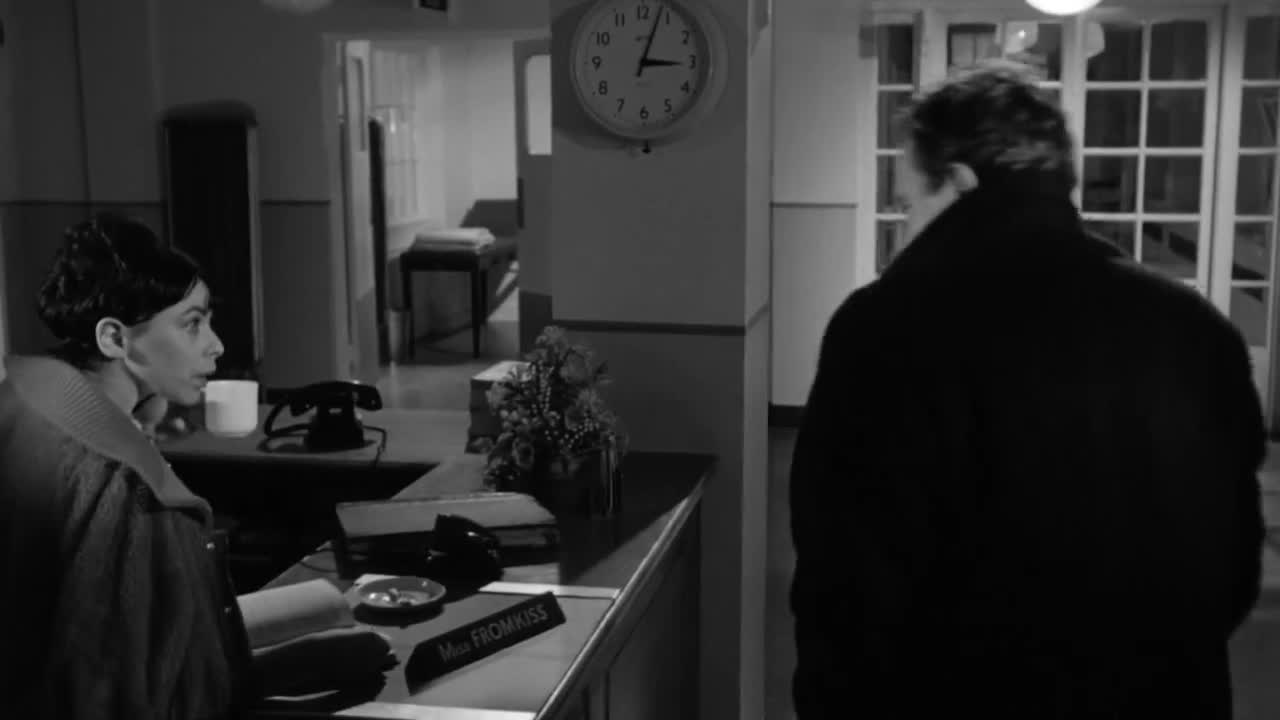
Humbert brings flowers to Lolita's hospital room. The nurse, Mary, reports that her temperature is normal and her cough is gone, but Lolita greets him coldly and calls the flowers gruesome. Humbert turns suspicious, studying the nurse and the room, until a staff member tells him to move his car.
The visit is meant to look like care and is actually surveillance. Humbert brings flowers, asks about her health, and then inspects everything: the notes, the books, the sunglasses worn indoors. The politeness on both sides is thin. Lolita answers him with insults and, when he presses the nurse, tells him to stop, asking, "Do you have to antagonize everybody?" Humbert's reply turns the question back on her and drags in the nurse: "I've no doubt she's been just as helpful with you all the time." Neither of them is really talking about flowers or nurses. He is checking whether she is still within reach, and she is telling him, in every line she can get away with, that she is not. The car at the wrong parking space gives the hospital, and the audience, an excuse to end the scene.
A1–C2 es la escala MCER. Las tarjetas por encima del nivel elegido se atenúan y la reproducción no se pausa en ellas.
“Do you have to antagonize everybody?”
The question format makes the rebuke hard to argue with and easy to reuse.
Informal
“I've no doubt she's been just as helpful with you all the time.”
It agrees in words while accusing in tone, the politest way to wound.
Formal
“And since when have nurses worn dark glasses when on duty?”
Since when turns a doubt into a courtroom challenge, catching the other person in the act.
Formal
“Are you going to read the magazine or talk to me?”
The either-or question makes ignoring someone sound like a choice they have to own, which is sharper than a plain complaint.
Informal
“Come on now, let's not start that all up again.”
The let's not pulls both people into the truce, so it stops an argument without openly blaming anyone.
Informal
 Siguiente · 28by any chanceLa escena: Lolita Leaves in Care of Her Uncle
She has had time away from him and does not want to be managed. She insults the flowers, snaps at his questions, and tells him to stop fighting with everyone.
He is jealous of anyone close to Lolita. He notices the nurse's sunglasses, the books in the room, and the notes, and reads all of them as proof of a relationship he cannot control.
It means to catch an illness. Humbert says he is coming down with a cold, which explains his dulled mood during the visit and gives him a reason to stay home that night.
Humbert has parked in a staff-only space, and a member of the hospital staff asks him to move it. It is a small humiliation that ends his visit.
Humbert talks about starting early on Tuesday and reaching the Mexican border in three days, escaping what he calls the mysterious agents following them.