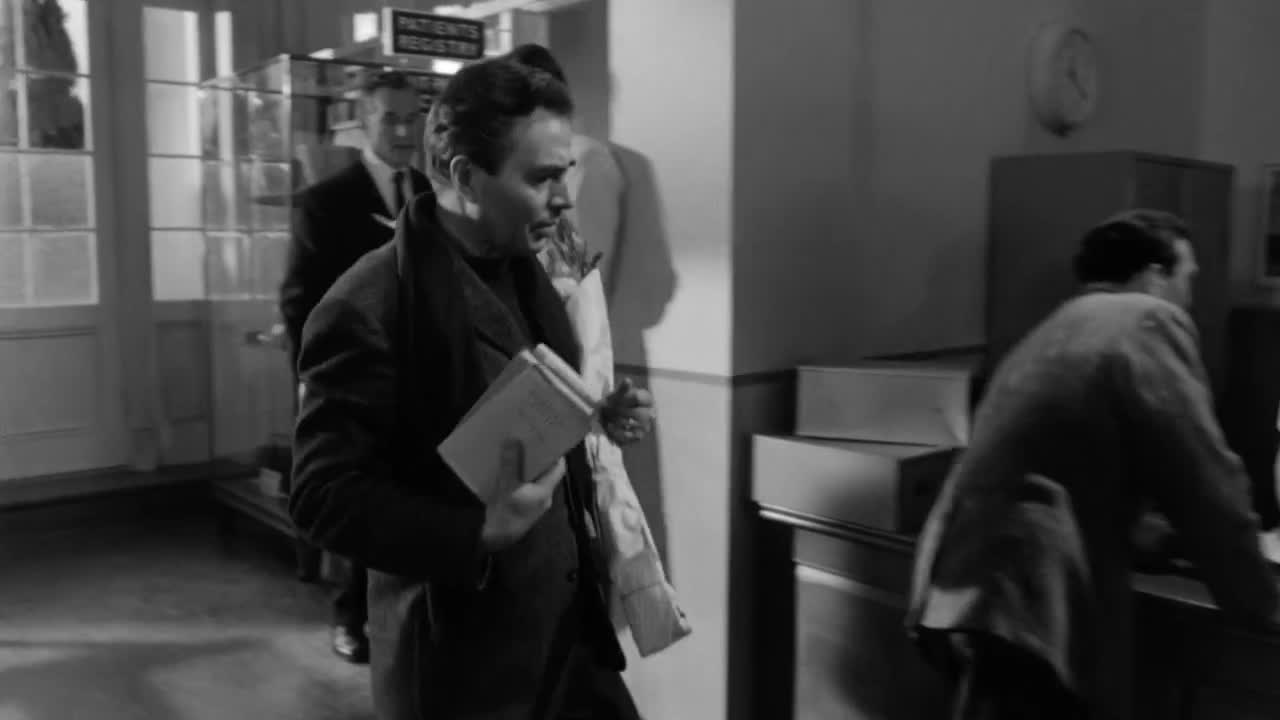
“Do you have to drive so fast? You're gonna get us killed.”
The question format smuggles in an accusation that lands harder than an order.
Informal
Capítulo 26 de 30 · 4'33"
A late-night drive turns paranoid: Humbert swears a car has tailed them for three days and may be the police. Lolita thinks he is imagining it—"Do you have to drive so fast? You're gonna get us killed." Then a tire blows, and the follower pulls up behind them before quietly driving away.
A Car Is Following Them
Humbert drives fast down a night road while Lolita complains. He admits a car has been following them for three days and was parked outside their motel the night before. He suspects the man who asked about a map at a service station. They argue about whether it is real, then a tire blows and the follower stops behind them.
On the run with Lolita, Humbert sees a threat in every mirror, and the film lets us wonder whether the follower is real or his fear. He tells her it has been there for three days, and his advice gives him away: "If he is, the worst thing we can do is let him know we're scared." He is not protecting her but managing appearances, the same way he manages everyone. Lolita's response—"I think you're imagining things"—keeps her skeptical and superior, and the pair bicker even as a tire blows. When the follower stops and then leaves without approaching, the tension collapses into illness: Humbert's arm aches, he thinks it might be a heart attack, and only Lolita's joke about a "Reader's Digest" symptom breaks it. The chase is as much inside him as on the road.
A1–C2 es la escala MCER. Las tarjetas por encima del nivel elegido se atenúan y la reproducción no se pausa en ellas.
“Do you have to drive so fast? You're gonna get us killed.”
The question format smuggles in an accusation that lands harder than an order.
Informal
“If he is, the worst thing we can do is let him know we're scared.”
It frames fear itself as the real danger, turning a rule into a stance.
Neutral
“I don't want him to think that we've seen him.”
It turns hiding your awareness into a clear intention, a line anyone can reuse under pressure.
Neutral
“Leave me alone, can't you?!”
The tag can't you turns a plain order into a plea and an accusation at once, which is why it sounds so human.
Informal
“I'm tired of hearing about your moans and groans.”
The paired moans and groans turns vague complaining into a sound you can hear, so the irritation feels physical.
Informal
Siguiente · 27since whenLa escena: Humbert Visits Lolita in HospitalHumbert believes it is a man—perhaps a cop—who asked about a map at the service station. The film keeps it ambiguous, and the car leaves without making contact.
No. She says she has seen no car and tells Humbert he is imagining things, which makes him angrier.
If the man is police, showing fear would confirm something is wrong. Humbert's instinct is always to manage how things look.
They fear an approach, but the driver simply waits, turns around, and drives off. The scene then shifts to Humbert's sudden chest and arm pains.
His arm aches, he cannot breathe well, and he remembers a Reader's Digest article saying heart attacks start that way, though he tells Lolita it is probably just something he ate.