
“Can you imagine how I feel about it, Dimitri?”
Por qué es buena
A plea for sympathy turns a global crisis into the speaker's hurt feelings.
Registro
Neutral
Úsala tú
Can you imagine how I feel about taking the blame?
Capítulo 8 de 20 · 4'12"
The hotline is supposed to prevent exactly this, so the president spends the first minutes being diplomatic — checking that the line is clear, exchanging pleasantries — before admitting why he called: "I'm just calling up to tell you something terrible has happened." The horror is delivered in the language of a polite apology.
❝ Monólogo · 5 frases The President's plea
He keeps defending himself before he is accused, and the panic makes the scene funny.
Two Leaders Argue Over Who Is Sorrier
On the hotline, President Muffley reaches Premier Dimitri to tell him that a rogue American commander has ordered planes to attack the Soviet Union. He first checks that the line is clear, then explains that the commander went a little funny in the head. He offers the Soviets the planes' targets and flight plans, and says that if the planes cannot be recalled, America will help shoot them down.
The scene's comedy comes from tone, not plot. The president has to announce the possible end of the world, and he does it the way a nervous man handles an awkward phone call: confirming the connection, trading small talk, asking after the other man's health, apologising for the hour. The catastrophe is buried in courtesy — "I'm just calling up to tell you something terrible has happened," as if the line were a formality. Then the two leaders start competing over who feels worse, each insisting he is more sorry, which turns nuclear annihilation into a matter of wounded politeness. Under the jokes sits the film's real point: the machinery meant to prevent this is staffed by fallible, slightly absurd men, and the hotline is only as sane as the people speaking into it.
A1–C2 es la escala MCER. Las tarjetas por encima del nivel elegido se atenúan y la reproducción no se pausa en ellas.
“Can you imagine how I feel about it, Dimitri?”
A plea for sympathy turns a global crisis into the speaker's hurt feelings.
Neutral
“I'm just calling up to tell you something terrible has happened.”
The mild 'just' makes the bad news land even harder.
Neutral
“Listen, if it wasn't friendly, you probably wouldn't have even got it.”
A neat conditional argues that a hostile call would never have been put through.
Informal
“They will not reach their targets for at least another hour.”
A calm timetable becomes the only thing standing between the world and disaster.
Formal
“I'd say that-- well, We're just gonna have to help you destroy them, Dimitri.”
An unspeakable offer is delivered as a reluctant little favour.
Informal
“Don't say that you're more sorry than I am, Because I'm capable of being just as sorry as you are.”
Two leaders compete over who is sorrier, turning catastrophe into a comedy of manners.
Neutral
To attack your country-- Well, let me finish, Dimitri. Let me finish, Dimitri. Well, listen, how do you think I feel about it? Can you imagine how I feel about it, Dimitri? Why do you think I'm calling you?
Dr. Strangelove or: How I Learned to Stop Worrying and Love the Bomb: tu progreso
Capítulo 8 de 20 · quedan unos 33 min
← Anterior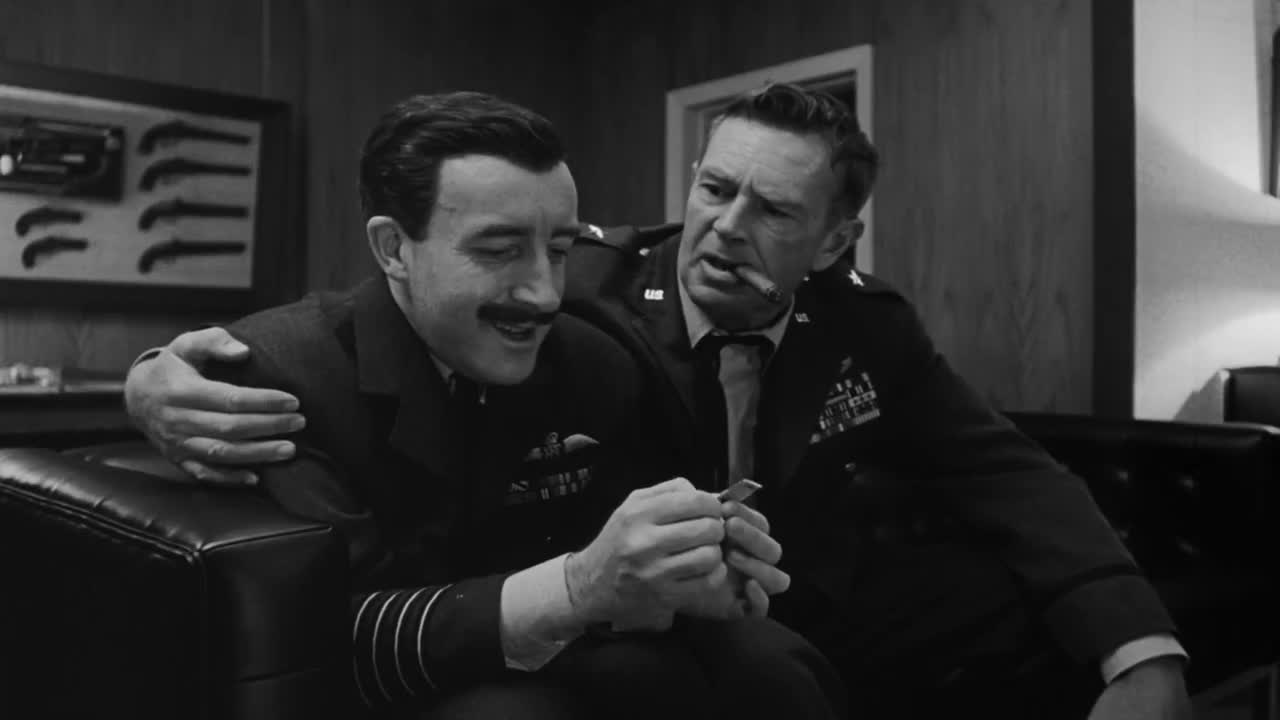 Siguiente · 09precious bodily fluidsLa escena: Ripper Explains the Fluoridation Plot
To warn the Soviets directly. A rogue American commander has launched planes at the USSR, and the president wants to explain the mistake and coordinate a response before it is too late.
He offers a full rundown of the planes' targets, flight plans and defensive systems, and says the US will help destroy the planes if they cannot be recalled.
It means a voice or signal is received clearly. The president keeps asking whether he is coming through fine, treating the connection itself as the first problem to solve.
It is a joke about politeness. Each insists he is more sorry than the other, until nuclear catastrophe becomes a matter of manners and wounded pride.
He is trying to keep Dimitri calm and listening. A surprise attack could look like a trick, so he stresses that a hostile call would not even have been put through: "if it wasn't friendly, you probably wouldn't have even got it."