
“No. I've just walked up from the road. I'm dying for a drink.”
Por qué es buena
Be dying for makes a small need sound delightfully dramatic.
Registro
Informal
Úsala tú
After the hike, I was dying for water.
Capítulo 8 de 19 · 2'59"
The picnic falls apart when Adela is found to have left with Mrs. Callendar, and Aziz cannot explain what became of her. "Our great day is in tatters," he says, while Fielding presses him to retrace exactly when he and Adela parted.
Fielding Arrives at the Caves
❝ Monólogo · 6 frases Aziz's broken account
The scrambled order and repeats show his panic better than any line could.
The Picnic Falls Apart
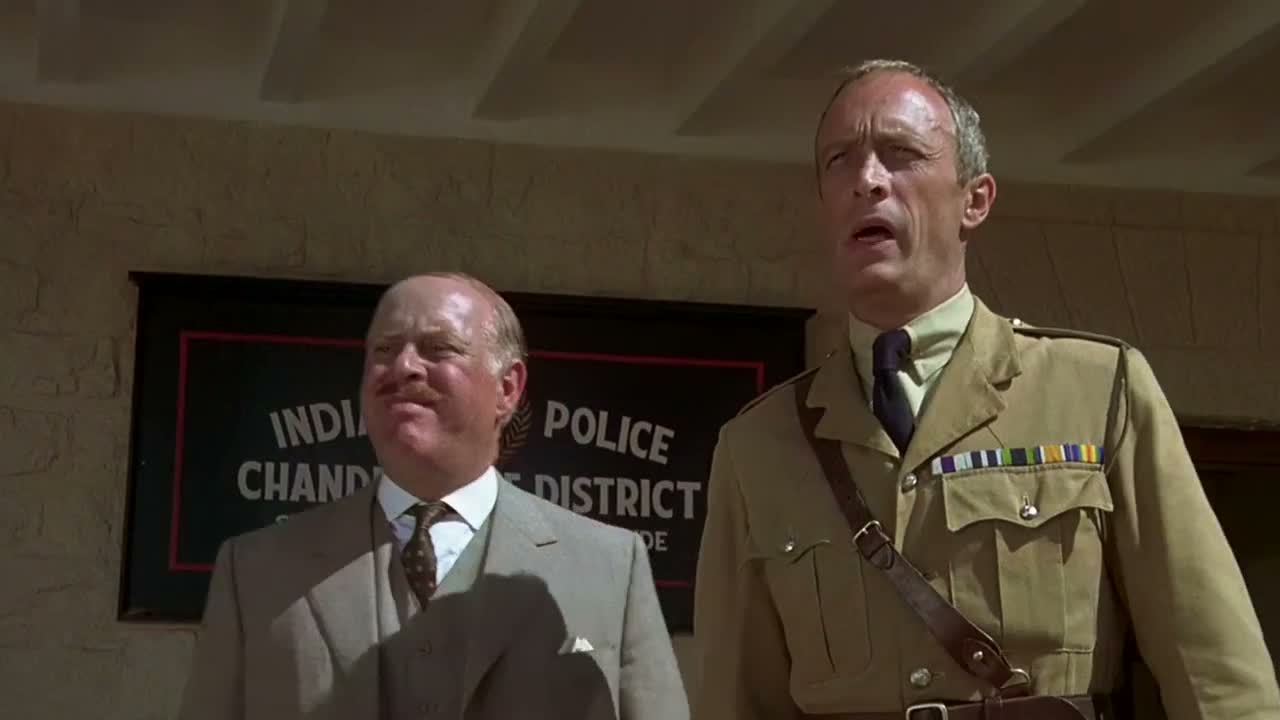
At the Marabar Caves, the excursion collapses. Adela Quested has driven off with Mrs. Callendar, and Aziz, who wandered into the caves, comes back unable to say clearly where she went. Fielding and Mrs. Moore question him as he recounts searching the caves and hearing the car leave. 'Our great day is in tatters,' he says.
This is the hinge of the film. One moment the outing is a triumph of Indian hospitality; the next, an Englishwoman has disappeared into a cave and reappeared in another woman's car, and the Indian host is left stammering explanations. Aziz's account is all confusion — 'I don't understand,' he keeps saying — and there is a red flag in the question Fielding repeats: 'when did you part with her?' The English instinct is already to reconstruct the day as a story with a culprit. Aziz senses it in his own line, 'Our great day is in tatters.' Mrs. Moore offers the only resistance, insisting 'Aziz is an innocent,' but her reassurance is exactly the kind of certainty the colonial machinery will refuse to hear. The scene ends not with an answer but with a suspicion forming.
A1–C2 es la escala MCER. Las tarjetas por encima del nivel elegido se atenúan y la reproducción no se pausa en ellas.
“No. I've just walked up from the road. I'm dying for a drink.”
Be dying for makes a small need sound delightfully dramatic.
Informal
“Our great day is in tatters.”
In tatters turns a ruined plan into a vivid, physical image.
literary
“I will never forgive myself.”
A flat vow of self-blame that carries real guilt.
Neutral
“Aziz is an innocent. Something else must have happened.”
She asserts his innocence and reasons that something else must explain it.
Neutral
“This is a dangerous place for new arrivals.”
New arrivals names the vulnerable group in one calm phrase.
Neutral
Then the guide couldn't recall which cave she'd gone into. So I looked in all the caves, and when I came out of... I think it was the third cave, I... I saw these. And then - I think it was then - I heard the car. So I ran over to the edge and I saw Miss Quested getting in. And... and then she drove away with Mrs Callendar.
 Siguiente · 09go over the topLa escena: Fielding Defends Aziz After the Charge
She meets Mrs. Callendar on the road and takes the car back, without telling Aziz. Her departure is left unexplained here, and it is what turns a routine outing into a crisis.
He is not accusing him yet, but he is already trying to pin down the sequence — 'when did you part with her?' His questions show the English instinct to find a culprit taking hold.
She trusts Aziz from their earlier meeting at the mosque and refuses to read the confusion as guilt. Her line comes before any charge is made, so it is a defense of character, not of evidence.
The film deliberately withholds it. Adela went into a cave, the guide lost track of which one, and she came out and left in a car. What actually occurred inside becomes the mystery the trial turns on.
It means torn to pieces or completely ruined. Aziz is describing the day itself, not his clothes — the picnic he planned has fallen apart in confusion.